Author: Andreas Wagner

  • From Search Analytics to Search Insights – Part 1

    From Search Analytics to Search Insights – Part 1

    From Search Analytics to Search Insights – Part 1

    Over the last 15 years, I have been in touch with tons of Search Analytics vendors and services regarding Information Retrieval. They all have one thing in common: to measure either the value or the problems of search systems. In fact, in recent years, almost every Search Vendor has jumped on board, adding some kind of Search Analytics functionality in the name of offering a more complete solution.

    How to Make Search Analytics Insights Actionable

    However, this doesn’t change the truth of the matter. To this day, almost all customers with whom I’ve worked over the years massively struggle to transform the data exposed by Search Analytics Systems into actionable insights that actively improve the search experiences they offer to their users. No matter how great the marketing slides or how lofty the false promises are, new tech can’t change that fact.

    The reasons for this behavior are anything but obvious for most people. To this end, the following will shed some light on these problems and offer recommendations on how best to fix them.

    Query Classifier

    First of all, regardless of the system you are using, the data that gets collected needs to be contextual, clean, and serve a well-defined purpose. I can’t overstate the significance of the maintenance and assurance of data accuracy and consistency over its entire lifecycle. It follows that if you or your system collect, aggregate, and analyze wrong data, the insights you might extract from it are very likely fundamentally wrong.

    As always, some examples to help frame these thoughts in terms of your daily business context. The first one refers to zero-result searches and the second deals with Event-Attribution.

    Zero-Results

    It’s common knowledge among Search-Professionals that improving your zero-result-queries is the first thing to consider when optimizing search. But what they tend to forget to mention is that understanding the context of zero-result queries is equally essential.

    There are quite a few different reasons for zero-result queries. However, not all of them are equally insightful when maintaining and optimizing your search system. So let’s dig a bit deeper into the following zero-result cases.

    Symptom Reason Insightfulness

    Continuous zero-result

    Search system generally lacks suitable content.

    Language gap between users and content or information

    Search system generally lacks suitable content.

    Language gap between users and content or information

    Temporary zero-result


    The search system temporarily lacks suitable content.
    a) Filtered out content that is currently unavailable.
    b) Possible inconsistency during re-indexation.
    c) Search-Service Time-Outs (depending on the type of tracking integration and technology)

    a) partially helpful – show related content.
    b) not very helpful

    c) not very helpful

    Context is King

    As you can see, the context (time, type, emitter) is quite essential to distinguish between different zero-result buckets. Context allows you to see the data in a way conducive to furthering search system optimization. We can use this information to unfold the zero-result searches and discover which offer real value acting as the baseline for continued improvements.

    Human Rate

    Almost a year ago, we started considering context in our Query Insights Module. One of our first steps was to introduce the so-called “human rate” of zero results. As a result, our customers can now distinguish between zero results from bots and those originating from real users. This level of differentiation lends more focus to their zero results optimization efforts.

    Let’s use a Sankey-diagram, with actual customer data (700.000 unique searches) to illustrate this better:
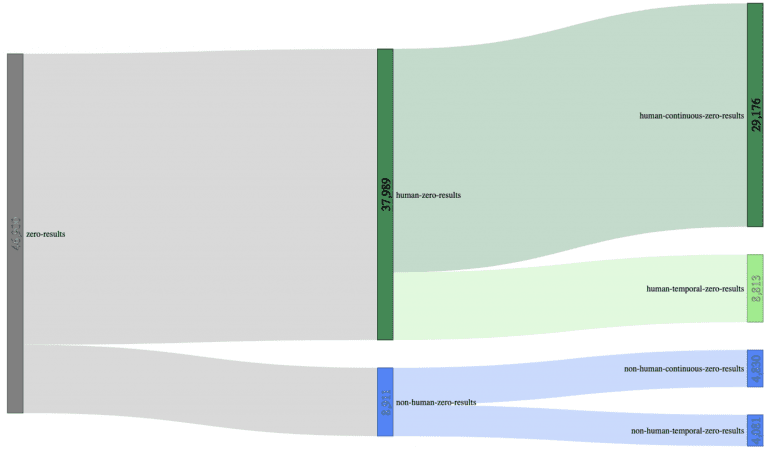
    Using a sample size of 700.000 unique searches, we can decrease the initial 46.900 zero-results (6.7% zero-result-rate) to 29.176 zero-results made by humans (4.17% zero-result-rate); a reduction of almost 40% compared to the original sample size, just by adding context.

    Session Exits

    Another helpful dimension to add is session exits. Once you’ve distinguished between zero-results that lead to Session-Exits, from those ending successfully, what remains is a strong indicator for high-potential zero-result queries in desperate need of some optimization.

    And don’t forget:

    “it’s only honest to come to terms with the fact that not every zero-result is a dead-end for your users, and sometimes it is the best you can do.”

    Event Attribution Model

    Attribution modeling gets into some complex territory. Breaking down its fundamentals is easy enough, but understanding how they relate can make your head spin.

    Let’s begin by first trying to understand what attribution modeling is.

    Attribution modeling seeks to assign value to how a customer engaged with your site.

    Site interactions are captured as events that, over time, describe how a customer got to where they are at present. In light of this explanation, attribution modeling aims to assign value to the touch-points or event-types on your site that influence a customer’s purchase.

    For example: every route they take to engage with your site is a touch-point. Together, these touch-points are called a conversion path. It follows that the goal of understanding your conversion paths is to locate which elements or touch-points of your site strongly encourage purchases. Additionally, you may also gain insights into which components are weak, extraneous, or need re-working.

    You can probably think of dozens of possible routes a customer might take in an e-commerce purchase scenario. Some customers click through content to the product and purchase quickly. Others comparison shop, read reviews, and make dozens of return visits before making a final decision.

    Unfortunately, the same attribution models are often applied to Site Search Analytics as well. It is no wonder then that hundreds of customers have told me their Site-Search-Analytics is covered by Google, Adobe, Webtrekk, or other analytics tools. However, whereas this might be suitable for some high-level web analytics tasks, it turns problematic when researching the intersection of search and items related to site navigation and how these play a role in the overall integrity of your data.

    Increase Understanding of User Journey Event Attribution

    To increase the level of understanding around this topic, I usually do a couple of things to illustrate what I’m talking about.

    Step 1: Make it Visual

    To do this, I make a video of me browsing around their site just like a real user would using different functionalities like Site-Search, selecting Filters, clicking through the Navigation, triggering Redirects, clicking on Recommendations. At the same time, I ensure we can see how the Analytics System records the session and the underlying data that gets emitted.

    Step 2: Make it Collaborative

    Then, we collaboratively compare the recording and the aggregated data in the Analytics System.

    Walk your team through practical scenarios. Let them have their own “Aha” Experience

    What Creates an Event Attribution “Aha” Effect?

    More often than not, this type of practical walk-through produces an immediate “Aha” experience for the customer when he discovers the following:
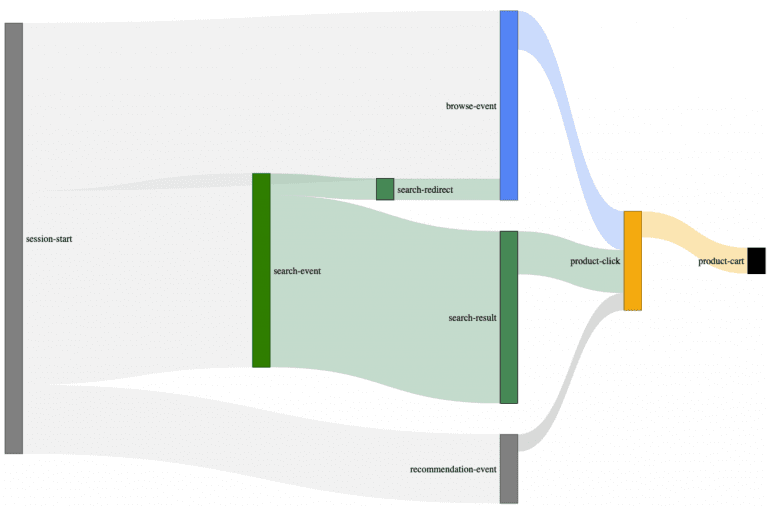
    1. search-related events like clicks, views, carts, orders might be incorrectly attributed to the initial search if multiple paths are used (i.e., redirects or recommendations)
    2. Search redirects are not attributed to a search event at all.
    3. Sometimes buy events and their related revenue are attributed to a search event, even when a correlation between buy and search events is missing.

    How to Fix Event Attribution Errors

    You can overcome these problems and remove most of the errors discussed but you will need to be lucky enough to have some tools.

    Essential Ingredients for Mitigating Event Attribution Data Errors:

    1. Raw data
    2. A powerful Data-Analytics-System
    3. Most importantly: more profound attribution knowledge.

    From here, it’s down to executing a couple of complex query statements on the raw data points.

    The Most User-Friendly Solution

    But fortunately, another more user-friendly solution exists. A more intelligent Frontend Tracking technology will identify and split user-sessions into smaller sub-sessions (trails) that contextualize the captured events.

    That’s the main reason why we developed and open-sourced our search-Collector. It uses the so-called trail concept to contextualize the different stages in a user session, radically simplifying accurate feature-based-attribution efforts.
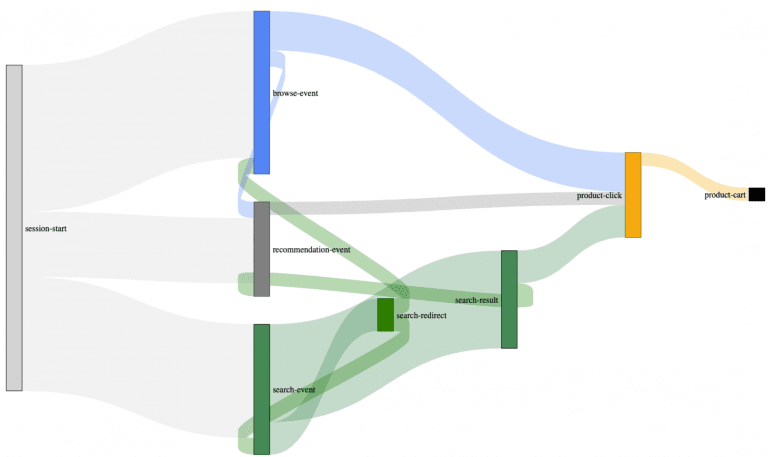
    Example of an actual customer journey map built with our search-collector.

    You may have already spotted these trail connections between the different event types. Most user sessions are what we call multi-modal trails. Multi-modal, in this case, describes the trail/path your users take to interact with your site’s features(search, navigation, recommendations) as a complex interwoven data matrix. As you can see from the Sankey diagram, by introducing trails (backward connections), we can successfully reconstruct the user’s paths.

    Without these trails, it’s almost impossible to understand to which degree your auxiliary e-commerce systems: like your site-search, contribute to these complex scenarios.

    This type of approach safeguards against overly focusing on irrelevant functionalities or missing other areas more in need of optimization.

    Most of our customers already use this type of optimization filtering to establish more accurate, contextualized insight regarding site search.


  • Search Quality in eCommerce Sellability – Three Pillars Series Part 3

    Search Quality in eCommerce Sellability – Three Pillars Series Part 3

    Previously, in this series we discussed why Findability, Discovery, and Inspiration are vital for analyzing and understanding search quality in eCommerce. These search quality dimensions relate mainly to the items or products themselves. We now turn our attention to another dimension, defined as Search Quality in eCommerce Sellability.

    What are the Three Pillars of Search Quality – a Recap

    Let me articulate this as clearly as possible: Relevance and Discovery or Inspiration, in isolation, are insufficient to judge search quality for eCommerce. And this is why.

    Even if still in the consideration phase, shoppers are often not simply looking for a product. And as a seller, you are not just offering products. The offer you make as a seller to a potential buyer is (almost) always a combination of a product and its more or less time-specific availability and price. Unfortunately, many people tend to forget or ignore this — most likely due to the added complexity. Still, it is indeed one of the most critical parts of the puzzle.

    If you fail to consider this, I guarantee you will forfeit the full potential your business could achieve. This is true irrespective of whether you are lucky or hardworking enough to have built or bought the best search & discovery platform out there. Provided you are not selling a unique product or type of product(s), alternative offers will exist. Based on the incredibly high adoption rate of Google, Bing, Amazon, Alibaba, et al., shoppers are aware of alternative offers.

    Side note: There is, even more, to consider (quality of service, branding, trust, you name it) which, potentially, all influence the buying decision and, more specifically, the price sensitivity of a prospective buyer. But these factors are either very hard to differentiate or quantify (measure) at scale, while product pricing and availability are not. That’s why, I’ll focus on the latter in this post.

    eCommerce Search Quality – Product Sellability

    Sellability is a compound of the words Sell and Probability. It describes the likelihood or probability that a specific product sells at a particular time if exposed to the shopper. For simplicity’s sake, let’s assume all product properties are static. A fair condition unless the product gets an upgrade or update. In this case, there are only three dimensions you the seller can influence: demand, availability, and price.

    Demand as a Dimension of Sellability

    Product demand can be generated or managed easily enough with marketing initiatives and seasonal or trend effects. This is admittedly no trivial task in and of itself. Naturally, if you are the first to sell an in demand product, you have the upper hand. You have first dibs on pulling some of this demand to your platform. And, your short-term monopoly typically means greater price elasticity.

    Availability as a Dimension of Sellability

    If a product is not in stock or unavailable, it’s pretty damn hard to sell. Therefore, regarding availability, there are also a couple of different scenarios to consider.

    1. You’re in the fortunate position to be the only one or one of the few who can sell a specific product. Maybe you have the exclusive right, or you are just faster in onboarding new products.
    2. The product is not yet in or out-of-stock.
    3. The product is generally available and in-stock.

    Price as a Dimension of Sellability

    Unfortunately, things get a bit more complicated when it comes to price. Demand-forecasting and price-optimization are two significant research areas of their own. However, using the following three scenarios, we can model the real world with reasonable accuracy. Please be aware: I assume the product is available. And as noted earlier, there are no distinct factors of competitive differentiation.

    1. Your offer has the lowest price compared with all alternative offers.
    2. Your offer has the highest price compared with all alternative offers.
    3. The price in your offer is quite close to your competition.

    Real-World Sellability Calculation

    Until now, we have reviewed the problem in theory only. Let’s switch gears and examine some actual data to check if we can spot any exciting patterns, correlations, or tendencies. These will help us better understand the problem we need to solve. We also hope to discover how sellability influences the results we measure and our Search Quality interpretation. Before we jump in, let me share how I gathered the data and why.

    Sellability Calculation Methodology

    First off, I spent some time researching products that at least three of our customers sell. After all it’s pretty useless attempt to understand sellability with data from just one shop. I looked at historical sales, prices, and availabilities over the last year.

    Unfortunately, I’m not permitted to share any information about the sellers, their products, or prices. However, I can show is non-brand-specific information.

    As a next step, I removed products for which we hadn’t enough data-points coverage over the last 12 months. And from the rest, I picked a small random sample-set for further analysis.

    Additionally, I put the resulting products into four different price buckets (under €10, between €10-50, and above €100). I then filtered out all products, within the designated period, with a significant price variation, that resulted in a bucket change. I manually sorted these into an altogether separate bucket ensuring they would not be part of the current evaluation.

    Sellability – How To Extract Useful Information from the Data

    This gave me eleven unique products in the first, ten in the second, and fifteen in the third bucket. All products fulfilled the above criteria. Once I had the data, I mainly observed the influence of pricing and availability on the view2click, view2buy-ratio, and nDCG@20.

    How To Leverage view2click and the view2buy-ratios

    For the pricing, I decided to do the following. I wanted to evaluate how a shop and its competitor’s pricing influences the respective shop metrics. So, I calculated the percent difference in price between the shop in question and the minimum price of its competition.

    The view2click-ratio is a straightforward yet compelling metric. It essentially gives you an idea of how attractive a product is for your audience. The closer this ratio gets to 1, the more attractive the product seems to be for your audience.

    The view2buys-ratio is quite similar. It’s more explicit in terms of business value since it essentially measures how well a product sells. Once again, the closer this ratio gets to 1, the more sellable the product seems to be for your audience.

    nDCG@20 and Your Search Quality Bias

    Regarding nDCG@20 — Many companies use implicit feedback (Clicks and Carts) as signals to develop query-relevance judgments in eCommerce. Based on these judgments, they then run automated nDCG-evaluations. Much effort can and should be spent on methods to understand these signals’ correct conclusions. I will keep it straightforward though, since the effects I’m looking for will affect each method or model below.

    1. For a given query, we count the clicks and carts for every product in the result-set.
    2. For clicks, we assign a weight of 1, and carts a weight of 3. Then calculate the weighted sum for each query/product pair and assign it to the variable interactions.
    3. Now we do a maximum-normalization. We take the maximum number of interactions for every query and divide all the other product interactions by this value. You can skip this normalization, or you could and should use other normalization functions. Let’s stick with this one for simplicity’s sake. In this way, all interaction values for our query/product tuples are normalized within a range between (0,1).
    4. The next thing we have to do is map the interaction values into the judgment space. There might exist infinite methods to do this, but I will again keep it straightforward. Let’s say we are going to assign judgments from (1,5). This results in 5 different judgment values that we could assign to a query/product pair. So let’s divide the interaction value range into five equal-sized buckets. For example, query/product pairs with an interaction value below 0.2 would map to judgment value 1, and so on.
    5. Once we have this mapping in place, we can calculate an optimal product ranking based on the judgments.
    6. Now we compare our optimal product ranking based on judgments with the observed click positions on the first 20 results and thus arrive at the nDCG@20.

    nDCG@20 a Practical View

    Suppose you work for a company that gathers implicit feedback (Clicks and Carts). It uses this feedback as signals to develop query-relevance judgments for eCommerce. They then perform automated NDCG-evaluations based on these judgments. If this sound like you, have a closer look at the next part.

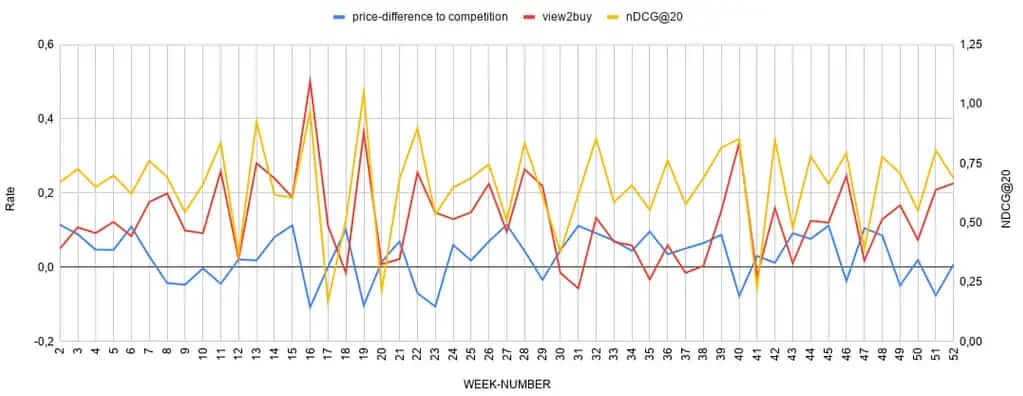
    With everything defined, I went on and calculated the different values for which I was looking. I did this for all three shop-competitor combinations and averaged the results, printing them in the following chart.

    View2Buy ratio vs. price difference to competition for products in the price range under €10

    The above chart illustrates the significant impact of price and availability on the number of clicks and carts for your search results. This results in quite a lot of bias in your search-quality measurement (or Learning-to-Rank) pipeline.

    The issue here is that changes in price or availability can significantly influence the user’s contextual relevance. This is true even if the textual and or semantic relevance between query and product hasn’t changed at all. This directly affects the click and cart probabilities.

    You may have spotted that I only include the data for the first price bucket. If you are interested in how the charts look like for the other buckets, PM me 🙂

    Conclusion

    This is the final entry for the Three Pillars of Search Quality in eCommerce Search series. I hope that the content I created helps you during your journey. To discover the perfect balance between what the seller wants to sell and what the users want to buy.

    Furthermore, if you’ve made it this far, you’re without excuse if you’re ever found stuck in strategies that never venture beyond findability improvements. You’re now equipped with the knowledge necessary to begin balancing the optimization of your discovery and inspiration journeys, against the underlying dimension of sellability.

    Final words: It’s no trivial task to fix these types of bias. I understand that. However, over-simplifying the problem and ignoring the facts won’t help you differentiate from the competition. There is no way around it. Offering an outstanding shopping discovery experience means taking external factors (like market trends, or competitor pricing) into account.

    Good Luck!

  • Part 2: Search Quality for Discovery & Inspiration

    Part 2: Search Quality for Discovery & Inspiration

    Series: Three Pillars of Search Quality in eCommerce

    In the first part of our series, we learned about Search Quality dimensions. We then introduced the Findability metric, and explained the relationship of this metric on search quality. This metric is helpful when considering how well your search engine handles the information retrieval step. Unfortunately, it completely disregards the emotionally important discovery phase. Essential for both eCommerce, as well as retail in general. In order to better grasp this relationship we need to understand how search quality influences discovery and inspiration.

    What is the Secret behind the Most Successful high-growth Ecommerce Shops?

    If we analyze the success of high-growth shops, three unique areas set them apart from their average counterparts.

    Photo by Sigmund on Unsplash – if retail could grow like plants

    What Separates High-Growth Retail Apart from the Rest?

    1. Narrative: The store becomes the story

    Your visitors are not inspired by the same presentation of trending products every time they land on your site. What’s the use of shopping if a customer already knows what’s going to be offered (merchandised) to them?

    Customers are intrigued by visual merchandising which is, in essence, brand storytelling. Done correctly, this will transform a shop into an exciting destination that both inspires, as well as entices shoppers. An effective in-store narrative emotionally sparks customers’ imagination, while leveraging store ambience to transmit the personality of the brand. Perhaps using a “hero” to focus attention on a high-impact collection of bold new items. Or an elaborate holiday display that nudges shoppers toward a purchase.

    Shopping is most fun, and rewarding, when it involves a sense of discovery or journey. Shoppers are more likely to return when they see new merchandise related to their tastes, and local or global trends.

    2. Visibility: What’s seen is sold (from pure retrieval to inspiration)

    Whether in-store or online, visibility encourages retailers to feature items that align with a unique brand narrative. All the while helping shoppers easily and quickly find the items they’re after. The principle of visibility prioritizes which products retailers push the most. Products with a high margin or those exclusive enough to drive loyalty, whether by word of mouth, or social sharing.

    Online, the e-commerce information architecture, and sitemap flow, help retailers prominently showcase products most likely to sell. This prevents items from being buried deep in the e-commerce site. Merchandisers use data analytics to know which products are most popular and trending. This influences which items are most prominently displayed. These will be the color palettes, fabrics, and cuts that will wow shoppers all the way to the checkout page.

    So why treat search simply as a functional information retrieval tool? Try rethinking it from the perspective of how a shopper might look for something in a brick and mortar scenario.

    3. Balance: Bringing buyer’s and seller’s interests together in harmony

    In stores and online, successful visual merchandising addresses consumers’ felt needs around things like quality, variety, and sensory appeal. However, deeper emotional aspects like trust are strongly encouraged through online product reviews. These inspire their wants: to feel attractive; to be confident, and hopeful. We can agree that merchandisers’ foremost task, is to attend to merchandise and the associated cues to communicate it properly. It’s necessary to showcase sufficient product variety, while at the same time remaining consistent with the core brand theme. This balancing act requires they strike a happy medium between neither overwhelming nor disengaging their audience.

    An example for the sake of clarity:

    Imagine you are a leading apparel company with a decently sized product catalog. Everyday, a few hundred customers come to your site and search for “jeans”. Your company offers over 140 different types of jeans, about 40 different jeans jackets and roughly 80 jeans shirts.

    Now the big question is: which products deserve the most prominent placement in the search result?

    Indeed this is a very common challenge for our customers. And yet all of them struggle addressing it. But why is it so challenging? Mainly because we are facing a multi-dimensional and multi-objective optimisation problem.

    1. When we receive a query like “jeans”, it is not 100% clear what the user is looking for. Trousers, jackets, shirts, we just don’t know. As a result, we have to make some assumptions. We present different paths for him to discover the desired information, or receive the inspiration she needs. In other words, for the most probable product types “k”, and the given query, we need to identify related products.
    2. Next we find the most probable set of product-types. Then, we need to determine which products are displayed at the top for each corresponding set of products. Which pairs of jeans, jeans jackets and jeans shirts? Or again in a more formal way: for each product type “k” find the top-”n” products related to this product-type and the given query.

    Or in simple words: diversify the result set into multiple result sets. Then, learn to rank them independently.

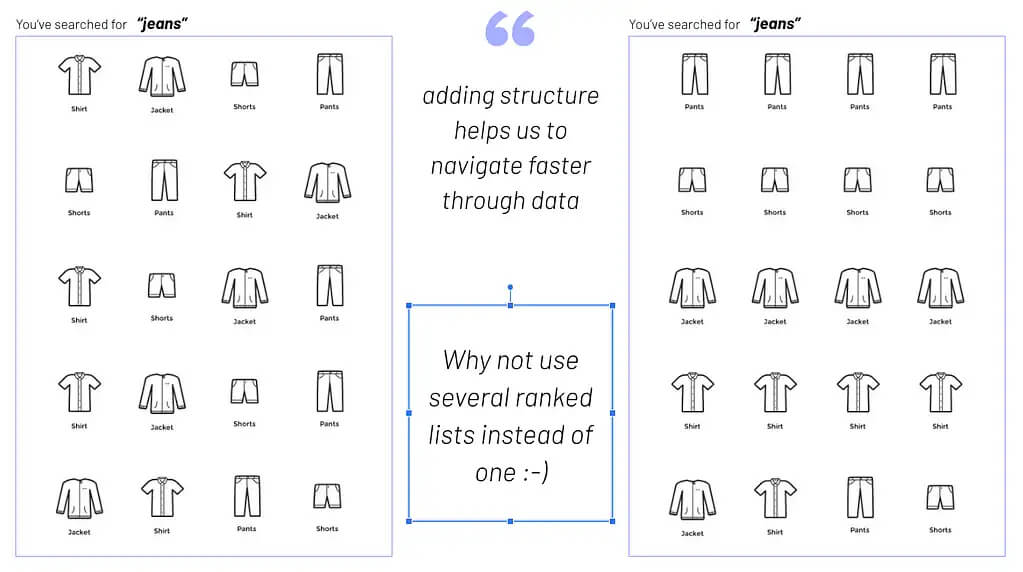
    Now, you may think this is exactly what a search & discovery platform was built for. But unfortunately, 99% of these platforms are designed to work as single-dimension-rank applications. They retrieve documents for a given query, assign weights to the retrieved documents, and finally rank these documents by weight. This dramatically limits your ability to rank the retrieved documents by your own set of, potentially, completely different dimensions. This is the reason most search results for generic terms tend to look messy. Let’s visualize this scenario to clarify what I mean by “messy”.

    You will agree, the image on the left-hand side, is pretty difficult for a user to process and understand. Even if the ranking is mathematically correct. The reason for this is simple: the underlying natural grouping of product types is lost to the user.

    Diversification of a search for “jeans”

    Now, let’s take a look at a different approach. On the right-hand side, you will notice, we diversify the search result while maintaining the natural product type grouping. Doesn’t this look more intuitive and visually appealing? I will assume you agree. After all, this is the most prominent type of product presentation retail has used over the last 100 years.

    Grouping products based on visual similarity

    You may argue that the customer could easily narrow the offering with facets/filters. Data reveals, however, that this is not always the case – even less so on mobile devices. The big conundrum is that you’ve no clue what the customer wants. To be inspired, to be guided in his buying process or just to quickly transact. Additionally, you never know for sure what type of customer you are dealing with. Even with the new, hot, latest and greatest, stuff called “personalization” – that unfortunately fails frequently. Using visual merchandising puts us into conversation with the customer. We ask her to confirm her interests by choosing a “product type”. Yet another reason why diversification is important.

    Still not convinced, this is what separates high-growth retail from the rest?

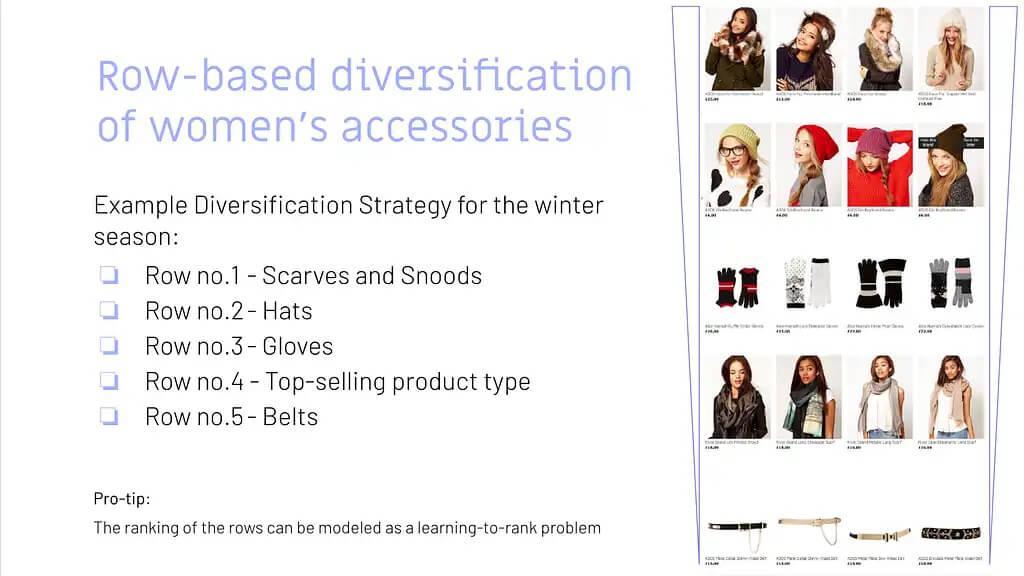
    Here is another brilliant example of how you could use the natural grouping by product type to diversify your result. Let’s take a look at a seasonal topic in this case. Another very challenging task. So we give customers the perfect starting point to explore your assortment.

    Row-based diversification – explore product catalog

    If you have ever tried creating such a page, with a single search request, you know this is almost an impossible task. Not to mention trying to maintain the correct facet counts, product stock values, etc.

    However, the approach I am presenting offers so much more. This type of result grouping also solves another well-known problem. The multi-objective optimization ranking problem. Making this approach truly game-changing.

    What’s a Multi-Objective Optimization Problem?

    Never heard of it? Pretend for a moment you are the customer. This time you’re browsing a site searching for “jeans”. The type you have in mind is something close to trousers. Unaware of all the different types of jeans the shop has to offer, you have to go rogue. This means navigating your way through new territory to the product you are most interested in. Using filters and various search terms for things like color, shape, price, size, fabric, and the like. Keep in mind that you can’t be interested in what you can’t see. At the same time, you may be keeping an eye on the best value for your money.

    We now turn the table and pick up from the seller’s perspective. As a seller, you want to present products ranked based on stock, margin, and popularity. If you run a well-oiled machine, you may even throw in some fancy Customer Lifetime Value models.

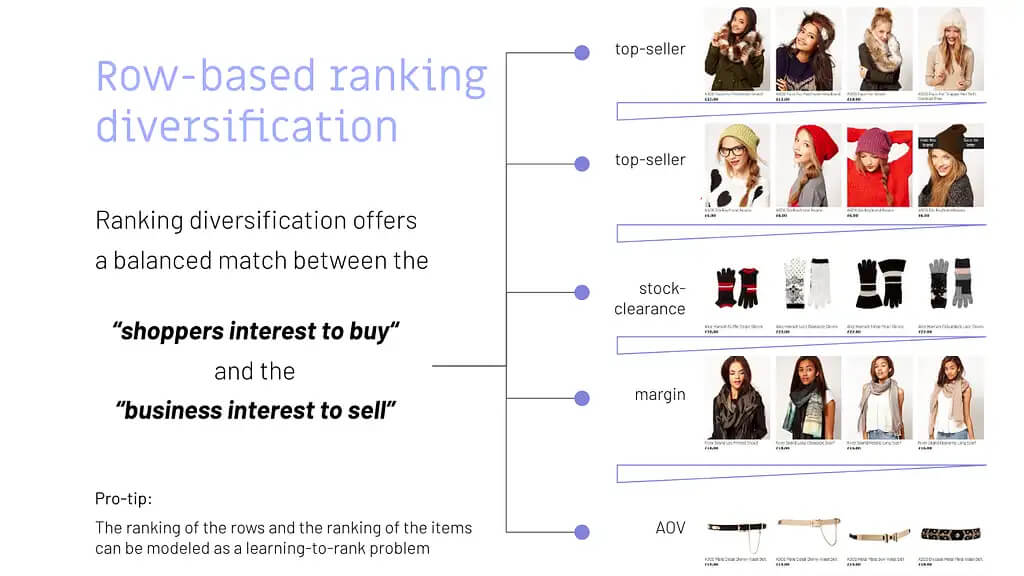
    So, our job is to strike the right balance between the seller’s goals and the customer’s desire. The methodology that attempts to strike such a balance is called the multi-objective optimization problem in ranking.

    Let’s use a visualization to illustrate a straightforward solution to the problem, by a diversified result-set grouping.

    Row-based ranking diversification

    Interested in how this approach could be integrated into your Search & Discovery Platform? Reach out to us @searchHub. Our Beta-Testphase for the Visual-Merchandising open-source module, for our OCSS (Open Commerce Search Stack), begins soon. We hope to use this to soon help deliver more engaging and joyful digital experiences.

    High-Street Visual Merchandising Wisdom Come Home to Roost

    This is all nothing new, rather it’s simply never found its way into digital retailing. For decades, finding the right diversified set of products to attract window shoppers, paired with the right location, was the undisputed most important skill in classical high street retail. Later, this type of shopping engagement was termed “Visual Merchandising”. The process of closing the gap between what the seller wants to sell and what the customer will buy. And of course, how best to manufacture that desire.

    Visual merchandising is one of the most sustainable, as well as differentiating, core assets of the retail industry. Nevertheless, it remains totally underrated.

    Still don’t believe in the value of Visual Merchandising? Give me a couple of sentences and one more Chart to validate my assumptions.

    Before I present the chart to make you believe, we need to align on some terminology.

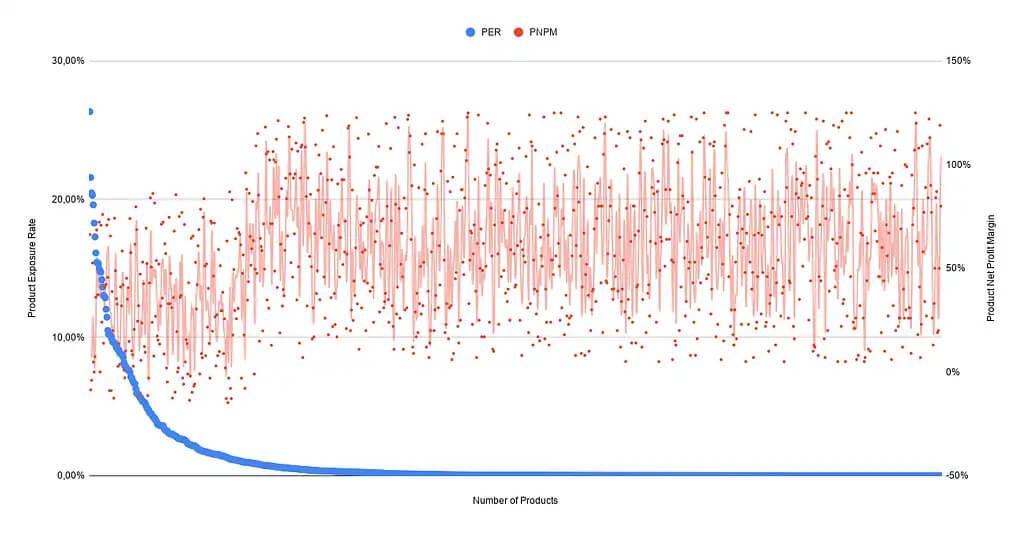
    Product Exposure Rate (PER): The goal of the product exposure rate is to measure if certain products are under- or over-exposed in our store. The product exposure rate is the “sum of all product views for a given product” divided by “the sum of all product views from all products”.

    Product Net Profit Margin (PNPM): With this metric, we try to find the products with the highest Net Profit Margin. Please be aware: it’s sensible to include all product related costs in your calculation. Customer Acquisition Costs, cost of Product returns, etc. The Product Net Profit Margin is the “Product Revenue” minus “All Product Costs” divided by the “Product Revenue”.

    Now that we have established some common ground, let’s continue calculating these metrics for all active products you sell. We will then visualize them in a graph.

    Product Exposure Rate vs. Product Net Profit Margin

    The data above represents a random sample of 10,000 products from our customers. It may look a bit different for your product data, but the overall tendency should be similar. Please reach out to me if this is not the case! According to the graph it seems that the products with high PER (Product Exposure Rate) tend to have a significantly lower PNPM (Product Net Profit Margin).

    We were able to spot the following two reasons as the most important for this behaviour:

    Two Reasons for Significantly Low Product Net Profit Margin

    1. Higher Customer Acquisition Costs for trending products mainly because of competition. Because of this you may even spot several products with a negative PNPM.
    2. Another reason is the natural tendency for low priced products to dominate the trending items. This type of over-exposure encourages high-value visitors, to purchase cheaper trending products with a lower PNPM. Customers to whom you would expect to sell higher margin products under normal circumstances.

    I simply can’t over-emphasize how crucial digital merchandising is for a successful and sustainable eCommerce business. This is the secret weapon for engaging your shoppers and guiding them towards making a purchase. To take full advantage of the breadth of your product catalog, you must diversify and segment. Done intelligently, shoppers are more likely to buy from you. Not only that, they’ll also enjoy engaging with, and handing over their hard-earned money to your digital store. For retailers, this means a significant increase in conversions, higher AOV, higher margins, and more loyal customers.

    Conclusion

    Initially, I was going to close this post right after describing how this problem can be solved, conceptually. However, I would have missed an essential, if not the most important part of the story.

    Yes, we all know that we live in a data-driven world. Believe me, we get it. At searchHub, we process billions of data points every day to help our customers understand their users at scale. But in the end, data alone won’t make you successful. Unless, of course, you are in the fortunate position of having a data monopoly.

    To be more concrete: data will/can help you spot or detect patterns and/or anomalies. It will also help you scale your operations more efficiently. But there are many areas where data can’t help. Especially when faced with sparse and biased data. In retail this is the kind of situation we are essentially dealing with 80% of the time. All digital Retailers, of which I am aware, with a product catalog greater than 10,000 SKUs, face the product exposure bias. This means, only 50-65% of the 10.000 SKUs will ever be seen (exposed) by their users. The rest remain hidden somewhere in the endless digital aisle. Not only does this cost money, it also means a lot of missed potential revenue. Simply put: you can’t judge the value of a product that has never been seen. Perhaps it could have been the Top-Seller you were always looking for were it only given the chance to shine?

    Keep in mind that retailers offer a service to their customers. Only two things make customers loyal to a service.

    What makes loyal customers?

    • deliver a superior experience
    • be the only one to offer a unique type of service

    Being the one that “also” offers the same type of service won’t help to differentiate.

    I’m one hundred percent sure that today’s successful retail & commerce players are the ones that:

    1. Grasp the importance of connecting brand and commerce
    2. Comprehend how shoppers behave
    3. Learn their data inside and out
    4. Develop an eye for the visual
    5. Connect visual experiences to business goals
    6. Predict what shoppers will search for
    7. Understand the customer journey and how to optimize for it
    8. Think differently when it comes to personalizing for customers
    9. Realize it’s about the consumer, not the device or channel

    I can imagine many eCommerce Managers might feel overwhelmed by the thought of delivering an eCommerce experience that sets their store apart. I admit, it’s a challenge connecting all those insights and capabilities practically. And while we’re not going to minimize the effort involved, we have identified an area that will elevate your digital merchandising to new levels and truly differentiate you from the competition.

  • Three Pillars of Search Relevancy. Part 1: Findability

    Three Pillars of Search Relevancy. Part 1: Findability

    One of the biggest causes of website failure is when users simply can’t find stuff on your website. The first law of e-commerce states, “if the user can’t find the product, the user can’t buy the product.

    Why is Measuring and Continuously Improving Site-Search so Tricky?

    This sentence seems obvious and sounds straightforward. However, what do “find” and “the product” mean in this context? How can we measure and continuously improve search? It turns out that this task isn’t easy at all.

    Current State of Search Relevancy in E-Commerce:

    When I talk to customers I, generally, see the following two main methods to measure and define KPIs against the success of search: relevancy, and interaction and conversion.

    However, both have flaws in terms of bias and interpretability.

    We will begin this series: Three Pillars of Search Relevancy, by developing a better understanding of “Findability”. But first, let’s begin with “Relevancy”.

    Search Relevancy:

    Determining search result relevance is a massive topic in and of itself. As a result, I’ll only cover this topic with a short, practical summary. In the real world, even in relatively sophisticated teams, I’ve only ever seen mainly three unique approaches to increase search relevancy.

    1. Explicit Feedback: Human experts label search results in an ordinal rating. This rating is the basis for some sort of Relevance Metric.
    2. Implicit Feedback: Various user activity signals (clicks, carts, …) are the basis for some sort of Relevance Metric.
    3. Blended Feedback: The first two types of feedback combine to form the basis for a new sort of Relevance Metric.


    In theory, these approaches look very promising. And in most cases, they are superior to just looking at Search CR, Search CTR, Search bounce, and Exit rates. However, these methods are heavily biased with suboptimal outcomes.

    Explicit Feedback for Search Relevancy Refinement

    Let’s begin with Explicit Feedback. There are two main issues with explicit feedback. First: asking people to label search results to determine relevance, oversimplifies the problem at hand. Relevance is, in fact, multidimensional. As a result, it needs to take many factors into account, like user context, user intent, and timing. Moreover, relevance is definitely not a constant. For example, the query “evening dress”, may offer good, valid results for one customer, and yet, the very same list of results can be perceived as irrelevant for another.

    Since there is no absolute perception for relevancy, it can’t be used as a reliable or accurate search quality measurement.

    Not to mention, it is almost impossible to scale Explicit Feedback. This means only a small proportion of search terms can be measured.

    Implicit Feedback for Search Relevancy Refinement

    Moving on to Implicit Feedback. Unfortunately, it doesn’t get a lot better. Even if a broad set of user activity signals are used, as a proxy for Search Quality, we still have to deal with many issues. This is because clicks, carts, and buys don’t take the level of user commitment into account.

    For example, someone who had an extremely frustrating experience may have made a purchase out of necessity and that conversion would be counted as successful. On the other hand, someone else may have had a wonderful experience and found what he was looking for but didn’t convert because it wasn’t the right time to buy. Perhaps they were on the move, on the bus let’s say. This user’s journey would be counted as an unsuccessful search visit.

    But there is more. Since you only receive feedback on what was shown to the user, you will end up at a dead-end. This is not the case, however, if you have some sort of randomization in the search results. This means that all other results for a query, that have yet to be seen, will have a zero probability of contributing to a better result.

    Blended Feedback for Search Relevancy Refinement

    In the blended scenario, we combine both approaches and try to even out their short-comings. This will definitely lead to more accurate results. It will also help to measure and improve a larger proportion of search terms. Nevertheless, it comes with a lot of complexity and induced bias. This is the logical outcome, as you can only improve results that have been seen by your relevancy judges or customers.

    Future State — Introducing Findability as a Metric

    I strongly believe that we need to take a different approach to this problem. Then “relevance” alone is not a reliable estimator for User Engagement and even less for GMV contribution.

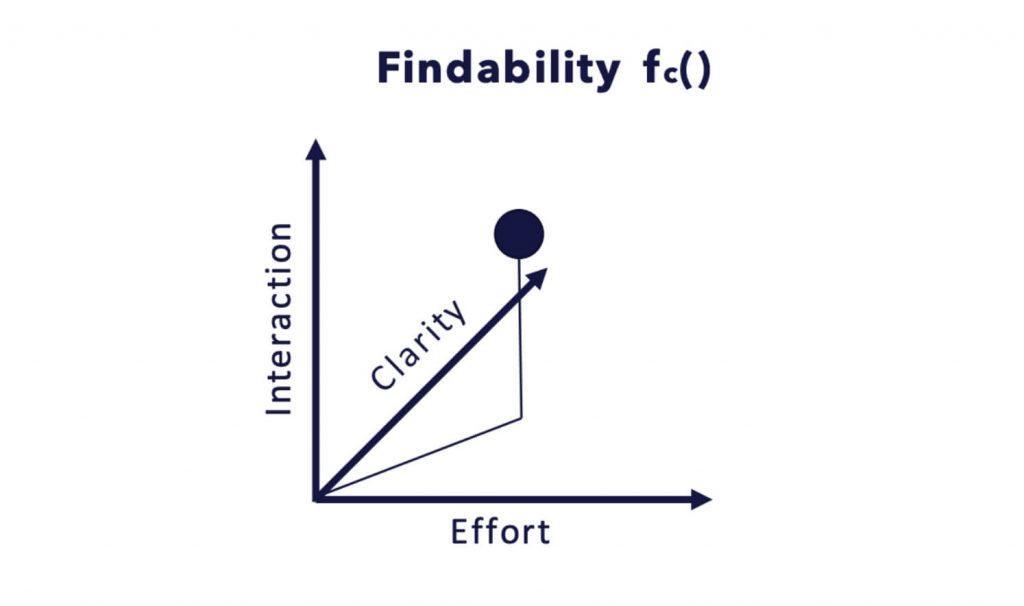
    In my humble opinion, the main problem is that relevance is not a single dimension. What’s more, relevance should instead be embedded in a multidimensional feature space. I came up with the following condensed feature space model, to make interpreting this idea somewhat more intuitive.

    Once you have explored the image above, please let it sink in for a while.

    Intuitively, findability is a measure of the ease with which information can be found. However, the more accurately you can specify what you are searching for, the easier it might be.

    Findability – a Break-Down

    I tried to design the Findability feature (measure) to do exactly one thing extremely well. Pointedly, to measure the clarity, effort, and success in the search process. Other important design criteria for the Findability score were that it should:

    a) not only provide representative measures for the search quality of the whole website, but also

    b) for specific query groups and even single queries to be able to optimize and analyze them.

    Findability not only tries to answer, but goes a step further to quantify the question.

    Findability as it Relates to Interaction, Clarity, and Effort
    • “Did the user find what he was looking for?” — INTERACTION

    it also tries to answer and quantify the questions

    • “Was there a specific context involved when starting the search process?”. “Was the initial search response a perfect starting point for further result exploration?” — CLARITY

    and

    • “How much effort was involved in the search process?” — EFFORT


    Appropriately, instead of merely considering whether a result was found and if a product was bought, we also consider whether the searcher had a specific or generic interest. Additionally, things like whether he could easily find what he was looking for, and if the presented ranking of products was optimal, provide valuable information for our findability score.

    Intuitively, we would expect that for a specific query, the Findability will be higher if the search process is shorter. In other words, there is less friction to buy. The same applies to generic or informational queries, but with less impact upon Findability.

    We do this to ensure seasonal, promotional, and other biasing effects are decoupled from the underlying search system and its respective configuration. Only by trying to decouple these effects, is it possible to continuously optimize your search system in a systematic, continuous, and efficient way respective to our goals to:

    • increase the customer experience (to increase conversions and CLTV)
    • increase the probability of interaction with the presented items
    • increase the success rate of purchase through search

    Building the Relevance and Findability Puzzle

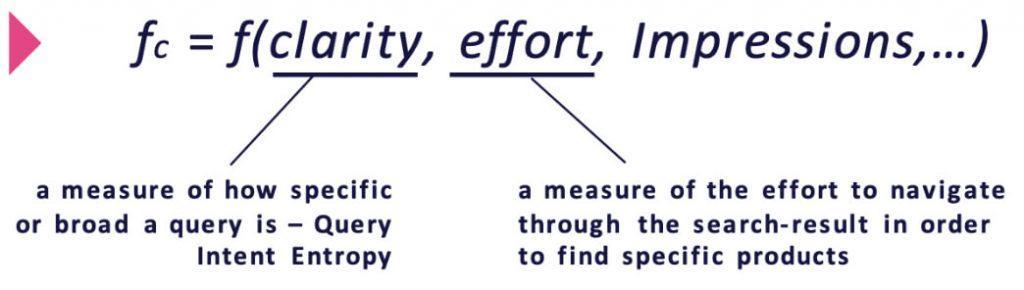
    To quantify the three different dimensions clarity, effort, and interaction we are going to combine the following signals or features.

    Clarity – as it Relates to Findability:

    In this context, clarity is used as a proxy for query intent type. In other words, information entropy. For example, in numerous instances, customers issue quite specific queries. For example: “Calvin Klein black women’s evening dress in size 40”. This query describes what they are looking for. For this type of query, the result is pretty clear. However, there is a significant number of examples where customers are either unable or unwilling to formulate such a specific query. On the other hand, the query: “black women’s dress”, leaves many questions open. Which brand, size, price segment? As a result, this type of query is not clear at all. That’s why clarity tries to model the query and deliver specificity.

    Features

    Query Information Entropy

    Result Information Entropy

    Effort – as it Relates to Findability:

    Effort, on the other hand, attempts to model the exertion, or friction, necessary for the customer to find the information or product for the complete search process. Essentially, every customer interaction throughout the search journey, adds a bit of effort to the overall search process, until he finds what he is looking for. We must try to reduce the effort needed as much as possible, as it relates to clarity, since every additional interaction could potentially lead to a bounce or exit.

    Features (Top 5)

    Dwell time of the query

    Time to first Refinement

    Time to first Click

    Path Length (Query Reformulation)

    Click Positions

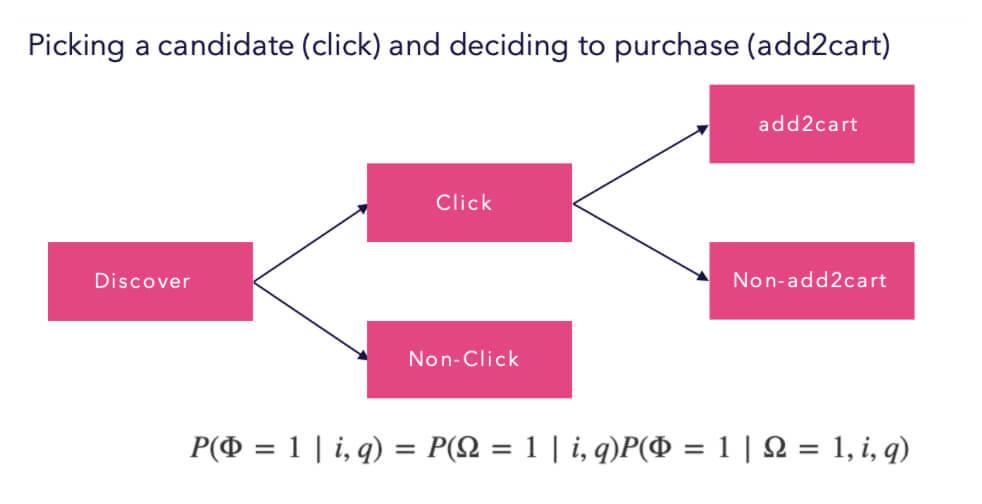
    Based on these features, it is necessary, in our particular case, to formulate an optimization function that reflects our business goals. Our goal is to maximize the expected search engine result page interaction probability while minimizing the needed path length (effort).


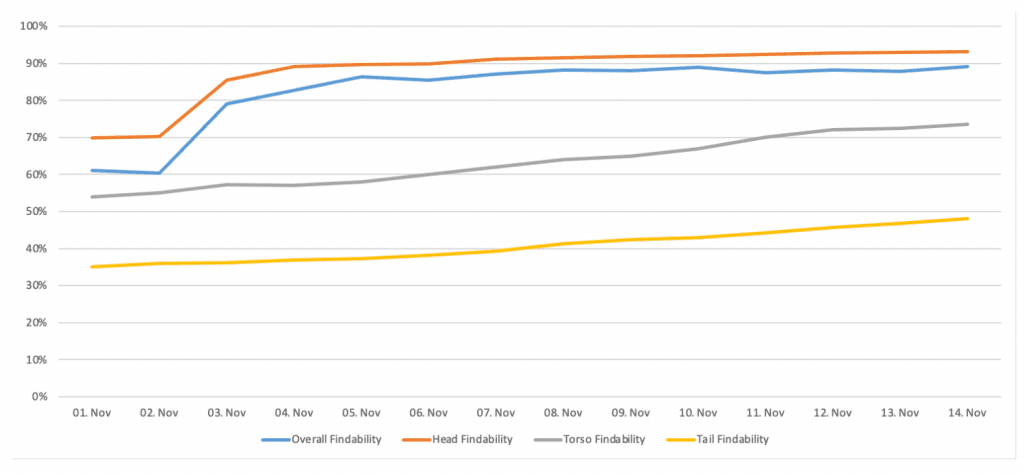
    The result of our research is the Findability metric (a percentage value between 0-100%), where 0% represents the worst possible search quality and 100% the perfect one. The Findability metric is part of our upcoming search|hub Search Insights Product, which is currently in Beta-Testing.

    I’m pretty confident that providing our customers easier to understand and more resilient measures about their site search, will allow them to improve their search experiences in a more effective, efficient, and sustainable way. Therefore, the Findability should provide a solid and objective foundation for your daily and strategic optimization decisions. Simultaneously, it should give you an overview of whether your customers can, efficiently, interact with your product and service offerings.

  • Why the smartSuggest Module Might Matter to You

    Why the smartSuggest Module Might Matter to You

    We at searchHub live to make existing search engines better understand humans and deliver exceptional search experiences. So, why have we now created our own smartSuggest Module, and why does this matter to you? Until a couple of months ago we were mainly focusing on rewriting the user queries into the best possible search engine queries helping our customers to deliver better results for a given user query and gain fantastic uplifts in their key business metrics.

    Why Site-Search Should be Considered Part of the User Experience

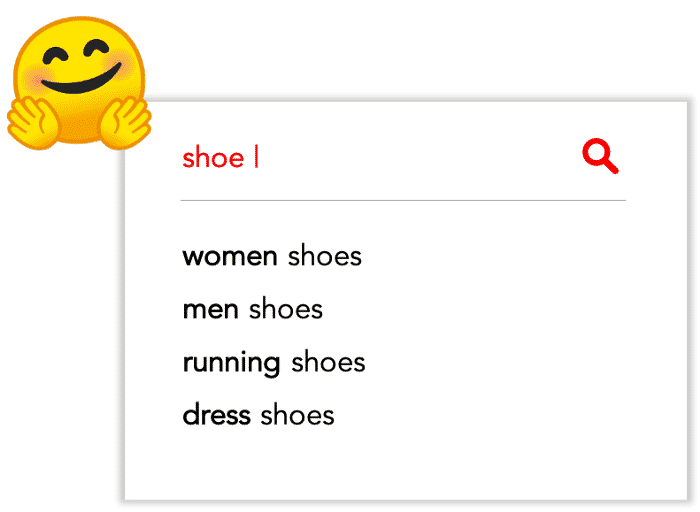
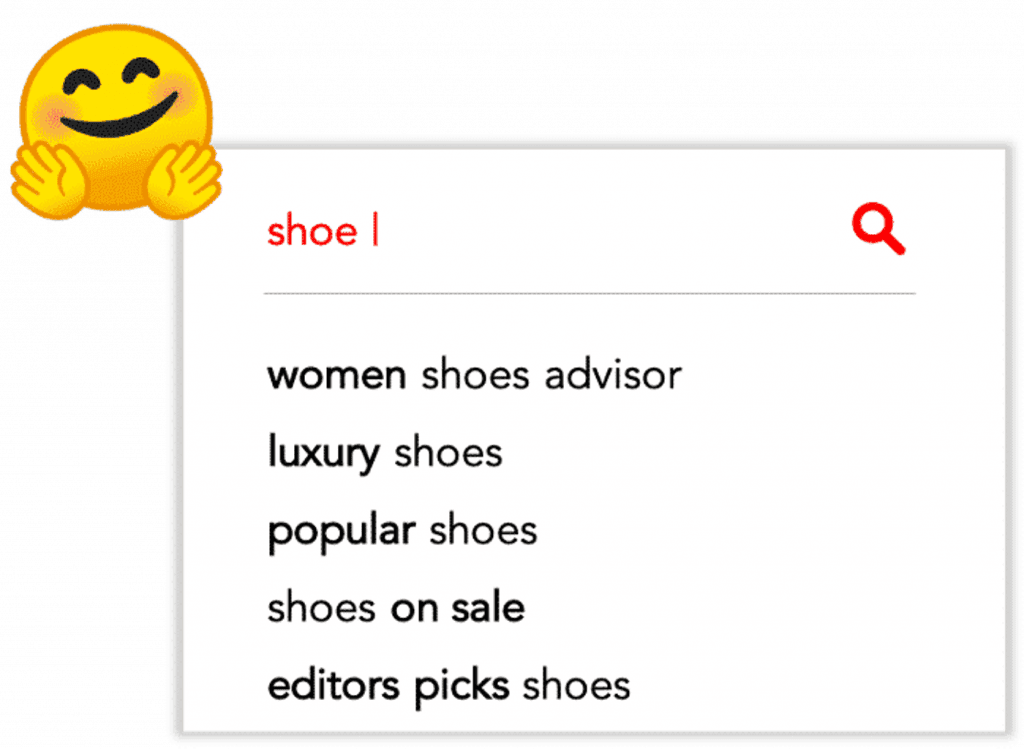
    But soon we realized that we still left much of its potential unused. Why? — because search is a process and not a single feature. Until now, we have thoroughly ignored the part of the whole search process where the user formulates his query. — and guess what — there is already a nice feature for that called “auto-suggest” or “query suggestions” or “auto-complete” in the search universe.

    1. The Goal of Serving Query Suggestions – smartSuggest

    Disclaimer — in this article we’ll not talk about UI and frontend implementations at all — instead we are going to focus on information-need and information delivery.

    We’re already a highly data-driven company. So, we went out and started to analyze our tracking data to find strong evidence that it is worth it to spend a significant amount of development time on either improving an existing or building our own query suggestions-system and to identify the areas we should focus on.

    But before we take a closer look at what the data revealed, let’s check if we can find some best-practice articles on the internet and see what they recommend:

    The Nielsen Norman Group recommends using query-suggestions to:

    • Facilitate accurate and efficient data entry
    • Select from a finite list of names or symbols, especially if the item can be selected reliably after typing the first 1–3 characters
    • Facilitate novel query reformulations
    • Encourage exploratory search (with a degree of complexity and mental effort that is appropriate to the task). Where appropriate, complement search suggestions with recent searches.

     In our summary, this boils down to — guide the user during the search formulation process to facilitate accurate data entry and encourage exploratory search. However, this is very much biased towards the user of a webshop— but what about the goals and needs of a webshop owner? Again, we can find some inspiration on the internet. Lucidworks, for example, points out some opportunities in terms of merchandising when it comes to query suggestions. 

    • Customize autocomplete suggestions according to where a visitor is on the site.
    • Retailers can use autocomplete search suggestions to draw customers’ attention to certain merchandise. Products that are on sale, that are from certain brands or have a higher margin.
    • Use past online behavior to shape search recommendations.
    • Tie autocomplete results to customer trends.
    • Factor geography into autocomplete recommendations.

     Time for another summary — while guiding the user during the search formulation process, encourage exploratory search, and boost product discovery for users. If we combine the essence of both summaries, we end up with something like:

    Guide the user during the search formulation process to facilitate accurate data entry, encourage exploratory search and boost product discovery.

    Now that we have a goal, query suggestions work well, if we observe that they help the user articulate better search queries and help to better discover the product offering. It’s rather about accelerating the search process than about guiding the user and lending them a helping hand in constructing their search query and guiding them through the available options.

    2. Validating the goal and identifying the most valuable use cases

    Now that we know which query suggestions should enable us to offer the user, let’s slice and dice some logs and tracking data to come up with the most valuable use cases we need to enable.

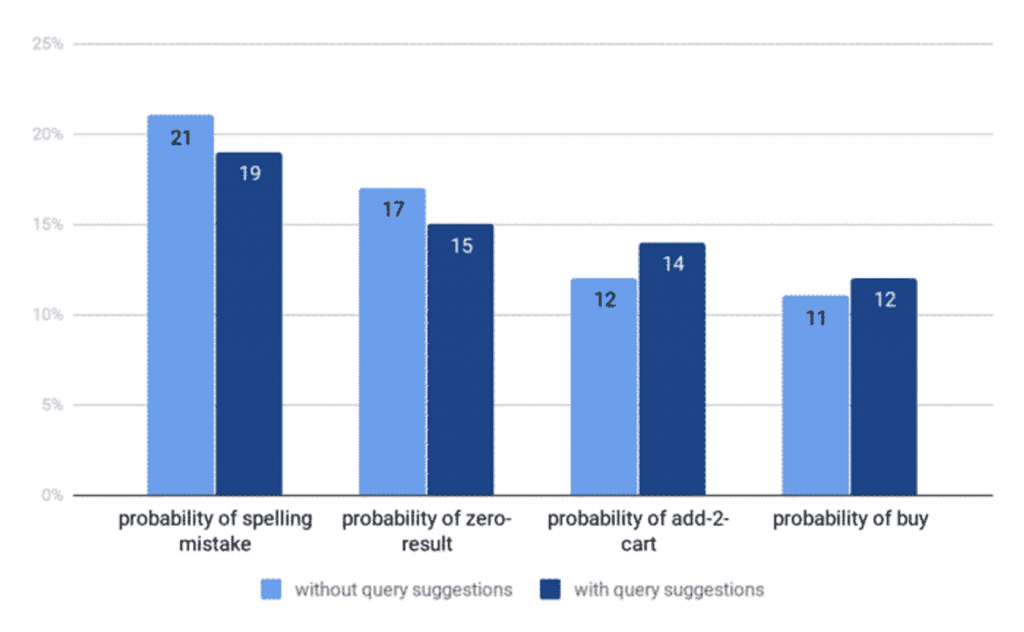
    To validate our goals or assumptions, we’ve sampled around 120,000 search sessions across several customers. We further filtered them down to roughly 57,000 search sessions by only looking at sessions that consist of two or more different searches, where at least one of these search types was either a “typed search” or a “suggested search”.

    • In this context, a “typed search” is defined as a query formulation process where the user typed each letter, digit, or punctuation that resulted in a search.
    • A “suggested search” is defined as a query formulation process where the user typed something and selected a query suggestion that resulted in a search.

    From here on, we compared the different search types in terms of their KPIs. The query suggestions have a large positive impact on, probability of add-2-cart and probability of buy and a large negative impact on the probability of spelling mistake and probability of zero-result. Therefore, serving query suggestions shows an improvement in all metrics.

    Results:

    • Query suggestions are used only if they are relevant and good enough to provide genuine guidance during the query formulation process. This is what we call the intent matching or retrieval process.
    • The likelihood of influencing the user’s query formulation process with query suggestions is highly dependent on the session context, resulting in a need for query and ranking flexibility. This is the so-called scoping, filtering, and ranking process.

    3. The Task of matching user intent and serving query suggestions

    How often have you already cursed your smartphone’s autocorrect?

    Any query recommendation should be relevant to the user. If irrelevant information (false promises or unintended suggestions) appears too often, the user’s confidence in the results will diminish, as will engagement. During the intent matching or retrieval process mainly two parts decide if you are able to provide relevant and inspiring query suggestions that can guide users. The first one is the suggestion corpus. And the second one is the matching strategy.

    Building the suggestion corpus.

    Let us first focus on the suggestion corpus. As with any data-driven application, the fundamental rule (bullshit in — bullshit out) still stands. The quality of the displayed query suggestions will mainly be dependent on building a quality corpus. A smart query suggestion solution needs to provide a robust process of building and updating the suggestion corpus(es).

    This corpus may rely on different sources like customer query data logs, product data, or even other data-pools like a knowledge-graph for example. Only by combining these data sources, you can provide the diversity in the suggestions you need. But this combination comes at a cost — redundancy.

    • Query suggestions that are semantically similar but contain different spellings should only be displayed once. As there is no value in showing semantically identical phrases with close spellings, for example:
    • Singular vs. plural forms of nouns (“women dress” vs. “women dresses”)
    • Order of words (“long blue dress” vs. “blue long dress”)
    • Compound words (“dishwasher” vs. “dish washer”)
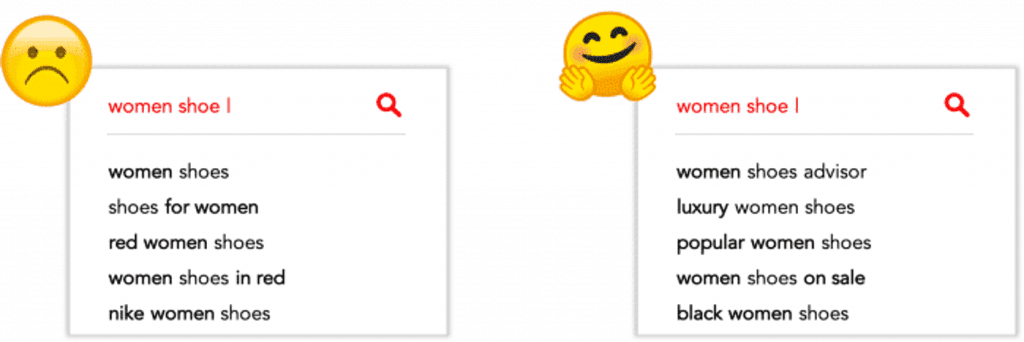
    • With and without stop-words (“women dress” vs. “dress for women”)
    • Special characters (“swell bottle” vs. “s’well bottle”)
    • Alternative spellings (“barbecue” vs. “barbeque”)

    To be able to ingest, combine, clean, and update this suggestion corpus in almost real-time is the key challenge for every query suggestion system and by the way, a very challenging engineering task.

    The query or user intent matching strategy

    The second part is how to match the given user query or user intent against the corpus and respond with a relevant and helpful list of query suggestions. To do so, you need a system that can handle the following cases in an intelligent and graceful way.

    • query normalization and spell correction. Since user input tends to be messy, your system needs to provide normalization & spelling correction functionality. When a customer misspells a word or a phrase in the search box, autocomplete identifies the misspelling, fixes it on the fly, and displays the correctly spelled suggestions instead.
    • partial and multi-matching. Multi-match is used in product searches to allow matching of different tokens of a phrase on the same product attribute or value.

    To handle all these cases, your query suggestion system must provide different types of suggesters. For example, with built-in suggesters you can choose an implementation that allows for fuzzy matches (celvin can return calvin) or another one matching infixes (calvin can return calvinklein for men), but you can’t have both. A nice query suggestion system can do both (celvin can return calvinklein for men)

    4. The art of Scoping, filtering and Ranking query Suggestions

    Once we have managed to get the matching or retrieval right, and we can receive meaningful and helpful query suggestions, we still have to work on the scoping, ranking, and filtering process to make the query suggestions even more relevant, more diverse, and more inspiring.

    1. query suggestion scoping. If we already know that we might be able to help the user to articulate his intent by scoping a broad query (“TV”) with relevant categories or important features, the chances he might find what he is looking for will be increased.
    2. query suggestion filtering. There will always be a situation where you might need to exclude or filter specific suggestions based on different data points. Some common examples are.
    • false promises — query suggestions, which yield a false promise or zero results, should be excluded from the autocomplete display.
    • blacklisted queries — Some phrases may be suppressed via a blacklist.
    1. query suggestion ranking. Since we are going to present the user a list of possible choices, ranking becomes a powerful tool to guide and inspire. Again, some common examples.
    • ranking query suggestions by business metrics — the most obvious approach is to rank suggested phrases by the number of search events, which works fairly well. But a higher number of search events does not necessarily mean a higher business value. Other relevant metrics could be considered in the ranking, such as the number of sales, margin, etc., which affect its business value. If business metrics are collected over a long period, it can be useful to boost the value of more recent events.
    • promote brands or important features — If a user types in a generic subject, say “TV”, a smart query suggestion system will use this opportunity to suggest tv brands, like “Samsung TVs” or tv types, like “curved TVs”, or “4K TVs”, which give users a helpful suggestion, and also applies a merchandiser’s business logic of promoting a brand or specific type of tv.
    • promote query suggestions by geographic segmentation — considering the user’s geographic location might improve ranking results. Users coming from different countries might have different interests.
    • promote query suggestions based on taxonomy location — taking into account the user’s location in the product taxonomy might help to add additional context to the user query. For example, a user typing in “t-shirt” while in the menswear section. Then the user might be more likely to be interested in shirts for men, rather than shirts for all genders.

    Again, a system with maximum flexibility helps to improve the system over time and adapt it to upcoming trends or new ideas and business opportunities. Being able to influence and optimize the ranking of your query suggestions based on behavioral and conditional signals is crucial for your business when it comes to anticipating a customer’s search intent, and provide useful suggestions. These suggestions will help guide the customer through the product discovery experience and remove barriers to finding new products online.

    The smartSuggest lib

    Since we at searchHub already solve the task of matching user intent, apply semantic deduplication, and provide query sharpening or query relaxation, we tried to find an existing system for serving query suggestions that on top provides the three above-identified use-cases of scoping, filtering and ranking Query Suggestions. Unfortunately, we could not find such a system and went down the path of building it on our own based on Lucene.

    With the data provider SPI, any kind of data source can be used to build up the suggestion corpus. The built data is then already tagged for boosting and filtering. It will then be indexed with different indexers, each one optimized for the particular search approach.

    For a search request, we search these indexes one after the other, until enough suggestions could be retrieved. This means if there are enough prefix matches, no unnecessary fuzzy matching is done. In a final step, the results are ranked and optionally grouped and truncated. This way the maximum performance with the necessary feature set can be achieved. Everything that’s not necessary will be skipped and won’t affect response time.

    The plugin is built as a production-grade workhorse, handling a load of up to 1500 QPS. And for customers using our smart query suggestion, more than 40% of all user sessions already start with a clicked query suggestion, which proves the quality of the suggestions served.

    smartSuggest can be a powerful discovery tool when implemented correctly since it offers you a simple, clean API to influence the query suggestions the way you want them by using contextual boosting tags, contextual filters & scopes, blacklists, and business ranking. smartSuggest is simple to integrate, too. You are only two steps away from testing it.

    1. Provide your search analytics data API (e.g., GA) or use our Search Collector SDK
    2. Start the smartSuggest service in your environment or request a SaaS instance
    3. Integrate the smartSuggest API in your Frontend…

    The value smarter query suggestions bring

    Especially in mobile-first scenarios, where the smaller screen and keyboard limit the use of more traditional faceted search selectors, smart query suggestions do more than merely forecasting words or phrases the user is typing. smartSuggest goes a huge step further, and anticipates the user’s intentions to make helpful suggestions.

    These suggestions improve the user’s search experience, increasing both online conversion rates and average online cart value. Overall, smart query suggestions improve both the customer’s experience, as well as helping the retailers merchandisers and the business bottom line. Investing in such features will consistently improve online conversion rates and the size of online shopping carts, especially on mobile devices. Given the high impact from this feature, retailers with a large online catalog are essentially leaving money on the table without such a powerful smart query suggestion solution.

    The technology behind searchHub is specifically designed to enhance our customer’s existing search, not replace it. With just two API calls, search|hub integrates as a proxy between your frontend application and your existing search engine(s) injecting its deep knowledge.

    If you’re excited about advancing searchHub technology and enabling companies to create meaningful search experiences for the people around us, join us! We are actively hiring for senior Java DEVs and Data Scientists to work on next-generation API technology.

    www.searchhub.io proudly built by www.commerce-experts.com

  • Humans — Search for Things Not for Strings

    Humans — Search for Things Not for Strings

    Information Retrieval (IR) systems are a vital component in the core of successful modern web platforms. The main goal of IR systems is to provide a communication layer that enables customers to establish a retrieval dialogue with underlying data. However, the immense explosion of unstructured data and new ways to interact with IR systems (voice, image…) drives modern search applications to go beyond just fuzzy string matching, to invest in a deep understanding of user queries through the interpretation of user intention (we like the term Query-Understanding) in order to respond with a relevant result set. In short: humans search for things, not for strings.

    How to Master the Challenge of locating Things not Strings

    Since the problem is not always obvious, I spent some time to find relevant real-life examples that do not require a lot of domain knowledge to judge the result quality.

    The good thing, here at searchHub, is that we currently have access to more than 15,000,000 unique search queries from the e-commerce domain. Why is it good? — well, by having access to this kind of information I was able to pick a very representative query — “women red dress size s” — which made it into our top-1000 fashion queries in terms of frequency and into the top-100 queries in terms of value per search. In essence, this query (and it’s variants) drives almost 1 Million USD in revenue per day for our customers!

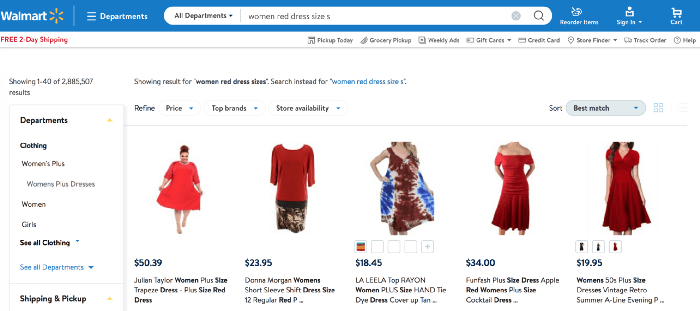
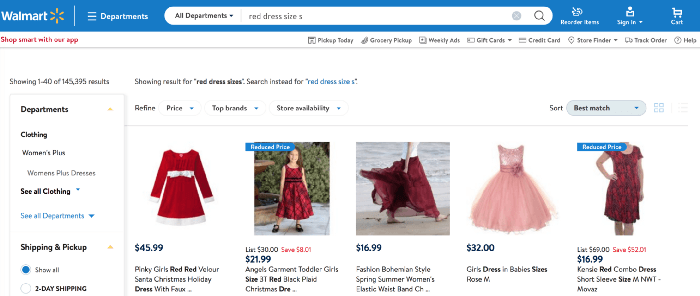
    Having found an economically relevant query example I went on to check the results for this query, and it’s top-variant on one of the biggest retail-sites on the planet walmart.com and this is what I received as feedback:

    search result for “women red dress size s” on walmartcom

    search result for “red dress size s” on walmart.com

    I’m not going to criticize these results in detail, but I’m pretty confident that these results do not represent the best possible feedback the system could come up with in terms of economic performance. Why am I saying that? — Well, firstly, there is and will always be a strong correlation between result-size and search conversion rate— the reason for this lies in the “paradox of choice” with search-effort. The impact of result-size vs. search conversion rate increases even more the more specific a query gets.

    Unfortunately, still most of the domain owners in search think that this challenge can be solved by a learning-to-rank approach. But you can’t — learning-to-rank will not solve the underlying precision problem. I agree that you might be able to reduce the negative impact by learning to push more relevant products to the top or to the first page, but you’ll still miss 70–80% of the underlying potential!

    Let’s be honest: when somebody is willing to spend the effort to articulate a quite specific query like — “women red dress size s” — he has a specific intent and wants to be understood. — Essentially, the visitor is looking for a “red colored dress in size s.

    Time for an experiment 🙂

    Since Walmart.com is unfortunately not one of our customers yet 🙂 we don’t have access to qualitative query performance data. But to test our hypothesis, we did a simple experiment with real-life users.
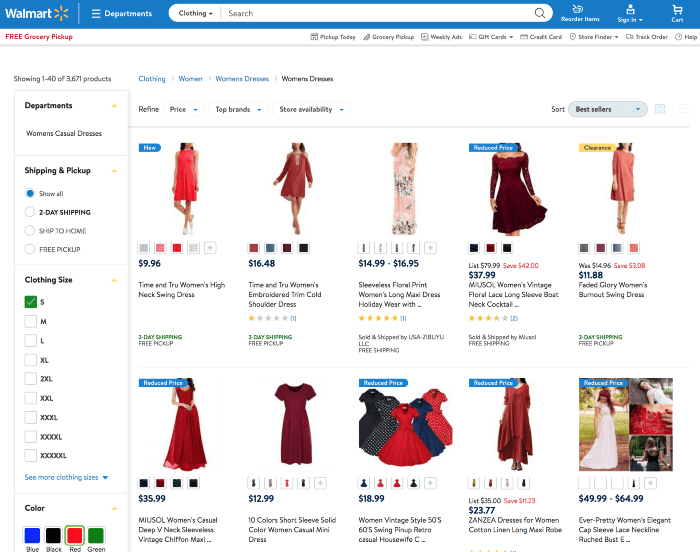
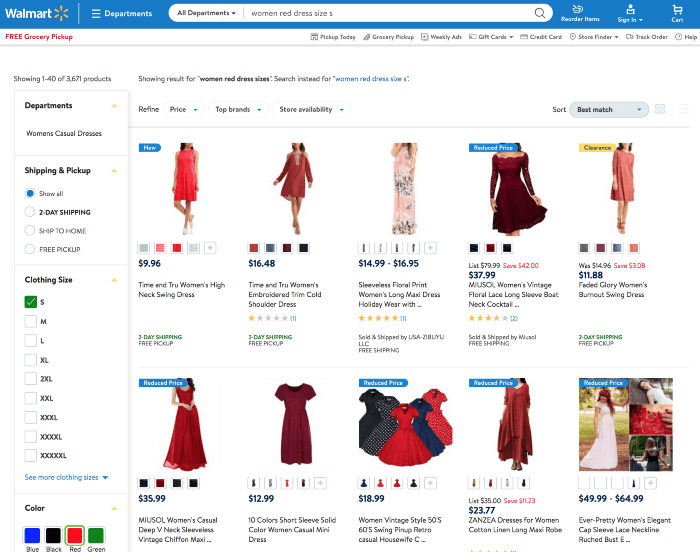
    We used the faceted navigation result representing the intent of the given query “red dress size s” on walmart.com. We think that from a precision perspective, this would be the most relevant set of products Walmart could reply to the given query. Then we rebuild the page so that it matches perfectly a search results page in terms of look and feel.

    original faceted navigation result representing the intent for the given query “red dress size s” on walmart.com

     fake search result for the given query “red dress size s” on walmart.com based on the faceted navigation result

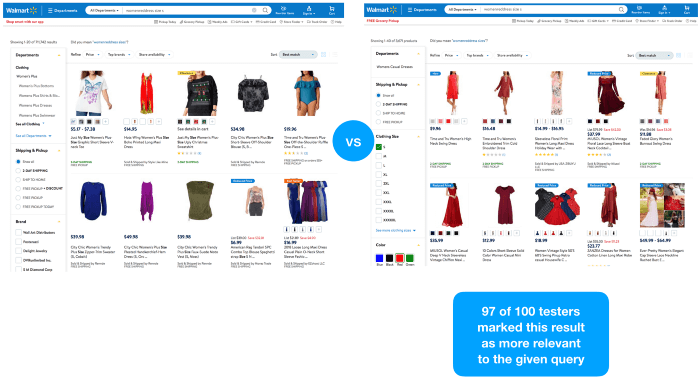
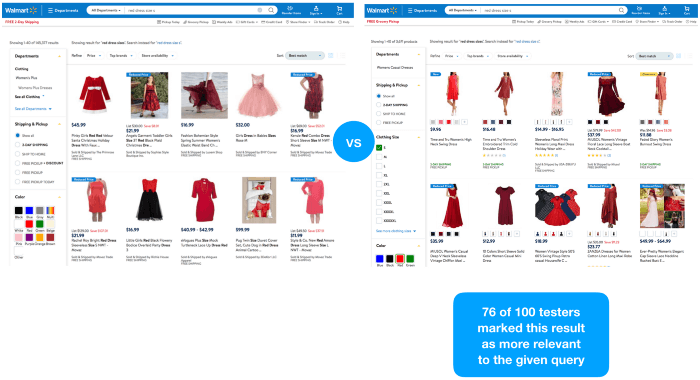
    We did the same for our top-3 variant queries, whilst again maintaining the same look and feel. Afterwards, we established a crowdFlower Human-In-The-Loop Search Relevance experiment with 100 users to receive some relevancy judgments for the different variations.

    Test results for variation 1 compared to test results for variation 2

    Test results for variation 3

    Results

    The results speak for themselves. Understanding the intent behind a search query is superior to string matching in isolation. And the reason for this is quite obvious — “people search for things rather than strings” —

    The Solution — Query Understanding (We Know “Things”)

    Search can and should be a gateway to open-ended exploration and discovery. Sometimes searchers want to be inspired, but most likely come to search with a specific need in mind. Here at searchHub, we work towards understanding user intent with the aim of bridging the gap between user intent and relevant results. We think a search engine should encourage searchers to express their specific needs by driving searchers to create search queries that are more specific. Our goal is to make the leap from query-to-intent less tedious to a more seamless search approach.

    Our Approach to Help Humans find Things

    Deciphering users’ ‘intent’ is the mind-reading game we have to continuously play with our customers. But how do we do that?

    searchHub’s stages of Query Understanding

    1. In the first stage, we start by improving the user queries themselves.

    Here we take advantage of our superior contextual query correction service which uses our concept of controlled precision reduction control. It automatically handles typos, misspellings, term decomposition, stemming and lemmatization at a yet unmatched level of accuracy and speed.

    2. In the second stage, we try to understand the intent/meaning of the query

    at this stage, the system tries to extract the entities and concepts mentioned in a query. As a result, search|hub predicts one or more possible intentions with a certain probability, which is particularly important for ambiguous queries.

    Most other solutions that attempt to tackle the same problem are using predefined knowledge bases / ontologies to represent dependencies and invoking meaning into the system. We spend a lot of time evaluating existing models and decided to do it differently because we wanted to build a system that learns at scale (different domains), can solve the language gap between visitors and catalog domain experts (wording and language) and even more essential automatically reshapes / optimizes and adapts itself based on explicit and implicit feedback. Therefore, we have developed an automated entity relationship extraction and management solution based on reinforced learning. Another benefit of this solution is that it does not waste computation time and money on building knowledge we don’t need to have 🙂

    3. Continuously test and learn which query/queries perform best for a given intent/meaning

    Another big differentiator of search|hub is that it is entirely data-driven. For quite several queries, there is no single best intent / meaning. In these cases, the right intent / meaning might be dependent on context (time, region, etc.) Therefore, we automatically multivariate test ambiguous queries and query intentions.

    The technology behind searchHub is specifically designed to enhance our customer’s existing search, not replace it. With just two API calls, searchHub integrates as a proxy between your frontend application and your existing search engine(s) injecting its deep knowledge.

    If you’re excited about advancing searchHub technology and enabling companies to create meaningful search experiences for the people around us, join us! We are actively hiring for senior Java DEVs and Data Scientists to work on next-generation API technology.

    www.searchhub.io proudly built by www.commerce-experts.com

  • searchHub Dramatically Improves Revenue for E-commerce by up to 39.6%

    searchHub Dramatically Improves Revenue for E-commerce by up to 39.6%

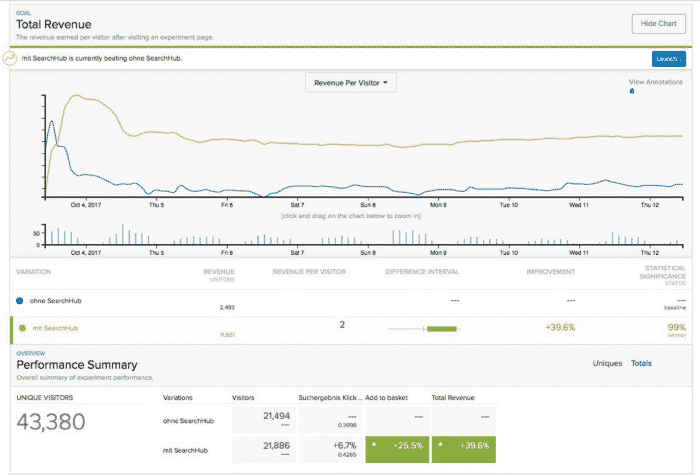
    We decided to put search|hub to the test, and the staggering results are in. By using searchHub with one of our customers current search solution, our customer made the following gains:

    • 39.6% improvement on total revenue
    • 39% improvement on revenue per User
    • 25.5% improvement on purchases
    • 6.7% improvement on total clicks on search results

    Over a period of 14 days, with almost 45,000 unique visitors, search|hubs self-learning query intelligence API helped to increase total revenue by 39.6% and purchases by 25.5% with a 99% confidence score. This impressive achievement is solid evidence that search|hub improves revenue and user engagement for online retailers.

    How We Determined searchHub’s superior performance – the Experiment

    For our comparison, we performed an A/B test using Optimizely to ensure unbiased results. The traffic allocation was set to 50% for their current onsite search solution and 50% for searchHub with their current search solution.

    We instituted a test period of two weeks. During the test period, we were tracking the following goals, with total revenue set to be the primary goal of the test:

    1. Total revenue (Primary goal)
    2. Revenue per Visitor

    Before starting the A/B test, search|hub was trained based on almost half a million searches with clicks and add-to-basket actions, extracted from existing search engine query logs. During the A/B test, search|hub used clicks and add-to-basket actions to continuously learn from user behavior.

    Results

    The results of the A/B test are staggering:

    1. 39.6% improvement on total revenue
    2. 39% improvement on revenue per User
    3. 25.5% improvement on add to basket
    4. 6.7% improvement on total clicks on search results

    (searchHub-A/B-Test — customer site search with and without searchHub)

    The results clearly show that while having a manually optimized state-of-the-art search engine can be of benefit, having searchHub’s self-learning query intelligence API as a layer on top of it helps to boost user engagement and revenue even more.

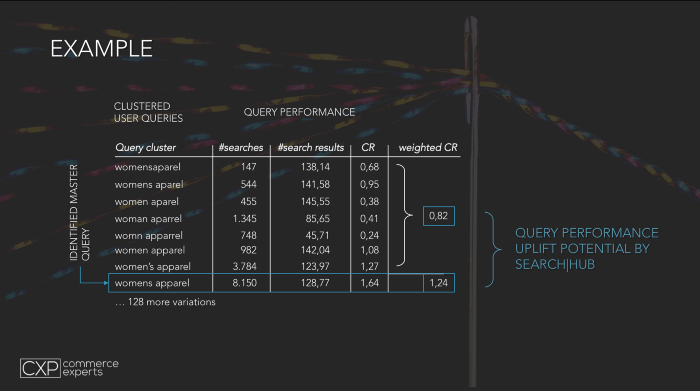
    What we see here is a great collaboration of humans and machines. People have used their onsite search tools to optimize queries, add synonyms & pre-processors and search-campaigns to the system, which were also optimized by searchHub. Moreover, searchHub automatically cleans, clusters search queries, and optimizes the search results for all queries by applying automatic query rewrites.

    IMPROVE YOUR SEARCH TODAY — Try searchHub now

    searchHub dramatically improves user engagement and revenue for e-commerce sites. It adds an intelligent layer to your search infrastructure and accounts for business rules, synonyms and extends them to optimize search results across all queries. The results of A/B testing shows good search is important and increases user engagement and revenue for online retailers.

    Get in touch to learn how we can help your online business with better search.

    www.searchhub.io proudly built by www.commerce-experts.com

  • searchHub.io Wins Award for Most Promising Start-Up 2017

    searchHub.io Wins Award for Most Promising Start-Up 2017

    searchHub is the Most promising start-up of 2017

    searchHub by CXP Commerce Experts GmbH for their work on developing and commercializing a system that infuses human understanding into existing search applications by automatically correcting human input and building context around each query.

    On November 29th 2017 — London — we have been awarded for our work on making search smarter. We are thrilled — that’s definitely a really cool prize and even more special — from people who clearly understand the challenges in this field.

    Thanks to the Information Retrieval Specialist Group of the BCS and the judges Charlie Hull, Rene Kriegler and Ilona Roth.

    we had a number of very strong submissions for this category, so I hope you share my view that this makes your award all the more special

    Tony Russell-Rose on behalf of the BCS IRSG committee

    About the IRSG

    Information Retrieval (IR) is concerned with enabling people to locate useful information in large, relatively unstructured, computer-accessible archives. In this respect, anyone who has ever used a web search engine will have had some practical experience of IR, as the web represents perhaps the largest and most diverse of all computer-accessible archives.

    Much of the technical challenge in IR is in finding ways to represent the information needs of users and to match these with the contents of an archive. In many cases, those information needs will be best met by locating suitable text documents, but in other cases it may require retrieval of other media, such as video, audio, and images.

    In addition, IR is also concerned with many of the wider goals of information/ knowledge management, in the sense that finding suitable content may only be part of the solution — we may also need to consider issues associated with visualization of the contents of an archive, navigation to related content, summarization of content, extraction of tacit knowledge from the archive, etc.

    The IRSG is a Specialist Group of the BCS. Its aims include supporting communication between researchers and practitioners, promoting the use of IR methods in industry and raising public awareness. There is a newsletter called, The Informer, an annual European Conference, ECIR, and continual organization and sponsorship of conferences, workshops and seminars.

  • Why AI Driven Site-Search is the Key to Success for Ecommerce Marketplaces

    Why AI Driven Site-Search is the Key to Success for Ecommerce Marketplaces

    We all know about artificial intelligence (AI). But what many of us don’t know is that AI is now an essential component of e-Commerce, and specifically, site-search. AI impacts the site search performance of your marketplace, and is a key success factor in holding a conversation with your customer — and in converting that conversation to revenue.

    How to Tune Your Ecommerce Site-Search – Not Replace it

    searchHub.io uses AI to integrate customers into your site’s search, with their unique ways of searching, their needs, and their preferences. Our AI technology predicts and understands what customers want, seamlessly and fast. We do this through intelligent query clustering, and through understanding the complex and unique characteristics of your customers queries to make search more intelligent, and tailored to each individual who visits your marketplace.

    Most standard site-search solutions are not optimized for the critical requirements marketplaces must deal with, such as large product catalogs, high site performance and scalability, and fast-changing product availability.

    Managing your audiences’ broad search choices

    A broader range of products means that visitors have more choice, which attracts more customers, and leads to increased revenue and profitability. This rule applies both to horizontal marketplaces where customers can find a wide range of products (e.g., otto.de), and vertical marketplaces where customers can find more specialized products (e.g., zalando.de).

    That’s why many marketplaces develop their own site-search solution based on Solr or Elastic, the most common open-source technologies. But these technologies don’t provide search results that are relevant to all users out-of-the-box. With a wider range of products, your long tail in search increases, and your site-search has to manage a much wider range of problems (long tail is the broad variety of search and keywords customers use when searching for the same thing). This can dramatically affect your search result quality.

    Your site search is your business card

    Your catalog is the way you introduce your marketplace to your visitors. Search is a key touchpoint in the buying process. It’s the place where the users are telling you what they want. If your search engine speaks the same language as your users, search becomes a conversation, and a conversation is the first step to a relationship.

    Therefore, search is the most vital function on your marketplace. Many businesses make high investments in product descriptions and other site content, but then lose their customers due to a poor search experience.

    Like any other e-Commerce site, marketplaces need to make sure that the process of product discovery is frictionless: visitors need to find and compare products easily, without wasting their time browsing an infinite catalog.

    Most marketplaces offer only limited capabilities of clustering search behavior. This means if a customer types in a more complex search term, there is a good chance of zero results and your customer will leave your marketplace. With searchHub’s AI technology, we automatically cluster millions of user and search queries by meaning and proximity. Deep learning testing and optimization continuously tests search queries for their economic outcome and optimizes the query rewrites accordingly in near-time.

    We are hiring

    If you’re excited about advancing our search|hub API and strive to enable companies to create meaningful search experiences, join us! We are actively hiring for Data Scientists to work on next-generation API & SEARCH technology.

    www.searchhub.io proudly built by www.commerce-experts.com

  • The Future of Ecommerce Site Search

    The Future of Ecommerce Site Search

    Which On-Site Search Changes to Watch Most Closely

    E-commerce site search has been evolving dramatically recently, moving away from a legacy keyword-driven approach, that often yielded inaccurate and confusing results, towards a leaner, more intuitive approach that puts user experience at its heart.

    The adoption of several worthy to mention technologies played a fundamental role in this evolution.

    NLP and Self-Learning Technologies

    Natural language processing (NLP) has already started to make a big impact in search, and its take-up is likely to accelerate in the coming years. NLP takes search away from the simplistic “is this keyword present in the title or description” approach, and starts asking “what is the customer really asking for?”. By taking a semantic angle to evaluating search results, the results produced are far more accurate and relevant to the customer’s actual search intent. Factor in the self-learning capabilities of many NLP-based engines, and suddenly site search starts to look very different.

    In the past, keyword-based search algorithms have often led to something of a ‘chicken and egg’ situation, with website visitors trying to ‘guess’ what terms they need to enter in the search box, in order to get the results they want from their search.

    Clearly, this is not an ideal approach, and, historically, it has led to high levels of frustration for information seekers.

    Natural language processing (NLP) is a component of artificial intelligence (AI) that enables computer programs and functions to understand human speech as it is spoken. In commerce-oriented websites and apps, NLP supports meaning-based search, allowing shoppers to search for items in their own language while still producing relevant results, even if the search terms do not directly match keywords in product records.

    All of this is possible because of NLP-based search, switches the focus from keywords to the actual meaning. Taking a semantic approach means that search results have a ‘connection’ to the search terms, rather than having to actually contain those search terms.

    Therefore NLP search can deliver accurate results and a successful user experience, where traditional text-based searches would typically fail.

    NLP and Linguistic Nuances, Synonyms, Misspellings

    NLP in site search must be able to recognize similar (though not identical) search terms, based on individual searchers unique lexicon preferences and context. NLP must be able to identify these items as being one and the same thing, producing the same relevant results regardless of the exact terminology being used.

    Most sites can’t afford to lose conversions to human errors. NLP can help ensure that a misspelled search for “red jacket” will deliver the same relevant results as a correctly typed search.

    NLP search can also outperform traditional search by learning about common miss-spellings, mixed-up brand names and other potential issues that could be entered into the search box. With self-learning abilities, NLP search never stands still, and continually becomes more accurate and better able to ‘understand’ customer intent.

    Conclusion

    Applying NLP to search can be incredibly powerful because it switches the focus from keywords to actual meaning, allowing humans to be humans while a machine does the work of accurate, intent-based interpretation. When applied to text-based site search, the NLP capabilities described above can play a key role in creating the kind of frictionless, seamless interactions that drive conversions, in a way that antiquated text-based searches simply can’t hope to.

    We are hiring

    If you’re excited about advancing our search|hub API and strive to enable companies to create meaningful search experiences, join us! We are actively hiring for Data Scientists to work on next-generation API & SEARCH technology.

    www.searchhub.io proudly built by www.commerce-experts.com