Author: Jonathan Ross

  • E-commerce Search Optimization: Retrospect, Outlook, and Our Community Commitment

    E-commerce Search Optimization: Retrospect, Outlook, and Our Community Commitment

    A challenging and highly successful year is drawing to a close. We want to take a moment to pause and thank you for the trust you have placed in us and for everything we have achieved together over the past year. Looking back, 2025 was a year of milestones. Our expertise in E-commerce Search Optimization has grown stronger than ever. Our commitment extends beyond software. Here, we offer you an insight into our greatest successes, our ambitious Vision 2026, and how we live up to our responsibility in the local community.

    searchHub staff Gabriel Bauer
    Gabriel Bauer

    2025 Review: Shared Milestones in E-commerce Search Optimization

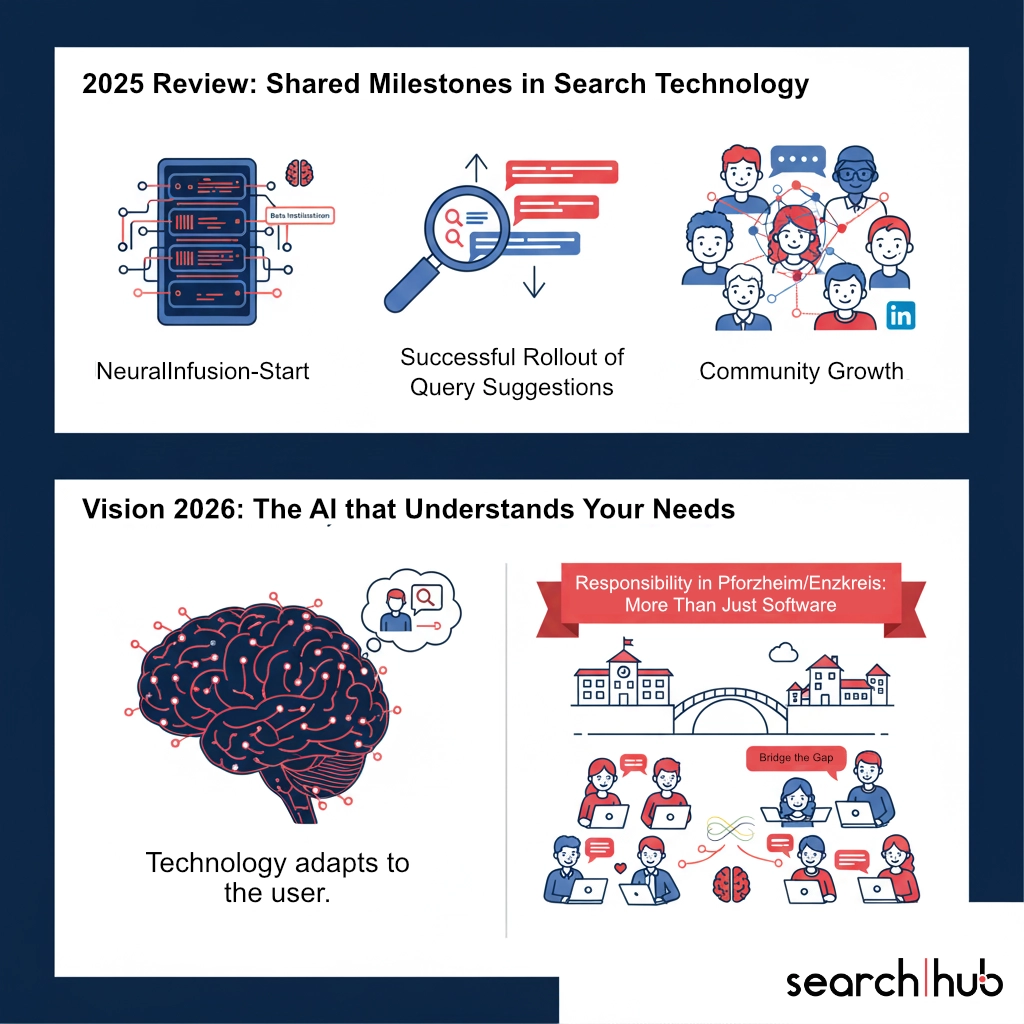
    Your partnership drives our innovations, and your success is our greatest motivation. Thanks to you, we took important steps toward a more human-centric search experience and significantly advanced the field of E-commerce Search Optimization in 2025:

    • NeuralInfusion Launch: We are excited about the first Beta installations of our groundbreaking NeuralInfusion technology [Link zur NeuralInfusion™ Produktseite]. This lays the foundation for a new age of semantic search intelligence and increased conversion rates, redefining modern E-commerce Search Optimization.

    • Successful Rollout of Query Suggestions: We saw great success with the rollout of our Query Suggestions feature [Link zur Query-Suggestions/SmartSuggest Produktseite]. This feature delivers more precise suggestions, helping you minimize search abandonment (zero-result pages) and boost revenue.

    • Community Growth: It was a pleasure connecting with many of you in our newly founded searchHub Community Group on LinkedIn. We appreciate your valuable feedback, which directly informs our product roadmap.

    searchHub 2025 Montage and Review and Vision for 2026

    Vision 2026: The Technology that Understands Your Customers’ Needs

    Technology should adapt to the human user—not the other way around. This is the foundation of our work and our central objective for the coming year.

    For 2026, we are pursuing a clear goal: we want to further improve the connection between user intent and the digital result. Our vision is to evolve our AI to capture the actual needs of people behind search queries even more precisely. We are committed to making sure search doesn’t just find, but truly understands, setting a new standard for E-commerce Search Optimization.

    Responsibility in Pforzheim/Enzkreis: More Than Just Software

    This holiday season, it is especially important to us to extend the influence of our software company beyond the digital world and strengthen healthy social coexistence right here in our region.

    Instead of traditional gifts, this year we are supporting the counseling and prevention work of the non-profit organization amwerden e.V.

    We are proud to actively support them in developing a prevention program for primary and secondary schools in the Pforzheim and Enzkreis region. Our common goal is to close the gap between simple media education and individual psychosocial services.

    Our Media Competency Curriculum:

    Together, we are developing a media competency curriculum that:

    • Students: Teaches a healthy relationship with digital media.
    • Teachers and Parents: Offers concrete assistance and guidance—both for school and private life.
    • Connects Generations: The overarching goal is to foster cooperation between generations and sustainably strengthen the mental and cognitive development of children and adolescents.

    Together and Leading the Way in the New Year

    We look forward to continuing our partnership with you. In the new year, we remain committed to offering you a leading E-commerce Search Optimization solution while continuing to exert a positive influence on the lives of those around us.

    We wish you and your family that we all find time in 2026 to be positive role models in our own spheres of influence—whether at work, in our communities, or at home.

    Warm regards and Happy Holidays,

    Your searchHub Team

    searchHub CEO - Siegfried Schüle
    Siegfried Schüle
  • The Informative Guide to Eliminating “No Results Found” Pages in Niche Ecommerce

    The Informative Guide to Eliminating “No Results Found” Pages in Niche Ecommerce

    For B2B E-commerce Website Managers, Owners, and Operators

    The “No Results Found” page: a seemingly innocent screen, yet in the complex world of B2B e-commerce, it’s a silent assassin of conversions, trust, and ultimately, revenue. For businesses operating in niche markets with highly specialized and technical product catalogs, the stakes are even higher. Every frustrated click represents a lost opportunity to connect a buyer with the exact product they need, often after a significant investment in acquiring that traffic.

    This guide is for B2B e-commerce leaders wrestling with ineffective site search. We’ll dissect why “no results” is a conversion killer, pinpoint its hidden causes, and unveil practical ecommerce search best practices. Most importantly, we’ll show how an AI-driven site search strategy can transform your search bar from a frustrating dead end into an intelligent, proactive guide for your customers.

    1. Why ‘No Results’ Is a Conversion Killer

    Imagine a qualified buyer—an engineer or procurement manager—landing on your site with a specific part in mind. They head straight to your search bar, type in their precise query, and are met with… a blank page.

    This isn’t a minor inconvenience; it’s a critical breakdown in the customer journey with cascading negative effects:

    • Immediate Revenue Loss: The most obvious impact. A buyer who can’t find what they need, even if it’s in your inventory, will go elsewhere.
    • Erosion of Trust and Credibility: A poorly functioning search suggests a poorly managed website. For B2B buyers who rely on precision, this undermines confidence in your entire operation.
    • Increased Bounce Rates: Dead ends frustrate users, causing them to abandon your site. This harms your SEO performance by signaling a poor user experience to search engines.
    • Wasted Marketing Spend: You’ve invested heavily to drive qualified leads to your website. If your site search then fails to convert them, that acquisition budget is wasted.
    • Missed Upsell Opportunities: A smart search can recommend related products or alternatives. “No results” pages cut off these revenue-generating opportunities entirely.
    • Damaged Brand Reputation: In a competitive B2B landscape, a reputation for a clunky website can be as damaging as a poor product.

    The underlying issue is that a “no results” query is not the absence of intent; it’s a clear signal of demand. Your customer is telling you exactly what they want. Failing to respond is a monumental missed opportunity.

    Root structure of a plant, illustrating the myriad ways in which "no results" pages ensue.

    2. Identifying the Root Causes of “No Results Found”

    Understanding why your site search falters is the first step toward a solution. In niche B2B e-commerce, the reasons are often complex:

    • Typographical Errors and Misspellings: Even for technical terms, typos are common. A conventional search engine that lacks sophisticated query understanding will fail on simple errors like “hydrolic pumpe” instead of “hydraulic pump.”
    • Synonyms, Jargon, and Industry-Specific Terminology: B2B industries have their own lexicon. Your search needs to understand that “PCB,” “Printed Circuit Board,” and “logic board” all refer to the same thing. This is a challenge of semantic search.
    • Lack of Product Metadata: Insufficiently detailed product descriptions or missing technical specifications severely limit the search engine’s ability to match queries to products.
    • Product Availability: A search for an out-of-stock item shouldn’t lead to a dead end. It’s a chance to offer alternatives or back-in-stock notifications.
    • Variations in Product Naming: Subtle differences in model numbers (e.g., “XYZ-123-A” vs. “XYZ123A”) can easily confuse basic search engines.
    • Long-Tail and Highly Specific Queries: B2B buyers often search with very specific, multi-word phrases. Standard keyword matching struggles with the nuance of these high-intent queries.
    • Poor Indexing or Catalog Management: If your product catalog isn’t properly indexed, relevant items simply won’t appear in search results.
    • Legacy Search Engine Limitations: Many out-of-the-box site search solutions rely on basic keyword matching. They lack the advanced AI capabilities to understand user intent, context, and semantic relationships.

    Lack of Continuous Optimization: Site search isn’t “set it and forget it.” Without ongoing analysis and refinement, your search performance will degrade over time.

    3. Strategies for a ‘No-Dead-End’ Search Experience

    Let’s explore actionable strategies to transform “no results found” into “we found something valuable for you.” These foundational ecommerce search best practices are crucial for success.

    3.1. Robust Data Foundation

    Before any AI can work its magic, your product data must be impeccable.

    • Enrich Product Metadata: Go beyond basic descriptions. Include all relevant technical specifications, attributes, and the like.
    • Standardize Naming Conventions: Implement consistent naming structures for products and categories to reduce ambiguity.
    • Replace “miscellaneous” Category with proper sub-categories.

    Regular Data Audits: Periodically review your product data for accuracy, completeness, and consistency.

    3.2. Analyze and Optimize with Search Performance Data

    With a solid data foundation in place, the next pillar of a ‘no-dead-end’ strategy is continuous analysis and optimization. How do you measure what’s working, find what isn’t, and act on that information? This is where you must leverage your search performance data.

    The searchHub searchInsights dashboard is your command center for this task. It’s a dedicated analytics suite within the searchHub UI that gives you a transparent view into your search performance.

    Inside searchInsights, you can:

    • Act on Zero-Result Searches: Get automatically notified about keywords that returned zero results. More importantly, searchInsights provides actionable suggestions on how to fix them, allowing you to quickly turn frustrating dead ends into successful conversions.
    • Track Meaningful KPIs: Move beyond simple query counts and monitor crucial e-commerce metrics like whether users are engaging with results, or identifying searches actually leading to purchases.
    • Validate Your Optimizations: To prove what works, you can leverage powerful query A/B testing. These tests run fully automated in the background, allowing you to compare the performance of different strategies for the same query, ensuring your optimizations are always backed by hard data.

    By providing this deep, actionable understanding of your search performance, searchInsights equips you to make smarter strategic decisions.

    3.3. Proactive Site-Search-Experience Design

    • Intelligent Auto-Suggestions: As users type, provide real-time suggestions for high-converting products, to prevent typos and guide users toward relevant terms.
    • Query Relaxation and Partial Matching: If a specific query yields no results, the search should automatically “relax” the query to show broader, yet still relevant, results.
    • Alternative Recommendations: If the exact item isn’t found, leverage product data to recommend similar products or suitable alternatives.

    Strategic “No Results” Page Design: This page is an opportunity. Clearly state that no exact matches were found, but offer solutions like links to popular categories, best-selling products, and prominent customer support contact information. Find a good (and legal!) strategy to deal with searches for competitor products or brands you do not list.

    4. Using AI to Proactively Guide Users: The searchHub Advantage

    This is where the game truly changes. Traditional approaches to reducing “no results” are reactive and manual, requiring constant human intervention. In the complex B2B landscape, this is unsustainable.

    searchHub is not a new search engine. This is a crucial distinction. We understand you’ve invested heavily in your current infrastructure, like Elasticsearch or Solr. Instead, searchHub enhances your existing site search by adding a powerful layer of keyword intent mapping to improve site search performance.

    Here’s how we leverage AI to eliminate “no results found” pages:

    4.1. Translating Customer Intent with smartQuery

    A woman performing a professional translation for her conversation partner.

    The core of searchHub’s innovation is its ability to understand customer intent, not just match keywords. Using smartQuery, our AI analyzes user behavior, click-through rates, and conversion data. This contextual understanding allows searchHub to infer what the user really wants, even if their query is imprecise. Our algorithms continuously learn from your specific product data and user behavior, ensuring the system is always adapting to your audience.

    4.2. smartQuery: Automating Keyword Clustering for Ecommerce

    This is a powerful differentiator. smartQuery doesn’t just swap keywords around; it performs automated keyword clustering for ecommerce. Imagine a thousand ways a customer might search for a “heavy-duty industrial valve.” They might use “high-pressure valve,” “large flow control,” or even incorrect part numbers. Our AI identifies that these diverse queries represent the same underlying intent and groups them into a single, cohesive “query cluster,” automatically capturing the vast long tail of B2B search.

    4.3. Defining a Best Performing Query (MasterQuery)

    Within each cluster, smartQuery intelligently defines a “best performing query”—what we call a MasterQuery. This isn’t arbitrary. The AI evaluates KPIs for every query within the cluster:

    • Did it produce results?
    • Was there interaction with the results (clicks) or only doom-scrolling? – we call this “findability”. 
    • Was something added to the cart?
    • Did a purchase occur? – we call this “sellability”.

    By analyzing these metrics, the AI identifies the single query that most consistently leads to conversions. This MasterQuery becomes the funnel point for all related traffic.

    4.4. Funneling Traffic with AI-Powered Search Redirects

    Once the MasterQuery is identified, our unique mechanism comes into play. When a user types a query from a cluster (like a typo or synonym), smartQuery intercepts it. Instead of sending the original, problematic query to your site search, it sends the designated, high-performing MasterQuery.

    • No Replacement, Just Enhancement: Your existing search engine receives a “clean,” high-performing query, dramatically reducing “no results” pages and improving relevance.
    • Simplified Optimization: You no longer need to manually create and maintain endless lists of synonyms or redirects. searchHub automates this complex optimization process, freeing up valuable resources.
    • Enhanced Landing Page Potential: By channeling traffic through MasterQueries, you gain clear insights for targeted merchandising and landing page optimization without having to account for every keyword variation.

    The result is a site search that is significantly more robust in handling variations, typos, and nuanced B2B terminology, leading to fewer zero-result hits and higher conversion rates.

    In the competitive landscape of B2B e-commerce, the “No Results Found” page is a glaring symptom of a missed opportunity. By welcoming an AI-driven site search optimization strategy with searchHub, you transform these dead ends into dynamic pathways to conversion, building trust and driving significant revenue growth.

    Sound too good to be true? Call me! 😉

  • A Practical Guide to Implementing Semantic Search for Your Mid-Sized Ecommerce Store

    A Practical Guide to Implementing Semantic Search for Your Mid-Sized Ecommerce Store

    In the competitive landscape of B2B e-commerce, the on-site search bar is more than a utility; it’s your most valuable salesperson. It’s the digital equivalent of a customer asking, “Where can I find…?” If your site search can’t understand the nuance and user intent behind that question, you’re not just losing a sale—you’re losing a customer.

    This is where semantic search comes in. It’s not about overhauling your entire system. It’s about making your existing search bar smarter through AI-driven site search optimization. This guide, inspired by the searchHub methodology, will walk you through a practical approach to implementing semantic search, designed for mid-sized e-commerce businesses looking for a competitive edge without a complete technological rebuild.

    A visualization of semantic search bringing context together.

    What is Semantic Search and Why It Matters

    At its core, semantic search is the ability of a search engine to understand the intent and contextual meaning behind a user’s query, rather than simply matching keywords. Traditional, or lexical, search looks for literal matches. If a user searches for “protective work gloves for cold weather,” a lexical search might struggle if your product is listed as “insulated safety mittens.” It sees different words and often returns zero results—a frustrating dead end for a motivated buyer.

    Semantic search, however, goes deeper. It understands that “gloves” and “mittens” can be synonyms, that “cold weather” implies “insulated,” and that “protective work” relates to “safety.” It deciphers the user’s goal and provides the most relevant results.

    Why is this a game-changer for your B2B store?

    • Drastically Improved User Experience: B2B buyers use specific, technical, or long-tail queries. They expect your site to understand their jargon. When your search can handle synonyms and conceptual queries, you eliminate friction and build confidence.
    • Higher Conversion Rates: A better search experience directly translates to more sales. When customers find what they’re looking for on the first try, they are significantly more likely to convert. Semantic optimization connects buyer intent with the right product.
    • Actionable Customer Insights: The queries your customers use are a goldmine of data. Analyzing them through a semantic lens reveals not just what they are looking for, but how they think about your products.

    Crucially, with a tool like searchHub, this doesn’t mean you need to replace your existing site search engine. The goal isn’t to be a search engine; it’s to optimize the one you already have. By improving query understanding, you can guide your current system to perform at its absolute best.

    An image illustrating common problems for mid-size ecommerce businesses.

    Common Challenges for Mid-Sized Retailers

    While the benefits are clear, mid-sized e-commerce businesses face unique obstacles.

    • The Synonym and Jargon Problem: A “hex key” is also an “Allen wrench.” Manually maintaining synonym lists for thousands of SKUs is a Herculean task that isn’t scalable. This is where the automation provided by a platform like searchHub becomes essential.
    • The “Long-Tail” Keyword Conundrum: Traditional search engines often fail with multi-word phrases like “12-volt DC submersible water pump with 2-meter head,” breaking them down and returning irrelevant results. This is a classic failure of query understanding that searchHub is designed to solve.
    • The Dreaded “Zero Results” Page: This is the ultimate conversion killer. Every “zero results” page represents a missed opportunity. The goal is to reduce null search results by intelligently understanding the user’s true intent, ensuring you connect them with products you already have.

    Limited Technical Resources: You probably don’t have a team of AI engineers on standby. You need a solution like searchHub that is powerful yet practical, one that leverages advanced technology without requiring you to build it yourself.

    An image of an old book on a desk with the title "Quick and Dirty Implementation Guide" referring to a simple way of integrating semantic search. As if there was such a thing.

    Step-by-Step Implementation Guide

    Here’s a practical, four-step guide to ecommerce site search optimization. This is the core process that searchHub automates to deliver results, enhancing your current search engine by intelligently managing queries.

    Step 1: Gather and Analyze Your Search Query Data

    Your first step is to become an expert on what your customers are asking for. Use searchHub searchCollector to gather the highest quality search data. Collect at least four to six weeks of search query data. This data is the foundation of optimization and is made accessible through the searchHub searchInsights dashboard. You’ll want to collect:

    • The search term itself
    • Frequency (number of searches)
    • Click-through rate (CTR)
    • Conversion rate
    • Number of “zero results” instances

    Step 2: Use AI to Cluster Queries by Intent

    Manually sorting thousands of queries is impossible. This is where searchHub’s smartQuery feature applies AI and machine learning for keyword clustering for ecommerce. The goal is to group semantically related queries based on user intent. For example, an AI model recognizes that “men’s size 11 waterproof hiking boots” and “waterproof trekking shoes for men 11” share the same intent and groups them into a single “intent cluster.”

    Step 3: Identify the “Best Performing” Query in Each Cluster

    Not all queries are created equal. Within each intent cluster, one query will inevitably perform better on your existing search engine. Using the data from Step 1, smartQuery analyzes the performance of each query within its cluster. For our hiking boot example, you might find:

    Query CTR Conversion Rate

    “men’s size 11 waterproof hiking boots”

    65%

    8%

    “waterproof trekking shoes for men 11”

    45%

    5%

    “gore-tex hiking boot male size 11”

    30%

    3%

    “best size 11 boots for mountain trails”

    25%

    2%

    Here, “men’s size 11 waterproof hiking boots” is the clear winner. This “Master Query” unlocks the best possible outcome from your existing search infrastructure.

    Step 4: Funnel All Related Traffic to the Best Result

    This final step is the most critical. Now that you’ve identified the top-performing query for each group, searchHub’s smartQuery automatically funnels all queries within that cluster to the search results page of the best-performing query.

    When a user searches for the low-performer (“gore-tex hiking boot male size 11”), they are automatically shown the results for the high-performer. The user gets the best possible experience, and you’ve created a semantic layer on top of your existing search engine. This method elegantly solves the core challenges:

    • Synonyms and long-tail queries are handled automatically.
    • “Zero results” pages are dramatically reduced.
    • It requires no change to your existing search engine. You are simply optimizing the traffic that flows into it, making it work smarter, not harder.

    Zero Results page showing on a computer screen - this is what happens without searchHub.

    Measuring Success

    To prove value, you need to track the right Key Performance Indicators (KPIs), which platforms like searchHub centralize in a searchInsights dashboard.

    • The Real Way to Calculate Conversion Rate from Search: The ultimate metric. Search Conversion Rate = (Number of unique items ordered from search / number of unique search trails) x 100%
    • Reduction in “Zero Results” Rate: Shows your intent clustering is effective. Zero Results Rate = (Number of Searches with Zero Results / Total Number of Searches) x 100%
    • Search-Led Revenue: Ties your optimization efforts directly to the bottom line.
    • Click-Through Rate (CTR) from Search Results: Shows your results are more relevant.

    To get a definitive measure, run an A/B test comparing the original experience to the new, intent-funneled experience. The data will provide clear, undeniable proof of the ROI.

    In conclusion, transforming your on-site search is one of the highest-impact investments you can make. By focusing on understanding and optimizing for user intent, you can create a superior user experience and unlock the revenue hidden in your search data. The path forward isn’t about a bigger budget or a risky “rip and replace” project; it’s about a smarter strategy, powered by searchHub.

  • The Behavioral Science Dilemma in Ecommerce

    The Behavioral Science Dilemma in Ecommerce

    Following a reading of the article “Wie KI Produktdaten zum Leben erweckt” (How AI brings product data to life) by Dominik Grollmann, from the German ecommerce magazine ONEtoONE (Q4 2024), a fundamental question arises: Why invest so much effort in machines trained on behavioral science to interpret human purchase behavior when all that’s needed is to correctly interpret keyword entries into the search box?

    Featured prominently in the ONEtoONE article, Paraboost and Contentserv position themselves as AI-driven powerhouses in the realm of product information management (PIM), aiming to transform static product catalogs into dynamic, experiential content. Their approach is, in part, based on Maslow’s hierarchy of needs—mapping products to human motivations in an attempt to optimize engagement and conversion. The theory is intriguing: by understanding whether a consumer is prioritizing safety, esteem, or self-actualization, online retailers can tailor product recommendations accordingly. But how well does this psychological framework translate into the fast-moving, intent-driven world of ecommerce? While understanding human motivations can be valuable, ecommerce search, more specifically, operates on a different principle: technocrats call it “onsite search,” which essentially amounts to customers explicitly expressing their needs, through keywords, to a chatbot of sorts: the search box. The real challenge isn’t decoding deep motivations—it’s ensuring search engines correctly understand and match those keyword signals to the right products.

    A 1950s comic book styled graphic of a behavioral scientist at work

    The Behavioral Science Dilemma in Ecommerce

    Modern AI-supported PIM solutions assume that consumers follow a structured path through Maslow’s pyramid when shopping. Take, for example, the airbag helmet purchased by a safety-conscious cyclist or the stylish sunglasses chosen by a fashion-forward biker. In theory, these choices reflect fundamental human needs. But ecommerce is rarely so neatly categorized. A customer might buy a princess-themed bicycle not because they prioritize self-expression over safety, but simply because their child insisted on it. Another shopper might frequent a specific online store based on habit, brand affinity, or even a one-time recommendation—factors that have little to do with psychological needs and more with convenience or loyalty.

    Moreover, data from mid-tier ecommerce stores is often too fragmented or inconsistent to support such sophisticated behavioral models. Customer behavior is complex, sometimes contradictory, and often driven by external variables—seasonality, trends, pricing fluctuations, and promotions—all of which introduce inconsistencies that challenge the accuracy of behavioral AI models. These external influences can create false correlations, leading AI to misinterpret why a product is being purchased or which factors are truly driving consumer decisions. And if an AI-driven PIM solution does trigger an immediate uptick in sales, is that truly the result of better product data, or simply the novelty effect of fresh content?

    These questions are left unanswered by the authors.

    The Real Missed Opportunity: Search

    The ONEtoONE article makes broad claims about enhanced product experience management, yet it lacks a crucial perspective: time. The success of AI-driven PIM solutions cannot be measured solely by short-term engagement spikes; their true value lies in sustained improvements in product discoverability, conversion rates, and customer retention. Without accounting for how these effects evolve over time, it’s difficult to separate genuine progress from a fleeting novelty effect. How does this supposed improvement sustain itself beyond initial implementation? Does customer behavior truly shift long-term, or do we simply see a temporary spike before shoppers revert to seeking the highest quality at the best price?
    Yet, despite these claims, an exact answer remains elusive. This raises an important question: how does an online retailer cater to customers who don’t fit neatly into behavioral models? Let’s shift the focus to a different scenario—one where the customer enters the online store as a blank slate. They don’t know the industry jargon. They’re not searching for trending terms. They don’t even know exactly what they need. Here, neither the AI-driven product enrichment of modern PIM-solutions nor their behavioral analysis can bridge the gap. The only interface capable of making sense of this unstructured intent is the search box.
    This is where searchHub changes the equation:

    1. Instead of overloading the product database with fleeting trends and subjective customer sentiment, searchHub refines and prioritizes keyword intent.
    2. It enhances search performance without invasive modifications to existing PIM infrastructure.
    3. Its low-maintenance approach ensures that ecommerce teams are not constantly chasing data updates.

    If AI is to be leveraged effectively in ecommerce, it must be in ways that yield sustained, scalable benefits. searchHub’s keyword clustering approach does precisely that. Consider an online store that receives 699 different variations of the keyword “yoga mat.” Search engines treat these as separate queries, often leading to scattered, inconsistent results. searchHub offers search engines assistance. It understands that these variations share a common intent. By analyzing purchase behavior, it identifies the single most effective term—the keyword ambassador—which is then sent on to the search engine for further processing. In the meantime, the other 698 variations undergo continuous reassessment.

    searchHub identifies the Keyword ambassador within a cluster.
    searchHub identifies the Keyword ambassador within a cluster.

    The Symbiosis of AI-PIM and AI-Search

    The true power of AI in ecommerce lies not in forcing product data into a psychological framework, but in seamlessly connecting customer intent with the right products. Intent-based AI prioritizes what customers explicitly express—through their search queries—rather than attempting to infer motivations from abstract psychological models. In the ‘yoga mat’ example above, the customer’s immediate need is clear, and a well-optimized search engine ensures they find the right product without requiring behavioral analysis to deduce their motivations. A modern PIM solution can certainly benefit from AI-driven enrichment, but it does best, when paired with an intelligent search solution.

    searchHub feeds real-time keyword-intent data into AI-powered PIMs like those mentioned in the ONEtoONE article. This integration ensures that product descriptions evolve dynamically, not based on rigid psychological theories but on actual customer behavior. The result? A more responsive, adaptive ecommerce ecosystem that continuously aligns product discovery with the way real people search and shop.

    So whether your goal is a streamlined, low-effort solution or a fully integrated AI-driven search and PIM ecosystem, the key to success in ecommerce is not about speculating on customer motivations—it’s about precisely understanding and responding to their purchase intent.

  • Merry Christmas and a Successful Start to the New Year! 🎄✨

    Merry Christmas and a Successful Start to the New Year! 🎄✨

    We look back with gratitude on an eventful and successful 2024. 

    Before we set our sights on an exciting 2025, 

    we’d love to share some of our highlights with you.

    Highlights 2024

    This year, we developed 21 new searchHub extensions, fulfilled 13 customer development requests, and welcomed 15 new clients. We’re proud of these achievements and grateful for the trust placed in us.

    image: Flaticon.com

    Industry Benchmark

    Compare your search KPIs with those of other companies—now available in the performance charts, segmented for B2B and B2C.

    image: Flaticon.com

    Query-Testing

    We automatically test different clusters continuously to optimize your search results. Say goodbye to rigid search patterns—always the best results for you.

    image: Flaticon.com

    AI-Redirects

    Based on your customers’ search behavior, searchHub automatically generates suggestions for redirects. This ensures your customers land on the strongest landing pages faster—and saves you valuable time.

    In addition to the ongoing development of searchHub, we’ve actively supported a project that is making a real difference.

    Boy drinking fresh water from a well.

    A Project Close to Our Hearts: Well Construction in Zambia

    A special project close to our hearts is our commitment to well building in Zambia. Scaling is in the DNA of searchHub. And that’s exactly what the construction of drinking water wells in 25 villages in the Mambwe district of eastern Zambia is all about. How is it “scalable”?

    • Children now have more time for school and education, as they no longer have to travel long distances to collect water.
    • Clean water leads to fewer illnesses caused by contaminated water. Dangers along the way to water sources, such as wildlife, are no longer a concern.
    • The local community is strengthened through the training of WASH committees and wildlife rangers.

    Women gathering water from dirty water hole
    Villagers gathering clean water from the new well.

    Looking Ahead to 2025

    Next year is going to be exciting! We’ll be developing new features, strengthening our platform, and looking forward to inspiring projects, events, and collaborations with our partners—all aimed at sustainable growth and your success.

    Feature Outlook: NeuralInfusion™

    Vector search is all the rage, but like traditional text search, it has its pitfalls. With searchHub, we’ll be introducing a “best of both worlds” hybrid search add-on that can enhance any search!
    Smart, AI-driven, and cost-efficient!

    Of course, we will…

    • Remain search provider-agnostic
    • Continue to prioritize automation in search
    • Expand and strengthen platform partnerships, ensuring we remain your trusted partner for all things search in 2025.

    Looking Ahead to 2025

    A heartfelt thank you to our valued customers, partners, and collaborators—your support makes all of this possible! We wish you and your families a Merry Christmas and a successful start to the New Year! 🎅🎁

    Stay healthy and successful—we look forward
    to shaping 2025 together with you!

    searchHub team photo fun

    Warm greetings,
    Your searchHub Team!

    Happy New Year!

  • Frohe Weihnachten und einen erfolgreichen Start ins Neue Jahr! 🎄✨

    Frohe Weihnachten und einen erfolgreichen Start ins Neue Jahr! 🎄✨

    Wir blicken mit Dankbarkeit auf 
    ein ereignisreiches und erfolgreiches Jahr 2024 zurück.
    Wir möchten einige unserer Highlights mit dir teilen,
    bevor wir uns auf ein vielversprechendes 2025 freuen.

    Highlights 2024

    In diesem Jahr haben wir 21 neue searchHub Erweiterungen entwickelt, 13 Kundenwünsche umgesetzt und damit 15 neue Kunden gewonnen. Wir sind stolz auf diese Erfolge und das uns entgegengebrachte Vertrauen.

    image: Flaticon.com

    Industry Benchmark

    Vergleiche Deine Such-KPIs mit denen von anderen Unternehmen – jetzt in den Performance-Charts, segmentiert für B2B und B2C.

    image: Flaticon.com

    Query-Testing

    Ganz automatisch testen wir permanent verschiedene Cluster, um Deine Suchergebnisse kontinuierlich zu optimieren. Nie wieder starre Suchmuster – immer die besten Ergebnisse für Dich.

    image: Flaticon.com

    AI-Redirects

    Basierend auf dem Suchverhalten Deiner KundInnen generiert searchHub automatisch Vorschläge für Weiterleitungen. So landen Deine KundInnen schneller auf den stärksten Landing-Pages – und Du sparst wertvolle Zeit.

    Neben der Weiterentwicklung von searchHub haben wir gezielt ein Projekt unterstützt, das echte Veränderung bewirkt.

    Boy drinking fresh water from a well.

    Ein Projekt von Herzen: Brunnenbau in Sambia

    Ein besonderes Herzensprojekt ist unser Engagement für den Brunnenbau in Sambia. Skalierung ist die DNA von searchHub. Und genau so ein skalierendes Projekt ist der Bau von Trinkwasserbrunnen in 25 Dörfern des Mambwe-Distrikts im Osten Sambias. Wie „skaliert“ das?

    • Kinder haben jetzt mehr Zeit für Schule und Bildung, da sie nicht mehr weite Wege zum Wasserholen zurücklegen müssen. 
    • Sauberes Wasser sorgt für weniger Krankheiten, die durch verunreinigtes Wasser verursacht werden. Gefahren auf dem Weg zu Wasserstellen, wie z.B. Wildtiere, sind vorbei. 
    • Die lokale Gemeinschaft wird gestärkt durch Ausbildung von WASH-Komitees und Wildhütern.

    Women gathering water from dirty water hole
    Villagers gathering clean water from the new well.

    Ausblick 2025

    Das nächste Jahr wird spannend! Wir entwickeln neue Features, stärken unsere Plattform und freuen uns auf inspirierende Projekte, Events und die Zusammenarbeit mit unseren Partnern – alles für nachhaltiges Wachstum und den Erfolg unserer Kunden.

    Feature-Ausblick: NeuralInfusion™

    Vektorsuche ist in aller Munde. Aber Vektorsuche hat, wie klassische Textsuche auch, ein paar Fallstricke. Mit searchHub werden wir ein „best of both worlds“ auf den Markt bringen, das als Hybrid-Search Add-on jede Suche erweitern kann!
    Intelligent, KI-basiert und kosteneffizient!

    Wir werden natürlich …

    • Suchanbieter-Agnostisch bleiben
    • Automatisierung rund um die Suche weiter in den Vordergrund stellen.
    • Plattform-Partnerschaften weiter ausbauen und stärken, um auch 2025 euer kompetenter Ansprechpartner zu allen Suchthemen zu sein.

    Danke und frohe Festtage!

    Ein herzliches Dankeschön an unsere geschätzten Kunden, Partner und Wegbegleiter – eure Unterstützung macht all das möglich! Wir wünschen euch und euren Familien ein frohes Weihnachtsfest und einen erfolgreichen Start ins neue Jahr! 🎅🎁

    Bleib gesund und erfolgreich – wir freuen uns darauf, gemeinsam mit Dir 2025 zu gestalten!

    searchHub team photo fun

    Herzliche Grüße
    Dein Team von searchHub

    Guten Rutsch!

  • Beyond Clicks and Scrolls: The Computational World of Online Retail Connections

    Beyond Clicks and Scrolls: The Computational World of Online Retail Connections

    Sophie has been an online retail merchandiser for two decades, navigating the complex digital landscape where every click generates data. Her computer screen is her canvas, and product connections are her analytical craft.

    When a customer lands on her e-commerce platform searching for a “summer weekend outfit,” Sophie observes the intricate patterns of interaction. A lightweight linen shirt isn’t just a digital SKU—it’s a data point in a complex computational network, waiting to be mathematically processed.

    Modern vector search operates as a precise computational mechanism. It creates dense mathematical representations of products that reveal probabilistic connections all throughout Sophie’s ecommerce shop.

    The Mathematics of Digital Interaction

    Imagine each product as a point in a massive, multi-dimensional computational space. A pair of sandals isn’t defined by a simple tag like “beach wear,” but by a complex vector—a mathematical coordinate that captures its measurable characteristics. Its color, material, comfort, style versatility—all encoded into a single, dense numerical representation that transcends traditional categorization.

    When a customer searches, the system calculates. It finds the nearest mathematical neighbors, revealing products with statistically similar characteristics beyond surface-level descriptions.

    Beyond Traditional Matching

    children sitting at a table matching images with one another in the style of a 1950s comic.

    Traditional online search is rigid. Search for “blue shirt,” and you’ll get exactly that. Vector search is different. It infers potential product relationships by mapping complex multi-dimensional spaces of customer interactions and product attributes.

    So let’s be clear: vector search doesn’t understand what customers want—it infers based upon mathematical proximity. Then it memorizes how users interact with those inferences and changes where necessary. This mathematical feat allows it to calculate the proximity between products with extraordinary precision, transforming complex digital product landscapes into navigable mathematical terrain.

    Business Dynamics in the Digital Realm

    Despite its computational precision, vector search faces significant challenges in real-world business applications. Most vector search systems struggle to incorporate critical business rules, leaving a substantial gap between mathematical potential and practical implementation.

    Traditional vector search operates as a closed system, generating results based on mathematical proximity. But ecommerce businesses need more. They require the ability to inject specific products, prioritize strategic inventory, and apply complex ranking rules that go beyond pure adherence to a formulaic model.

    This limitation creates a critical bottleneck in e-commerce performance. Mathematically perfect product recommendations mean little if they don’t align with immediate business objectives.

    The Power of Computational Inference

    Person at a desk using a computer to perform computational matching

    With NeuralInfusion, searchHub represents a breakthrough in addressing these fundamental vector search limitations. It doesn’t just generate vector-based recommendations—it provides a sophisticated layer of business logic that can dynamically rerank and modify search results.

    Imagine a vector search system that can:

    • Inject specific products based on strategic business goals
    • Apply complex ranking rules that override pure vector similarity
    • Dynamically adjust search results based on inventory, margins, and business priorities

    NeuralInfusion transforms vector search from a purely mathematical exercise into a powerful, business-driven tool. It bridges the gap between computational inference and strategic business requirements, creating a new paradigm of intelligent product discovery.

    Data-Driven Discoveries

    Sophie knows something fundamental: great digital retail is about revealing probabilistic product connections through precise statistical analysis. 

    Vector search accomplishes this through mathematical inference. It transforms complex product data into a language of numerical proximity, where computational nearness suggests potential customer interactions. Paired with searchHub, Sophie’s customers receive curated results that perform in-line with her business goals.

    In a world of infinite online choices, we need intelligent computational product discovery that respects the complexity of digital marketplaces.

  • AI-Redirects – Capitalizing on Retail Media Opportunities

    AI-Redirects – Capitalizing on Retail Media Opportunities

    AI-Redirects have come a long way, helping eCommerce sites simplify keyword management, make customer paths more intuitive, and even increase conversions. 

    A person trekking through the underbrush.

    Without query-level-tracking, there’s no way for you to attribute your search revenue to specific keywords. You’re flying blind whenever it comes to measuring your landing-page value against natural search results. If, however, you’ve taken the time to ensure a smart deep-level query tracking is implemented, you can clearly:

    1. Analyze customer intent. This is different than search conversions, which are misleading at best.
    2. Consolidate intent traffic into clusters.

    At this point, you will have built a perfect foundation so that your insights can begin offering more than the sum of its parts — like creating fresh revenue streams through Retail Media Ads.

    This post explores how understanding keyword performance, an asset from AI-Redirects, can fuel targeted advertising opportunities, bringing measurable value to your brand and new income potential from your eCommerce traffic.

    In previous discussions (like Beyond Redirects), we explored how AI streamlines keyword mapping and search experience. Now, let’s dive into how these insights create advantages for Retail Media Ads.

    1. Granular Keyword Insights = Targeted Ad Opportunities

    AI-Redirects, helps you understand whether a landing page, or natural search result page leads more customers to specific, sellable products. This insight allows you to create hyper-targeted ad spaces for brands—spaces backed by data showing high-performing keywords, such as “lightweight running shoes” or “safety shoes.”

    Brands value precision and relevance, and with this performance data, you can offer 🤵 premium ad space that aligns their ads with the right customers. It’s the kind of advertising environment brands pay a premium for.

    2. Increase ROI with Precise Ad Placements

    Person looking up at a waterfall in the wilderness.

    Working like this, you have access to popular high-revenue search terms. That’s a pretty big differentiator, considering most retailers rely on broad, less tailored ad placements. By targeting ads that resonate directly with popular search terms, you’re not playing pin-the-tail-on-the-donkey blindfolded, but able to leverage your path to ROI by placing highly relevant ads for a complete cluster of search terms that are already driving valuable traffic. 

    For instance, you might discover over 300 different keyword variations for the keyword “leggings” in your AI-Redirects report. All you have to do is enter a redirect for that one “leggings” cluster, and shwup-di-woop, all 300 keyword variations benefit from a well-crafted landing-page, while simultaneously becoming prime real estate for brands competing for prominence. That’s your cue to collaborate with specific brands and display relevant ads. This relevance increases conversion rates, benefiting your ad partners and your bottom line.

    3. Offer Brands Unmatched Value

    Real-time keyword performance data makes your eCommerce site a valuable advertising partner. Brands know you can show clear, data-backed pathways for which keywords drive product sales and how these insights translate into highly targeted retail ad campaigns. This level of data granularity is rare, positioning you as a unique ad partner and setting your business apart from competitors who lack keyword-level insight.

    Putting It All Together: Transforming AI-Redirects into New Revenue

    Traveler looking out over vast wilderness, with waterfall beneath.

    AI-Redirects do more than enhance customer journeys. They unlock opportunities for monetizing keyword clusters, allow you to provide targeted ad opportunities for your brand partners, and help turn performance data into high-ROI retail media campaigns. Here’s how to leverage these insights:

    • Monetize top-performing keyword clusters through strategic ad placements
    • Build ad space that appeals to brands based on proven search demand
    • Create retail ad campaigns that align with specific customer needs

    Wrapping Up Our Series on AI-Redirects

    Throughout this series, we’ve covered how AI-Redirects streamline keyword management, improve customer journeys, and unlock ad potential. This final post emphasizes that AI-Redirects not only improves the technical side of search—it’s a revenue generator waiting to be tapped.

    Whether you’re interested in optimizing site search or looking for new ad revenue, AI-Redirects offers tools to visualize keyword performance, maximize ad placements, and enhance your revenue streams. Thanks for joining us on this journey!

  • Beyond Redirects: Leveraging AI to Streamline Site Search and Boost Customer Experience

    Beyond Redirects: Leveraging AI to Streamline Site Search and Boost Customer Experience

    Redirects are a cornerstone of eCommerce search management, yet handling them well often feels like a puzzle with too many pieces. Ideally, you have to answer questions like: Are your redirects performing better than organic search results? Are customers finding what they need, or are they getting lost due to overlooked keywords or confusing paths?

    In this post, we’ll explore how searchHub’s AI-driven redirects offer a smarter way to manage keyword complexity and provide actionable insights into redirect effectiveness. These tools not only simplify redirect setup but also offer you data-driven clarity on what works and what doesn’t—a game-changer for customer satisfaction and conversion.

    The ongoing challenge of long-tail keywords

    Image of a monster with a disproportionately long tail.

    If you’ve tackled redirects before, you’ve probably wrestled with long-tail keywords. Each keyword variation represents a customer with specific intent, but mapping these terms effectively can be exhausting. Traditionally, this involves:

    • Manually building keyword maps
    • Tracking and updating redirects with every shift in inventory
    • Deploying static SEO terms or relying on manual keyword entries


    As we discussed in our earlier post on using AI for site search optimization, traditional keyword approaches often fail to capture the breadth of customer language. Instead, AI can group related keywords based on intent, clustering searches that lead to the same product, regardless of phrasing. The system flags unknowns for review, while most terms are automatically mapped to the right results—no manual intervention needed.

    Tracking redirect effectiveness: moving beyond basic metrics

    Redirects should do more than just bring users to a landing page; they should guide them to the right content based on intent. Unfortunately, common tracking methods, like monitoring general hit counts, don’t provide the specificity needed to assess which keywords are driving customers to convert.

    This is where keyword-level insights come in. By tying redirects to specific keywords, you can see what brings customers in and whether they convert. You’ll get insights like:

    • Which keyword variations lead to sales
    • Where specific redirects outperform organic search results
    • How redirect improvements can close gaps


    These insights go far beyond what traditional site search provides, giving you concrete data on what’s working and where there’s room to refine, ultimately helping you optimize the search experience.

    Real-World Impact: How AI Redirects prevent customer frustration and boost insights

    Image of Mr. Bean frustrated about something.

    Imagine you manage a German eCommerce store that sells workwear. Your landing pages are optimized for the term “Sicherheitsstiefel” (safety boots in German). But many customers, especially non-native speakers, search for “safety boots” instead. Without AI to recognize and redirect them to the correct page, these customers might encounter a frustrating “no results found” page or land somewhere irrelevant.

    AI-Redirects from searchHub eliminate this issue by grouping variations of “safety boots” and linking them to your optimized page. As we explored in the previous post, AI-driven clustering ensures that customer intent aligns with your content, reducing frustration and increasing conversions as customers find what they’re looking for right away.

    Gaining deeper insights with granular keyword analysis

    Beyond simply redirecting traffic, AI-Redirects also give you the ability to analyze keyword performance with a new level of granularity. This enables you to:

    • Pinpoint which keyword clusters bring high-traffic but low-conversion
    • Identify keyword gaps where searches don’t convert
    • Make informed adjustments to optimize pages


    These insights allow you to refine your search strategy based on real data, aligning better with actual customer behavior and minimizing missed opportunities. As a result, you’ll improve both user experience and revenue.

    Wrapping Up: Building on AI’s role in ecommerce site search

    gif of Sherlock Holmes saying: Do your research!

    Summing up, effective keyword redirect management is a cornerstone of improving customer experiences and boosting search relevancy. With searchHub’s AI-Redirects, you gain advanced tools for: 

    • managing keyword variations, also known as the long-tail
    • analyzing performance
    • and ensuring customers reach the right products with minimal friction

    As we’ve seen, aligning redirects with customer intent and measuring the performance of these AI-driven adjustments unlocks more profound insights and revenue opportunities.

    Beyond the obvious enhancement to search functionality, these granular keyword insights can open doors to new revenue streams. In our upcoming post, we’ll explore how to harness long-tail keyword data for Retail Media Ads—transforming keyword traffic into targeted, high-ROI ad opportunities that benefit both you and your brand partners.

    Stay tuned for the next steps in creating a smarter, data-driven search experience.

  • Beyond Keywords: Using AI to Transform Site Search and Customer Navigation

    Beyond Keywords: Using AI to Transform Site Search and Customer Navigation

    Navigating site search can be challenging. Many companies struggle with guiding customers efficiently from a search query to relevant products or information. This post explores common challenges in search redirects, explains why typical solutions often fall short, and introduces a dynamic, AI-driven approach to manage redirects effectively. By the end, you’ll have a clearer understanding of modern search optimization techniques and a hint of what’s next in the evolving field of search engineering.

    Photo by cottonbro studio from Pexels

    The Challenge of Onsite Search and Redirects

    How do you accurately redirect customers to the right product or result page without creating a tangled mess of rules?

    Site search engineers often face the complex task of directing customers from their initial search to relevant results in an efficient, user-friendly manner. Imagine a well-organized library where visitors quickly find what they need without knowing where every book is. Similarly, an optimized search system can guide users directly to the relevant “shelves” without manual interventions—minimizing both time and frustration.

    However, traditional built-in systems for managing search redirects are limited. They often leave customers with irrelevant results and businesses with missed opportunities to optimize sales. So, how can you know if a search result aligns with customer intent? Or if your manually-set redirects perform better than the default search results?

    This is where searchHub can help. Unlike search engines, searchHub enhances your existing search capabilities, aligning users more accurately with the products or pages they’re looking for. Let’s dive deeper into how different redirect methods compare and why some fail to deliver the results you might expect.

    Common Redirect Approaches: Their Limits and Drawbacks

    To address the challenges of search redirects, teams often rely on three common strategies:

    1. Pulling Data from CMS with Keyword Pairing

    Many start by pairing top product data from the CMS with obvious keywords. This may seem straightforward, but with fluctuating stock and product attributes, it quickly becomes unmanageable. Constant updates turn into a full-time task, often becoming obsolete before they’re completed.

    2. Relying on SEO Keyword Lists

    Leveraging SEO’s keyword lists might seem logical; however, static SEO keywords don’t adapt quickly to changes in product offerings. This leads to mismatches in search results, such as a search for “pink skateboarding shoes” showing no results, even though there are similar products in stock. SEO-driven lists rarely reflect the nuances of inventory and customer intent, creating a frustrating experience.

    3. Using Regular Expressions (RegEx)

    Some try to handle search term variations with regular expressions. While useful for some scenarios, RegEx often creates an overly complex and error-prone system when applied to unpredictable customer queries. For instance, broad expressions like “Under*” to capture brand-related queries may mislead users searching for unrelated terms.

    These approaches are often inefficient and lack the adaptability required for a dynamic eCommerce environment. Without data-driven insights, it’s nearly impossible to gauge whether redirects improve user experience and conversion rates.

    A Smarter Solution: AI-Driven Redirect Management

    To overcome these limitations, searchHub’s AI-Redirects takes a different approach. By automating keyword mapping based on user intent, AI-Redirects adapts dynamically to the variety in search terms without requiring extensive manual adjustments. For instance, whether a customer searches for “Nike running shoes” or “lightweight shoes from Nike,” AI-Redirects can guide them to the same optimized landing page, reducing error and maintaining consistency in customer experience.

    This shift to AI-based redirects provides several key benefits:

    • Efficiency: Streamlines redirect management by consolidating variations without endless manual input.
    • Consistency: Enhances customer experience by delivering relevant results, regardless of wording.
    • Insightful Tracking: Provides data on whether AI-driven redirects outperform default search results.

    Why This Matters

    Using AI-driven redirects not only saves time but also enhances the customer journey. A frictionless search experience leads to higher conversion rates, and fewer abandoned searches—contributing to improved customer satisfaction and business outcomes.

    Recap

    We discussed:

    • The challenges in creating effective site-search redirects.
    • The limitations of manual methods like CMS data pulling, SEO keywords, and RegEx.
    • The advantages of AI-Redirects in automating and enhancing the search experience.

    What’s Next?

    In this post, we explored the limitations of traditional redirect methods and introduced an AI-driven alternative for managing search. In a follow-up, we’ll delve into specific metrics to track the impact of redirect optimization, helping you evaluate the success of these AI-powered changes.


    Stay tuned for our next post, where we’ll dive into performance metrics to optimize and refine your search strategies even further.