Author: Jonathan Ross

  • Why librarians Are The E-commerce Site Search Pioneers

    Why librarians Are The E-commerce Site Search Pioneers

    Enhancing efficiency, accuracy, and customer satisfaction are foundational optimization factors both when managing vast product inventories offline or optimizing onsite-search with redirects. Just as a well-organized inventory ensures quick and precise product retrieval, search redirects streamline the user’s journey by guiding them directly to relevant content. This digital parallel highlights the importance of strategic organization and management in both physical and digital spaces to improve overall user experience and business outcomes.

    Are librarians the real pioneers of ecommerce site-search?

    Do you remember librarians?

    The word, librarian, always reminds me of that one Michael Jackson song, “Liberian Girl”. As a kid, I thought he was saying: “librarian girl” 🤦 😁. 

    I digress …

    At the library, Librarians had an almost mythical status. Acting as a shortcut right through the heart of the Dewey Decimal Classification. Of course, if you had the time, there were other options for finding a book. There was the card-catalog, and if you just wanted to meander, there were signs guiding you to different areas of interest. But areas of interest overlap. And the card-catalog required you to know at least a book title or author to get any further. A book about climbing, for example, could just as easily be in either the sports or health categories. Before too long, you could easily find yourself running all over the library on a wild-goose-chase looking for that perfect book. 

    For the most part, when I went to the library, however, I had a good idea of what I was looking for. I knew the subject, or maybe the author, so I would frequently head straight to the card-catalog. On more than one occasion, though, I would stand in line at the librarian’s desk to tap into the secret power that was The Library Gods. Of course, you’d have to have a bit of luck. There was never a guarantee that the librarian would be at her desk. And, what’s more, she’d have to be willing to help you, and not just direct you to the catalog-cards. So, you’d flash your charming eyes and ask if she could help you find your book. If all went well, she’d look at you over her glasses, stand up, and walk across this tremendous room with vaulted ceilings, to the exact location of your book, pull it out, hand it to you, and then begin providing suggestions for further reading on the topic but in a different part of the library. It was pure, sorcery.

    Good librarians are like sorcerers.

    Now, that we’ve evolved away from library use, I’m wondering … where’d the magic go? Remember the last time you navigated to your favorite ecommerce website, using the latest in cutting-edge site search technology, typed in your search term and, like witnessing the all powerful sorcery of a well-versed librarian, you immediately got the result you were looking for

    Nah … didn’t happen.

    Or at least not consistently.

    To top it off, there’s no way to quickly speak with a search engine. It’s like a librarian, who’s not interested in what you’re looking for at all. Imagine getting a response like: “this is your book, babe. Take it or leave it!”.

    But, like masochists, we take it on the daily, from site-search engines the world over. Sometimes, you don’t even find anything related that would help guide you in your search process. Instead, you get a list of results that make you question, whether you may have clicked into the wrong shop altogether.

    One might be tempted to begrudge ecommerce site-search vendors, or the ecommerce industry as a whole. Especially, when considering the history (from 7th century B.C.) of product catalogization. But alas, product data retrieval has not evolved linearly. Its haphazard, almost accidental improvement over the last 30+ years, has not infrequently been the bane of many an ecommerce manager’s existence.

    Only recently, with the advent of Large Language Models, increased computational power, and sinking hardware costs, has product search began to nudge its way back into the sphere of magical sorcery. Even so, for the vast majority of ecommerce shops, it remains a black art to this day. No matter their level of product search mastery.

    It behooves us, in light of the above, to briefly pause and pay homage to the dark art of librarian sorcery, and its nexus … the human brain. I mean, Christ, it’s been holding the keys to product discovery, like it ain’t no one’s business, going on 6,000+ years. 

    And for all ecommerce search’s shortcomings, we must consider the grandness of our task these last decades: to reproduce a neural cataloging structure that mimics the very powers of our favorite librarian. Breaking this code, and laying it free for all humanity to benefit from, is something comparable to supplanting said librarian, and expecting her to perform feats of magic irrespective of the library, the language, or the subject she’s confronted with.

    It will simply fail.

    So where do we begin?

    Mimicking human classification methods

    Building on the idea of the library, how do we go about searching specifically enough, to lead customers to their intended product as efficiently as possible, while simultaneously making them aware of related or similar products, with different names, in different categories, but directly related in scope or kind? 

    This type of product display (or information delivery) is necessary because it mimics the way the human brain catalogs information.

    So how do I do it, how do I mimic the ingenuity of human information retrieval?

    Before we get ahead of ourselves, let’s take a moment to acknowledge the technologies and strategies that have gotten us to where we are.

    • Search filters
    • Curated landing pages
    • Product finders

    These tools are helpful and necessary. However, they all assume the customer knows precisely how to find their product. Product finders, are often hidden within category landing pages, or appear after a related search (all spelling mistakes aside). Curated landing pages, again, are triggered only if a certain keyword is entered. Search filters are only then relevant if the customer has managed to land in the general location of their product of interest.

    This leads to unnecessary frustration, for the uninitiated first-time-visitor to your shop. And what’s more, the strategies, aren’t increasing search conversions like you think they are. Even for the visitors using them. They simply provide another point of entry for those visitors who already have a good idea of what they want. 

    This is not a trivial problem, and one for which AI was predestined.

    So what’s the alternative to current site-search-journey optimization?

    AI-Search-Redirects

    Consider a smarter alternative to the above. Imagine consolidating all keyword variations that verifiably lead to the purchase of the same article. Then, in a feat of sheer brilliance, funnel all traffic generated by this keyword-cluster, to a dynamically populated landing page. 

    It’s at this point that we return to the above-mentioned search optimization strategies. Because, now, you’ve ensured that a broader audience of highly targeted consumers reach the right page. As a result, your product finder reaches the appropriate people with a relevant product suggestions for an audience in market. What’s more, context-driven search filters are considered helpful by your audience because they match expectations. Expectations that were gathered at the point the keyword was entered into the search box, allowing you to create a CONTEXT, not simply from a single keyword, but a whole cloud of keywords related to the customer’s topic of interest. 

    So, now, not only do you return spot-on search results, but simultaneously whet the appetite of your customers for more, based on a highly relevant result context.

    All of this can’t be cumbersome or overly engineered, requiring scientific rule-sets. And … it has to be possible without changing search vendors because that’s a shit-show of epic proportions. Nah, it’s gotta be an intelligent AI perfectly mimicking the magical associative sorcery of a librarian.

    searchHub AI Search Redirects

    This is where AI-Search-Redirects comes in.

    Like a librarian leading visitors to their precise book, customers are led directly to their product. What’s more, AI allows categorical connections between products. This is like the librarian leading you to different sections of the library, making you aware of related content and media. Whether a book, magazine, video, or that 35mm archiving machine that saved everything onto film.

    This is a monumental step forward for site search. The last decades have focussed on lexical similarities. Think fuzzy logic, phonetics, synonyms/antonyms, and the like. AI-Search-Redirects considers all these lexical properties, but now as a piece in the puzzle that is the shopper’s context. We consider things such as categorical proximity, and go as far as evaluating visual likeness between products. This translates to maximum efficiency, while maintaining ultimate flexibility.

    Maximum Efficiency, ultimate flexibility

    Off-loading bulkier search management tasks to AI increases efficiency. Think about the ability of artificial intelligence to identify contextually related lexical, orthographical, and visual signals to deliver an optimized user-experience for each possible query.

    This in no way undermines ultimate flexibility when managing search manually. Integrating AI assistance into your search optimization is not an “either, or” decision. Good use of technology, always presents the best possible mix of all existing options. In this way, AI-Search-Redirects is a “yes, and” addition to your current search optimization workflow. Like an autopilot, guiding a plane or automobile to its destination, there is always the flexibility to take control and edit customer search journeys manually.

    Like signs that guide us through a library, a card-catalog, or the librarian at the front desk, AI assistance works in the background so that customers always receive the most optimized product listings, ensuring the highest shop revenues.

    How Can I Trust the Accuracy of the Results?

    You might be weary of optimizing your site-search by machine. With over 25 years of site-search-optimization experience, we were too. That’s why we backed-in continuous A/B-Query-Testing from the start. 

    searchHub runs continuous a/b query tests against all query edits, even after they’ve been optimized. No matter if AI, or manual human intervention. Continuous A/B Query Testing ensures the most accurate, optimized search result for the consumer experience in question. If at any point a better performing query variation should emerge, it is flagged and awaits human confirmation.

    Customer satisfaction

    Customer satisfaction is paramount to search optimization. 15% of customers are using search terms, you’ve never encountered before. It goes without saying that customers who are unhappy with the search results, won’t purchase from you. Because of this, we’ve taken great pains to integrate customer sentiment into our AI. We’ve even gone as far as creating two new KPIs, just to be sure, because we weren’t happy with the way site-search journeys are currently measured.

    • Findability
    • Sellability

    Product findability evaluates how easily products were found after entering a keyword into the search box. Based upon this information, we create either a positive or a negative association between the keyword and the related product result set.

    Product Sellability, measures to which degree products are added to the basket for a given keyword cluster. searchHub then records positive (a product was added to the basket), and negative associations (no product was added to the basket) respectively. 

    As you can imagine, there are myriad ways to combine these two KPIs. Just to give you an idea of the complexity, we evaluate all associated keywords (variations, typos, misspellings, synonyms, etc.), and all products within the result-set viewed by the customer.

    In the end, searchHub provides your existing site-search with something no one has ever seen before: clarity. Clarity of customer context. And clarity about what it means to have an optimized customer search journey.

    True site-search personalization is a conversation

    AI-Search-Redirects, allows you to communicate clearly back to the customer. And why shouldn’t you? The site-search is the only place on your website, where customers condense their intentions into a limited number of keywords, telling you what they want from you. Nowhere else, on your website, do you have the opportunity to be this personalized with your customers.

    AI-Search-Redirects leads highly qualified traffic to curated landing pages

    The last piece of AI-Search-Redirects, is the redirect. Once the AI has analyzed your shoppers’ purchase behavior, and clustered all variations of keywords leading to purchases of the same product, it’s time to test which keyword within a cluster will be the one to receive all the cluster traffic. Once that’s in place, it’s time to create the store window those customers will see when they land on the result set. It’s no different from what you’ve been doing the last 20 years in ecommerce. Only now, these strategies yield the returns you’ve been looking for:

    Product Placement
    Which products and categories will appear most prominently.

    Signage
    Category Banners, offers, partners

    Advertisements
    Highly qualified search traffic is more easily monetized programmatically. 

    AI-site-search redirects, are the foundation for highly optimized, high-return, dynamic landing pages for each customer query.

    It’s remarkable to think this is all possible without changing your site-search vendor. Maybe we have created the perfect modern librarian: one that functions equally well, no matter the “library” (shop, or search technology). In that case, I take back what I said earlier: I am hopeful about the state of site search. And you should be too! 😀

    If you’re not already working with searchHub, reach out to us! We’d love to hear the pains and woes of your journey, designing context-driven customer site-search journeys.


  • FYAYC and searchHub Partnership Announcement

    FYAYC and searchHub Partnership Announcement

    FYAYC and searchHub partnership
    announcement

    searchHub partners with unconventional ecommerce consultants foryouandyourcustomers

    foryouandyourcustomers is a unique commerce consultancy, placing art at the foundation of business change, and the ensuing technological innovation.

    Their unconventional methods bring renewed, artistic, emphasis to change management, grounded in a holistic methodology they call the “Exploded View”. This model forms the groundwork for consultation, design, implementation and support of businesses large and small.

    Jonathan Möller – illustrating the Exploded View

    foryouandyourcustomers view the human experience, whether as customer, channel owner and operator, part of an organization, part of a process, system, or data ingester as paramount for brands’ fiscal success. This twist in focus, challenges our modern business landscape, which is predominantly known for quick wins, and following the next best technological breakthrough. In short: it’s nothing less than revolutionary (Latin: revolvere “turn, roll back”).

    searchHub, is both excited and challenged as we take a moment to celebrate our recent partnership with foryouandyourcustomers.

    Together, we look forward to impacting a wider audience with:

    1. Strategies and solutions that seek to reduce human error, operational complexity, and erroneous cost in our area of onsite search optimization.
    2. Facilitating space within mundane tasks, for humans to shape their business environment as artisans, and not mere operators.
    3. A more honest interaction with customers, leading to higher purchase levels and increasing customer lifetime value.

    In the words of foryouandyourcustomers

    “searchHub provides tools that solve how to increase onsite search efficiencies, at lower costs, while making happier end customers.”

    – Jens Plattfaut – CEO – FYAYC Munich

    “searchHub complements our business approach on a practical level: they provide tools that solve how to increase onsite search efficiencies, at lower costs, while making happier end customers. Through automated processes within searchHub, they’re able to minimize learning curves and cost. This means, additional creative space for both employees and customers.” – Jens Plattfaut – CEO – foryouandyourcustomers Munich

    In the words of searchHub:

    “FYAYC ensures the highest value of onsite search for their customers, no matter the vendor. That’s our business model, and foryouandyourcustomers transport this value, elegantly.”

    – Mathias Duda – Co-Founder & CSO – searchHub

    “foryouandyourcustomers, understand onsite search and how finicky optimization can be. They understand that changing search vendors is not an economical solution. They want to ensure the highest value of their customer’s onsite search, no matter the vendor. That’s our business model, and foryouandyourcustomers transport this value, elegantly.” – Mathias Duda – Co-Founder & CSO – searchHub

    At foryouandyourcustomers, we support businesses with expertise in all matters of digital change.

    We create excellent customer experiences. With proven methodologies, we support organizations in strengthening their customer-centric mindset and realizing customer experiences that work. We understand customer and business needs, design digital experiences and accompany the technical realization of digital channels.

    Customer Centricity / Customer Experience Design / Digital Channels / Strategy / User Research / UX/UI / Organizational Development / Implementation Companionship

    About foryouandyourcustomers

  • searchHub gewinnt renommierten K5 Commerce Award für Search & Marketing

    searchHub gewinnt renommierten K5 Commerce Award für Search & Marketing

    Pressemitteilung:

    searchHub ausgezeichnet auf der K5 in Berlin.

    Berlin, 20. Juni 2023 – Die CXP Commerce Experts GmbH, ein aufstrebendes Pforzheimer IT Start-up, hat mit ihrem innovativen Produkt searchHub.io auf dem diesjährigen K5 Event in Berlin den Commerce Award im Bereich Search & Marketing gewonnen.

    Die K5 E-Commerce Veranstaltung, eine der bedeutendsten Konferenzen in der digitalen Handelsbranche, versammelte führende Experten, Investoren und Unternehmen aus der ganzen Welt. In diesem Rahmen gewann die CXP Commerce Experts GmbH mit ihrer Lösung, searchHub.io, eine Revolution im Bereich der Suche und des Marketings im E-Commerce.

    searchHub.io, das Add-on für jede Site-Search Lösung von CXP Commerce Experts GmbH, zeichnet sich durch eine herausragende automatisierte Optimierung einer jeden Suchtechnologie aus. Dieses ermöglicht es Online-Händlern, die Kundenerfahrung zu optimieren und gleichzeitig ihre Umsätze zu steigern, ohne ihre gegenwärtige Site-Search Lösung ersetzen zu müssen. 

    Die searchHub.io Algorithmen analysieren das Benutzerverhalten, die Produktdaten und die Trends eines E-Commerce-Shops, um hochrelevante Suchkorrekturen in Echtzeit zu machen. Dadurch werden Kunden bei ihrer Produktsuche mit präzisen und personalisierten Ergebnissen unterstützt, was zu einer erhöhten Kundenzufriedenheit und einer verbesserten Konversionsrate führt.

    Die Auszeichnung mit dem K5 Award für Search & Marketing bestätigt das enorme Potenzial von searchHub.io, das von der hochkarätigen Jury als wegweisende Lösung im E-Commerce anerkannt wurde. 

    Die Jury besteht aus angesehenen Branchenexperten, Technologieinnovatoren und erfolgreichen Unternehmern, die die vielversprechendsten Produkte und Dienstleistungen im Bereich E-Commerce bewerten.

    Foto: Erich Althaus -Siegfried Schüle (CEO) und Markus Kehrer (Head of Sales) von searchHub.io nehmen die K5 Auszeichnung entgegen.
    Foto: Erich Althaus – Siegfried Schüle (CEO) und Markus Kehrer (Head of Sales) von searchHub.io nehmen die K5 Auszeichnung entgegen.

    “Wir sind überwältigt und stolz darauf, den renommierten K5 Award für Search & Marketing gewonnen zu haben”, sagte Siegfried Schüle, CEO von CXP Commerce Experts GmbH. “Diese Auszeichnung ist eine Bestätigung unserer harten Arbeit und unseres Engagements, bahnbrechende Lösungen für die Herausforderungen im E-Commerce zu entwickeln. Wir sind fest davon überzeugt, dass searchHub.io den Online-Händlern dabei hilft, ihre Such- und Marketingstrategien auf ein neues Level zu heben und ihren Kunden ein erstklassiges Einkaufserlebnis zu bieten.”

    CXP Commerce Experts GmbH hoffe mithilfe der Auszeichnung für Search & Marketing auf der K5 E-Commerce Veranstaltung neue Geschäftsmöglichkeiten und Partnerschaften zu erschließen. Darüber hinaus ihre Position als führender Anbieter von E-Commerce-Lösungen weiter auszubauen.


    Über CXP Commerce Experts GmbH:

    Datengetrieben und hoch-automatisiert das Kunden-Sucherlebnis und die Suchqualität verbessern – dafür steht CXP. Die langjährige E-Commerce-Erfahrung im Bereich der Suchtechnologien (u.a. bei FactFinder, Fredhopper, Attraqt, Elasticsearch, SolR) macht CXP zu Ihrem idealen Partner für eine effektive On-Site Suchstrategie.

  • searchHub New Feature Announcement

    searchHub New Feature Announcement

    For English Language, Please Scroll Down!

    Der neue Standard für Suchoptimierung

    wir freuen uns sehr, Dir die Einführung einer revolutionären neuen Methode zur Ermittlung des besten Suchbegriffs ankündigen zu können. In dieser Post möchten wir Dir die neuen Funktionen vorstellen und zeigen, wie sie Dein tägliches Arbeiten noch zielführender machen.

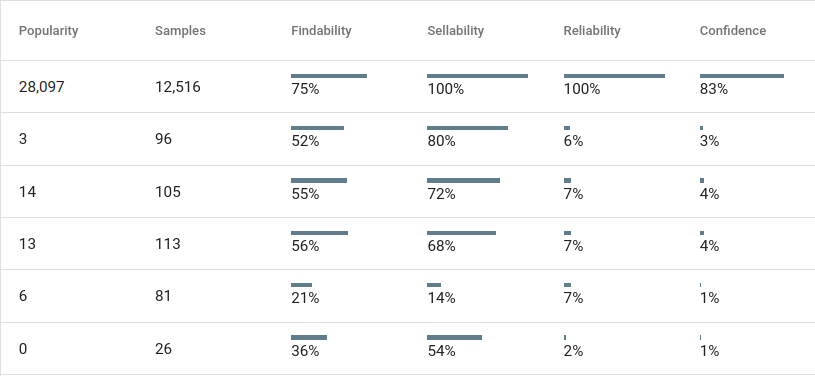
    Bisher wurde der repräsentativste Suchbegriff innerhalb eines Varianten-Clusters vor allem anhand der KPIs CTR (Klickrate) und CR (Kaufrate) ermittelt. Mit unserer neuen „Best Query Picking-Technology“, haben unsere Kunden die searchCollector integriert haben zwei neue KPIs, über die sie sich freuen dürfen: Findability und Sellability.

    Findability“ ist ein KPI, der positives und negatives Nutzerfeedback, wie Klicks und Views, aber auch zusätzliche Informationen wie nicht geklickte Produkte, zu viele Filter, und Seitenausstiege berücksichtigt. „Sellability“ hingegen misst alle angeklickten Produkte, die in den Warenkorb gelegt oder gekauft worden sind. Diese einzigartige Kombination von KPIs stellt sicher, dass für jedes Suchbegriffscluster die leistungsfähigste, beste Schreibweise ausgewählt wird. Auf dieser Weise wird transparent, welchen Einfluss die Relevanz eines Suchergebnisses auf das Kaufverhalten der Nutzer hat.

    Maximale Transparenz ist uns wichtig. Deswegen haben wir die KPI „Reliability” eingeführt. Diese misst, wie zuverlässig die KPIs der Vergangenheit für eine bestimmte Suchbegriffs-Variante sind. Dies geschieht, indem wir Varianten mit aktuelleren Daten höher gewichten als Varianten, zu denen es ggf. schon seit längerer Zeit keine neuen Daten gibt.

    Zwei weitere neue KPIs in der Benutzeroberfläche werden Dir sicher auch noch auffallen: “Popularity” und „Sample Size“. Die Popularity misst, wie oft in den vergangenen 28 Tagen ein Suchbegriff gesucht wurde. Die Sample Size ist die Häufigkeit der ungemappten Suchen, die wir aus verschiedenen Zeiträumen erfasst haben. Alle restlichen KPIs beziehen sich auf diese Häufigkeit.

    Diese Änderungen werden sich auf die Cluster-Ansicht auswirken, die genau angibt, welche Cluster und Varianten zusammengehören und warum.
    Es ist wichtig zu beachten, dass die Cluster-Ansicht keine Analyse ist, sondern vielmehr eine Steuerungszentrale, um die Qualität der Suchergebnisse zu beeinflussen. searchHub gibt Dir hier volle Kontrolle über Suchbegriffsbeziehungen.

    Für Kunden, die unsere searchInsights abonnieren, geht eine detaillierte Analyse der Suchmaschinen-Performance leicht von der Hand. Hast Du schon den neuen Date-Picker oder die Vergleichsmöglichkeit entdeckt?

    Date-Picker in searchHub UI.

    Hast Du noch keine searchInsights und bist auf der Suche nach einer detaillierteren Analyse der Suchmaschinen-Performance, mit granularem, beispiellosem Suchmaschinen-Tracking, solltest Du Dir unser Modul searchInsights anschauen. Dies ist das optimale Vorgehen, um Deine Suchmaschine in ein Business-Tool zu verwandeln.

    Wir hoffen, Du bist von diesen Änderungen genauso begeistert wie wir. Diese werden am 15. März im searchHub UI sichtbar sein. Vielen Dank für Dein Vertrauen in searchHub!

    Beste Grüße
    Dein searchHub Team

    English Version

    The New Standard for Search Optimization

    We are thrilled to announce the launch of our revolutionary new way to identify the most representative search term for a given query cluster. Today, we’re sharing these exciting new features and how they benefit your business.

    Traditionally, identifying the most representative query within a query cluster was done using the KPIs CTR and CR. Now, we’re doing something different. For our customers using our searchCollector, our Query Picking Technology, introduces two new KPIs: Findability and Sellability.

    Findability” is a KPI that measures positive and negative user feedback, such as clicks and views, but also considers products that aren’t clicked. “Sellability”, on the other hand, measures all clicked products, which are either added to the basket or purchased. This unique combination, ensures the highest performing, best query, is picked for each query cluster.

    Additionally, we are introducing a new KPI called “Reliability”, which measures how representative past KPIs are for a given keyword variant, within a cluster. This ensures the best performing query is always chosen over any period. We do this by weighting recent keyword data (interactions) higher than older keyword data.
    Surely, you won’t miss two additional new KPIs in the UI: “Popularity” and “Sample Size”. Popularity measures how often a query was searched in the last 28 days. The “Sample Size” is the frequency of the unmapped queries, which we gathered across different time periods. All other KPIs build on the search term frequency that comes from “Sample Size”.
    These changes will affect the query cluster view, and more precisely communicate which clusters and variants belong together and why. It’s important to note that the Query Cluster view is not an analysis, but rather a command center to influence the search result quality. searchHub allows you the complete control.

    For our customers, already subscribing to our searchInsights module: you already have the most detailed analysis possible of search engine performance. Have you discovered the Date-Picker and comparison functions yet?

    Date-Picker in searchHub UI.

    If you’re not yet using searchInsights, but you’re looking for a more detailed analysis of your search engine performance, with granular, unparalleled search engine tracking, please consider adding our searchInsights to your current searchHub subscription. This is the way to go if you’re looking for a way to turn your search engine into a business tool.

    We hope you’re as excited about these changes as we are. They’ll be live in the searchHub UI on March 15th. Thank you for your trust in searchHub.
    Best regards,

    Your searchHub Team

  • Y1 and searchhub partnership announcement

    Y1 and searchhub partnership announcement

    Y1 and searchHub partnership
    announcement

    searchHub partners with boutique agency

    We are delighted to announce our partnership with Y1. This team of talented strategists, creators and developers has been a constant staple in the ecommerce community in Europe for over 20 years.

    Working together gives us the opportunity to inject our expertise into projects where it’s most valuable – in the context of the customer journey. We look forward to expanding our range of experience as we collaborate with Y1 on projects ranging from online retail to b2b projects taking us closer to industrial manufacturing.

    Y1’s expertise sits poised at the juncture where customers seek a partner at eye level, able to deliver future oriented digital solutions with innovative power and high business value. Who wouldn’t want to be a part of that? 😄

    In the words of Y1

    “Together with our customers, we want to be proud of all our projects.” – Y1

    In our words:

    We are confident in the expertise and craftsmanship of this team, and look forward to many projects we can be proud of, together! – Markus Kehrer – searchHub.io

    About Y1

    The agency for valuable and sustainable digital commerce projects. We are an established team of over 100 digital natives, strategists, conceptualists, creatives, and developers that all have one thing in common: we love what we do. Over 20 years. Together One. Y1.

    We continually measure ourselves anew, and always strive to be a bit better by elevating our customer’s needs above our own. From the very beginning, we work to collaborate with our customers at eye-level to identify future oriented digital solutions with innovative power and a high business value. The B2C (including D2C) and B2B worlds are balanced in our portfolio of expertise, which allows us to identify and capitalize on the total market potential. Together with our customers, we want to be proud of all our projects.

  • hmmh and searchHub Partnership Announcement

    hmmh and searchHub Partnership Announcement

    hmmh and searchhub Partnership
    Announcement

    searchhub partners with leading global agency

    hmmh and their parent, Serviceplan Group, are heralded as one of the most highly rated, privately owned agencies globally. For more than 25 years hmmh has been managing the in-house digital transformation, to the front end solutions and designs for the world’s most successful brands, along the way giving life and direction to what is known today as connected commerce.

    Adding to the core value of connected commerce searchhub.io allows hmmh to augment their brand development strategies by supplying a bolt-on software solution that opens the door to enhance every onsite search system across all of their brands without overly inflated project costs or having to strap their customers with large vendor changes. This ad-hoc flexibility allows hmmh to effortlessly increase customer engagement, and drive lifetime order value.

    “We welcome hmmh as a competent agency partner furthering both our journey’s along a more user centric approach to optimization that ensures brands and customers work more closely together as partners in the purchase funnel.”
    Markus Kehrer – searchhub.io

    About hmmh

    hmmh is Germany’s leading agency in connected commerce. Over 300 colleagues work at their offices in Bremen (headquarters), Berlin, Hamburg, and Munich. For more than 25 years, they have pioneered the development of digital business, watching the limits between on and offline fade away. The transformation from a multichannel business to connected commerce requires holistic, flexible and seamlessly interconnected strategies and processes. To this end, hmmh designs intelligent overarching business solutions. In line with their value proposition: “consult • create • care” hmmh offers comprehensive and individualized consultation, accompanying both national, and internationally successful businesses.

  • Wie Produkte gefunden werden

    Wie Produkte gefunden werden

    Wie Produkte gefunden werden

    Kommentar

    Wer nicht direkt die komplette Suche in seinem Shop austauschen möchte (meist ein größeres Projekt das Wochen bis Monate dauert), kommt um intelligente Erweiterungen nicht herum. Deshalb geht searchhub – unser junges KI Startup aus Pforzheim – genau diesen Weg. Umso mehr freuen wir uns über den tollen Beitrag des Internetworld Business zum Thema “Suche” in dem wir auch prominent erscheinen.

    “Im Bereich Shopsuche setze man auf neue Produkte wie Searchhub oder die Headless-Lösung von Makaira” Anatolij von Kosmonaut.

    Als headless KI Erweiterung für alle Suchlösungen hilft Searchhub durch intelligente Clusterung von Suchbegriffen die Ergebnisqualität durchgängig zu erhöhen und gleichzeitig den manuellen Pflegeaufwand (Synonyme, Vertipper, etc) deutlich zu reduzieren.

    Vielen Dank Matthias Hell für die Erwähnung in deinem IWB Artikel in dem du dich mit Anatolij & Christian zu Suchen ausgetauscht hast.

    Und wer mehr wissen möchte >>> Mathias & Markus stehen gerne für einen unverbindlichen Blick hinter die Kulissen zur Verfügung.

    Hier der ganze Artikel

  • valantic and searchhub – partnership announcement

    valantic and searchhub – partnership announcement

    valantic and searchhub – partnership
    announcement

    Partnerships

    Valantic understands the intricacies of working with large corporate digitization projects with systems like SAP, Spryker, Magento, Shopware, and Scayle, among others. It’s common to experience a lack in these types of rollouts when it comes to onsite search. As an alternative to building a completely new site search solution valantic took a closer look at what searchhub has to offer and found tremendous potential in optimizing search for their customers using our approach.

    searchhub is the autopilot addon for every site search on the market. As such we easily integrated into the existing site search of one of Valantic’s customers, and quickly illustrated the fiscal sense behind working with us compared to heavy manual optimization or even replacing site search solutions.

    So, it is with great pride that we announce valantic as one of our new partners!

    Since 2017 we have managed to grow organically, mostly by leveraging our own network. As we transition to scaling our business model, strong partnerships with agencies will be pivotal. Markus Kehrer – searchhub

    About valantic:

    Valantic develops a digital transformation strategy with you. For over 10 years they have been successfully advising on the selection of, and assisting clients in their transition to the ideal solution. With over 2,000 in-house experts, they move fluidly from designing the optimal customer experience, to developing the platform that supports you in customer acquisition and retention with the right digital marketing tools. The result: quantifiably successful e-commerce.

  • How to Cook Soup in a Team – And not Spoil it

    How to Cook Soup in a Team – And not Spoil it

    How to Cook Soup in a Team
    – And not Spoil it

    13% of all startups fail due to a lack of harmony within the team. We know this and have no intention of adding to that statistic. A year ago, I had the privilege of joining this incredible team of individuals to be a part of this startup. During the last year, I’ve watched the quality of our technology grow congruent with the rate of personality development. And I’d like to tell you about it.

    How my searchhub journey began

    Stepping into the office in the heart of Pforzheim, situated directly on the north bank of the river Enz, I knew I had no idea where this was going to lead. One thing I did know, however; these are people I believe in. And so it began.

    Initial 500 Errors

    My responsibilities at the company, as is the case with all startups, are pretty broadly defined. Sales, Marketing, and PR. Immediately after joining, I began reviewing which areas made the most sense for my immediate focus. Next, I started building out this blog and creating some pretty cool videos to train our quickly growing customer base on using our software.

    These new territories, possible strategies, and tasks quickly led to a readjustment and questions within the team. Unfortunately, the result wasn’t always a mature adult conversation. In fact, at one point, early on, I was involved in a particularly immature antagonistic conflict in which I was the aggressor. Of course, I had my reasons for unreasonableness, and so too my colleague. And to make matters worse, I come from a liberal arts background and work all day with IT Gurus. It’s safe to say, I was feeling more than a little self-righteous about my communication abilities. The ensuing conflict and subsequent resolution caught me all the more off guard.

    Humbled by the emotionally inept

    It’s generally accepted that IT nerds are rather limited when it comes to emotional intelligence. So I was feeling somewhat smug, believing my communication skills were greater than those of my colleague. Quite presumptuous considering the circumstances of the conflict (my desire to protect my ego was standing in the way of a solution). Imagine my surprise when none other than an IT nerd colleague schooled me in a more noble manner of communication.

    Let’s take a step back for clarification. You see, the same day of the conflict, a different colleague (part of the IT Crowd) approached me about the incident. This is the kind of guy I was talking about earlier. You know the brilliant, emotionally deficient type. Only… he’s not.

    My colleague explained to me (the trained pastor and communication expert who should have known better) how he would like such conversations to go in the future in a friendly and respectful tone. They should be held in private, both parties should remain respectful. And if it becomes apparent that there is no way of coming together around the topic of disagreement, agree to disagree and move on. It’s what’s best for the consistent progress of the company. How could I disagree?

    He was right. And I was humbled.

    Luckily, I’m not the only one in the company who’s had the privilege of experiencing this type of reflection and good guidance from a colleague. It’s becoming part of our culture.

    Discovering Our New Identity as Soup Chefs!

    In the context of a startup, everyone must pull their weight. We haven’t the time, resources, or funds to waste with people not willing or unable to be a part of progressing our technology and market footprint. Everything and everyone counts.

    How this plays out from a technical point of view is pretty straightforward. Flat hierarchies, scrum meetings, everyone is heard no-one walks alone.

    The underlying communication, however, is more tricky. Communication is often seen as something we naturally do.

    The misnomer: everyone is already invested in the vision and direction of the startup. This unites us and precludes any need to place an extra focus on interpersonal communication.

    Unfortunately, being a good communicator is all but natural. Even teams seemingly working towards the same goal are comprised of individuals, each with his or her own unique dependencies. These dependencies act as a kind of built-in bias, preventing pure objectivity.

    Now, just add Corona, and home office to the mix, and baaam, you gotta recipe for disaster.

    Anyone Can Spoil a Soup

    Let’s stick with the recipe example and build on this illustration. Imagine you own a startup soup company. Everyone in the business is responsible for certain parts of the revolutionary soup. Once a day, we come together to talk over our soup-making experience from the day before. If the context permits, we, objectively, offer our outside perspective. So far, so good. Then everyone goes back to cooking his or her own soup. The main ingredient is always the same. We simply add different spices, varieties, and amounts. These spices create unique associations with the soup that our colleagues are not having in the same way.

    What’s more: everyone likes a different kind of spice in their soup. So even though we use the same words to describe our experiences, each of us has a unique image of what those words mean. Details are lost as a result of missing context.

    To make matters more challenging. Even if we had the same context (identical spices and amounts), our lack of objectivity would be our guiding bias.

    What’s more, in the case of a real startup, daily meetings are not the place to go into detail. As a result, potential misunderstandings go unidentified. And in the background, more spices and seasonings are added, everyone secretly hoping not to deviate too far from the original plan. Working toward the same goal, building the business. I mean: how bad could it get? After all, we all use the same words to describe our experiences. It must be right. And then…

    Someone commits some code, makes a software purchase, writes an article for the press, generally does their best to progress our beloved technology.

    It’s at this moment it becomes apparent that something has gone wrong. Perhaps still a bit early to acknowledge as a communication problem, a conflict ensues. Blame and quick fixes are rolled out en masse to try and get a grasp on the situation.

    Only later does it become clear that all the Daily’s, all the technology conversations, all the references to the soup, its consistency and taste were not verified or even verifiable. Truth be told, some part of us willfully avoided difficult conversations where we would be forced to articulate what we mean. Instead, hiding behind phrases like “add just a little salt” or “more than enough pepper.”

    Keeping a conversation purely factual allows us to hide our personal preferences behind coded phrases and generally acceptable jargon without needing to explain ourselves. However, upon returning to our desks and finding ourselves confronted with a challenging piece of code, or a decision of preference, our natural fallback will always be what is most comfortable to us. Not what has the greatest consensus.

    So the question is: how to close the gap between the best outcome for the business and what is most practical for the individual? This is the heart of communication and the essence of self-leadership.

    Refining Technology – Rethinking Communication

    Refining this communication process improves the character and leadership qualities of the people communicating and has the harmonious effects of increasing the quality of business output and customer happiness.

    The negative consequences of ignoring better communication manifest themselves differently depending on your business. For the soup company, poor internal communication means sour soup. For searchhub.io, it means: our software development and customer satisfaction suffer. Or to use a more common IT expression: garbage in, garbage out.

    Successful Startups are like Meals, not Ingredients

    We’re small, privately owned, and funded. As a result, we can make quick changes. So a couple weeks ago, our team came together to talk about communication and its affect on our software quality. We left with a better understanding of where we failed to communicate more boldly at earlier communication processes. Stages at which it would still have been possible to avoid personal conflict and ultimate software errors.

    Moving forward, we determined to focus on different types of communication throughout the software development process. We need something more strategic than a “Daily,” but less formal than a company meeting and more weighty than a one-on-one technical conversation. A space in which the technical side is heard, but reading between the lines and calling each other out is equally accepted and conducive to a positive outcome. And… it all needs to be accessible to employees both in the office and home office regularly.

    How the hell is that going to work?

    Preliminary ideas range from small group meetings to discuss personal views about company issues to larger team gatherings with professional moderation. Our goal is to make our working environment as conducive to production as possible. Learning to resolve conflicts without sacrificing your own standpoint, or feeling beaten down by the owners, is key to creating an environment where everyone can develop and perform from a position of strength.

    Fixing Server Errors

    Facilitating communication is like fixing a server error. The goal is not to change the function of the server. On the contrary, only by resolving the error are all the pieces of the server able to communicate with each other at their designed speeds, ensuring the best performance. So too, in the case of communication. More focussed communication aims not to disrupt natural conversation flow but rather to raise the profile of each participant ensuring confidence and a level playing field for all parties involved.

    But there’s a blinding difference between fixing server errors and learning to communicate better. Unlike machines, words and context matter to humans. So ensuring positive future outcomes within your team is not simply about obtaining a better understanding of what it takes to make communication run smoothly and then redeploying.

    Redeploy

    In software, if an error is found, all it takes is fixing it and redeploying. Humans, however, don’t forget. We remember what went before, leaving an open window for trust issues and power abuses, which can take months if not years to recover from.

    As a result, being aware of what it means to communicate well also means applying the rules you learn. These rules act as a safeguard ensuring the success and innovation of your business not only in the short term for your current crisis but, more importantly, for the longevity of your company in general.

    Conclusion

    We’re a new company basking in the light of a bright future. We have intelligence, practical genius, a good network, and a strong work ethic. In short: the sky’s our neighborhood. 😉

    We acknowledge that we struggle communicating through inherent bias, personal preference, and big egos. Nevertheless, we are choosing daily to devote ourselves to better communication practice despite our inadequacies. I hope you do too.

  • Artificial Stupidity – How To Avoid it before it’s too late

    Artificial Stupidity – How To Avoid it before it’s too late

    The realization struck me while holding the hand of my seven-year-old son, standing at the precipice of the most giant cliff I had ever looked over. At this moment, his boundless freedom to explore his surroundings took a back seat to his safety. In that precarious and volatile moment, my natural intelligence as a human outweighed philosophical notions of parenting. Anything less would have been artificially stupid.

    Machine Learning and Real-World Consequences

    Assuming my parental judgment, described above, is sound, we could safely say that most parents, placed in a similar situation, would make a similar judgment call. Suppose it is true that we can make intelligent, rational decisions in the interest of posterity. Why are we so sluggish about transferring this embedded natural intelligence to the machine learning algorithms we develop and implement into, arguably, equally precarious business situations?

    When AI is your lover — you extrapolate all over the place

    Our infatuation with artificial intelligence leads to a mindless disregard for natural intelligence. Unsurprisingly, in the words of Vincent Warmerdam this makes our machine learning algorithms artificially stupid.

    Algorithms merely automate, approximate, and interpolate. Extrapolation is the dangerous part.

    Vincent Warmerdam, 2019

    Image by Gerd Altmann from Pixabay

    The danger of getting emotionally involved

    This post pays open homage to Vincent’s enlightening talk from 2019 entitled “How to Constrain Artificial Stupidity”– a topic increasingly deserving of a more watchful eye. What follows is part 1 of a series, in which we will take a closer look at several of Vincent’s fixes for Artificial Stupidity in the field of machine learning.

    Artificial Stupidity: the lack of real-world consensus (or natural intelligence) reflected in machine learning algorithms.

    This complacency around natural intelligence and how to implement it in our machine learning models results in dumbing down the output of our otherwise ingenious AI creations, resulting in disastrous real-world consequences.

    Example of Artificial Stupidity in the Wild

    The Boston Housing Data Set used broadly to run probability tests on the housing market. One of the data columns delineates the “number of black people in your town.” If unquestioned, running probabilities against this data set will ironically reinforce a preexisting bias within the same data thought to provide a “fair” estimation of housing trends.

    This example makes strikingly clear how important remaining curious about your database’s sources and content is before reporting any algorithmic successes.

    Artificial: Made or produced by human beings rather than occurring naturally, especially as a copy of something natural.1

    Stupidity: Behavior that shows a lack of good sense or judgment.

    How wrong can an AI Model be?

    There are usually two things that can go HorriblyWrong™ with models.

    1. Models don’t perform well on a metric people are attached to.
    2. Models do something that you don’t want them to.

    My thesis is that the industry is too focused on the performance; we need to worry more about what happens when models fail.

    Vincent Warmerdam, 2019

    Image by succo from Pixabay

    Avoiding the AS (Artificial Stupidity) — “Love is Blind” Trap

    If the above thesis is confirmed, a stronger focus on understanding why models fail and taking necessary steps to fix them is in order. It would better serve us if we began approaching machine learning like people in physics: study a system until it becomes clear which model will explain everything.

    The following is the first in a set of four suggested fixes. The remaining three will follow in future posts.

    Fix #1: Predict Less, and more carefully

    We must be honest about what AI does. AI does not, in fact, deliver a probability. Honestly put, AI gives us an approximation of a proxy, given certain known factors.

    AI cannot determine how unknown factors will influence what we do know. As a result, any missing data or data we are unaware of will dramatically affect our model’s output. Without all the data, we are unable to illustrate at which point the AI model will fail.

    This wouldn’t be a problem if machine learning models weren’t always designed to return a result. We need to build safeguards to constrain when a model returns a result. And determine at which threshold the constraints will prevent an artificially stupid prediction.

    In short: If we don’t know, don’t predict!

    Missing data or wrong data means unwittingly solving for the wrong problem. In the real world, our model will fail. It’s okay to approach failure with humility, take a step back, and use natural human-intelligence to evaluate if we can come to a more valuable human solution. This humility will help us better articulate what we are solving for. Maybe this will lead to us realizing that we missed something in or asked the wrong questions of the data.

    Algorithms merely automate, approximate, and interpolate. Extrapolation is the dangerous part.

    Try not to report an AI miracle until we understand when the model will fail.

    Fairness at the cost of privacy?

    What are the practical implications? If I am looking to build a model to grant the highest possible fairness across my data set, I will need to calculate at what point the model is unfair. Having information like gender, race, and income within the data set will provide more transparency into how fairness is defined within a specific dataset. Baffling as it may be, without being honest about how this type of data influences our models, hiding instead behind good-intentioned data-privacy conventions, businesses can legitimately refuse transparency into their algorithmic predictions on the grounds of anti-discrimination.

    In this way, an algorithm whose original purpose was, for example, to generate greater fairness among demographics in the housing market could become the basis for intensified segregation and systemic racism.

    This is ethically debased and begs a solution. Something this post is far from providing. Suffice it to say: honest digital business looks different.

    At the very least, we need to identify sensitive variables and do our best to correct for them. This means we must do everything we can to understand better the data going into our models.

    If the predictions coming out of your model are your responsibility, so too should be the data going into the model.

    Rediscover a Whole new World — Design-Thinking

    Having this knowledge raises the stakes of machine learning! Simultaneously, approaching machine learning and AI in this way redeems our whole world around design–thinking (Read Andreas Wagner’s interpretation of a findability score to get an idea of what I mean!). Suddenly, we are once again the creators of our own design. No longer blindly plugging data into models whose outcomes we are powerless to influence. Understanding and giving merit to the human intelligence behind the models we use positions us to ask critical questions of the data we plug into the model.

    As a result, we can move away from a OneSizeForAll().fit() or model().fit, and toward more meaningful bespoke models tailor.model().

    In this way, we increase how articulate a system is while at the same time answering questions about assumptions without resorting to basic metrics.

    From this perspective, making a model is: learning from data x whatever constraints I have.

    Maybe we should start learning to accept that model.fit()is incredibly naive. Perhaps we would be better served if we began approaching machine learning like people in physics: study a system until it becomes clear which model will explain everything.

    Vincent Warmerdam

    Most importantly

    Take a step back and consider for which use case your model should be a proxy. Does it mimic its real-word naturally intelligent counterpart? Or is your model out-to-lunch concerning real-world application? Beware: you don’t want to be the person designing an algorithm responsible for quoting less than fair housing rates due to the number of black people in a neighborhood! Which natural thinking person would do that?

    Natural Intelligence isn’t such a bad thing

    Grant yourself the creative freedom to understand the problem. Your solution design will be better as a result.

    Check out Vincent’s open-source project called scikit-lego (an environment to play around with these different types of strategies in real-world scenarios) and his YouTube video which inspired this blog post.

    Summary

    Artificial Intelligence isn’t such a bad thing if we are willing to bestow credit on the beautiful, natural intelligence which is human. This approach is lacking in our Machine Learning models today. If intelligently implemented into our models, the potential for this natural intelligence approach to deliver more meaningful results is excellent.

    We’ll be talking more about the remaining three fixes for artificial stupidity in future posts. Stay with us!!