Category: Business

  • Y1 and searchhub partnership announcement

    Y1 and searchhub partnership announcement

    Y1 and searchHub partnership
    announcement

    searchHub partners with boutique agency

    We are delighted to announce our partnership with Y1. This team of talented strategists, creators and developers has been a constant staple in the ecommerce community in Europe for over 20 years.

    Working together gives us the opportunity to inject our expertise into projects where it’s most valuable – in the context of the customer journey. We look forward to expanding our range of experience as we collaborate with Y1 on projects ranging from online retail to b2b projects taking us closer to industrial manufacturing.

    Y1’s expertise sits poised at the juncture where customers seek a partner at eye level, able to deliver future oriented digital solutions with innovative power and high business value. Who wouldn’t want to be a part of that? 😄

    In the words of Y1

    “Together with our customers, we want to be proud of all our projects.” – Y1

    In our words:

    We are confident in the expertise and craftsmanship of this team, and look forward to many projects we can be proud of, together! – Markus Kehrer – searchHub.io

    About Y1

    The agency for valuable and sustainable digital commerce projects. We are an established team of over 100 digital natives, strategists, conceptualists, creatives, and developers that all have one thing in common: we love what we do. Over 20 years. Together One. Y1.

    We continually measure ourselves anew, and always strive to be a bit better by elevating our customer’s needs above our own. From the very beginning, we work to collaborate with our customers at eye-level to identify future oriented digital solutions with innovative power and a high business value. The B2C (including D2C) and B2B worlds are balanced in our portfolio of expertise, which allows us to identify and capitalize on the total market potential. Together with our customers, we want to be proud of all our projects.

  • Why searchHub?

    Why searchHub?

    Why searchHub?

    SEARCH OPTIMIZATION WITH SEARCHHUB

    tl;dr – Increasing search revenue by +10% from day one!*

    If you are responsible for site search, you understand the strategic significance of this “small” yet important element for your online store. No place is this more visible than in bottom line conversion statistics. It would be remiss to disregard the disproportionately high rate of conversion from users who have in some way interacted with the site search. Conversion rates three to five times higher than sales via site navigation are not trivial. However, maintaining the search, monitoring the top search terms and zero hits is a Sisyphean task.

    A “Longtail”

    What Are Longtail Queries?

    These types of queries sit somewhere between the top100 search terms and the zero result queries.

    It’s no surprise that most search managers are happy when at least their top100 searches perform optimally. The unfathomable scale of site search longtail, dissuades even the most hardened ecommerce professional from touching it with a 10 foot pole.

    However, the search terms that make up ecommerce longtail, account for the motherload of all search queries. Yep… over 90% of all queries entered on ecommerce retail sites fall into this longtail category. Understandably, they usually don’t get any attention. And that’s no fault of the search managers. It’s already damned near impossible to ever feel like you’ve adequately optimized your top100. But it’s bloody mind-boggling to even glance at the list of longtail keywords. Let alone consider optimizing them. There’s simply that many.

    Human and AI Collaboration

    Manual Site Search Optimization is Impractical

    It goes without saying that in everyday life, no human has the time to deal with all search queries. Oftentimes, the day has barely enough hours to do little more than a quick “once over” the zero results. If all goes well, you might be awarded the luxury of squeezing in the top50 to top200, give them a high-level analysis, check whether the results are, relatively, good and proof the KPIs.

    This modus operandi has a catch: you never can, confidently, say that the search is optimized. Especially, considering the vastness of the longtail! We have customers with searchhub clusters exceeding 1,000 different spellings for a single search term! Manually attempting to manage scale of these proportions is clearly unthinkable.

    That’s where searchhub plays a critical role.

    We created a one-of-a-kind AI to analyze the search history stuff referenced above. Now, we can easily answer common questions that we encounter among customers across every flavor of site search:

    • Which terms are being searched, in all their conceivable, and inconceivable variations? To get this, we had to measure the importance of each minute KPI that in some way has to do with site search.
    • How do shop visitors behave after searching for a particular keyword or any of its variants – tracking of anonymous customer behavior?
    • What would it look like if I had a knowledge base with clusters of similar search terms that I could enrich with external data sources (e.g. product data).

    How Is Searchhub Different From a Site Search Vendor?

    The struggle to answer these questions led us to a unique solution. searchhub’s AI takes queries that lead to similar product purchases, and merges them together into clusters. For each cluster a so-called Master Query is defined. We get this by analyzing the KPIs of the individual search terms within a cluster further.

    How Does Searchhub Pick a Master Query?

    KPIs important for Master Query selection include:

    • were there results?
    • how many results were shown?
    • was there interaction with the search result?
    • what was the quality of the interaction?
    • was something added to the cart post interaction?
    • was something purchased?

    Once a Master Query is defined, all other query variations within a cluster are excluded from the search and instead substituted by the master query!

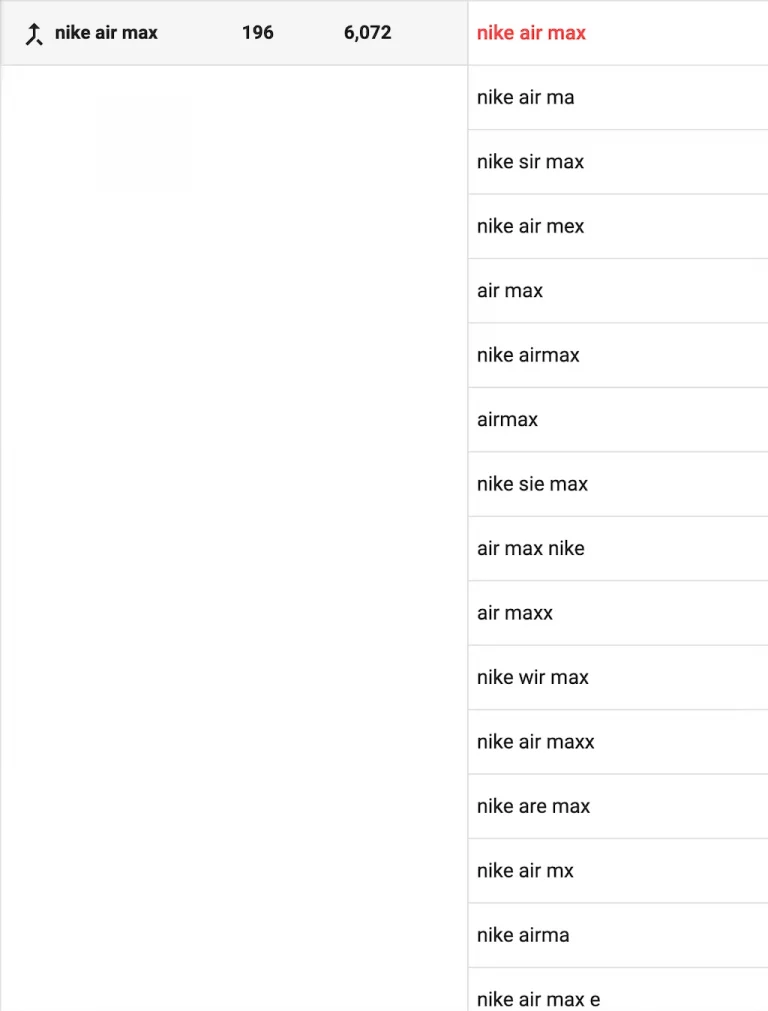
    The following is an excerpt from the cluster “nike air max” with 196 different spellings. We would replace all of these with “nike air max”.

    Master Query Selection

    Not only does this ease the strain of search management by decreasing time spent on search maintenance, but marketing and purchasing also benefit from this clustering!

    How Do Marketing And Purchasing Departments Benefit From Search Query Clustering?

    Marketing departments invest significant resources into enriching frequent and relevant search terms with redirects, curated results, marketing campaigns, product promotions and product advisors.

    To this end, searchhub makes it easy to access rich search journey insights that can be used for targeted SEO actions. searchhub generally increases traffic to these keywords upwards of 20-30%. This is a consequence of more customers being funneled to master query landing pages. This translates into additional value for the colleagues in server side advertising!

    Additionally, onsite search suggestions also benefit from query clustering!

    Our proprietary tracking not only measures search frequency, but also transparently quantifies any other search KPI and trend. This means we know exactly which products to display from the very first letter your customers type. Naturally, these suggestions are based on our learnings drawn from master query performance.

    Our SmartSuggest makes search suggestions more relevant, significantly varying the result-set in the process. This means we are able to put into practice what many search technologies only give lip service to:

    “We deliver a window into the product assortment!” — Andreas Wagner (CTO searchHub.io)

    Positive Effects of Query Clustering

    Substituting search terms with the best performing Master Query has several positive effects depending on the site search you use. Below are some examples.

    “My shop uses SolR / Elastic – what advantages do we have by using searchhub?”

    • Site search Maintenance interface for non-IT people
    • UI for configuring the Suggest feature
    • Create and maintain synonyms through the UI
    • Use Full Potential of Search Analytics

    “We use Attraqt, Algolia, FACT-Finder, Findologic, etc. – what advantages do we have by using searchhub?”

    • significantly less maintenance effort
    • better overview of queries, search quality and KPIs
    • new and existing campaigns, landing pages, curations and advisors receive more traffic.

    Irrespective of your site search engine the following points are globally relevant.

    • SIGNIFICANTLY better error tolerance with higher precision
    • Cost reduction due to superior and faster maintenance
    • More and flexible reporting functions
    • Patented findability score that determines to which degree customers are able to use on site search to find and purchase products easily on your website.
    • Search analytics that filters queries made by bots vs. humans!
    • Product data quality optimization through transparent analyses of search intent.

    searchhub Business FAQs

    Does the above sound exciting? Then let’s dive into the really important questions:

    1. What does searchhub cost?
    2. How long does searchhub integration take?
    3. What do I gain from searchhub?

    What does searchhub cost?

    Unlike many solutions, our pricing is not based on page impressions, search queries or similar traffic indicators.

    searchhub pricing follows these two guidelines:

    1. Which business KPIs (e.g. revenue, CR, CTR, value per search) are crucial for our customer in evaluating the success of search?

    and

    1. How high is the potential impact of searchhub?

    During the sales process, we create an analysis of a shop’s individual uplift potential with searchhub. This analysis uses your site search data, to illustrate the expected added value based on the clusters searchhub will generate.

    This allows us to create an equitable value-added offer for all our customers. The monthly fee is then fixed, with no risk of increase over 12, 24, or 36 months.

    What do I gain from searchHub?

    “With searchhub, we increased the value per session ad-hoc by more than 20%.”

    searchhub improves business KPIs of your entire search longtail.

    • Higher ClickThroughRatios
    • fewer zero result hits and
    • higher conversion rates are the result.

    This is why all our customers have a speedy return on investment!

    Interested? Contact us at hello@searchhub.io we’ll set you up with your own demo!

    *A/B-Tests have shown that CXP searchhub significantly increased our search driven revenue by more than 10% from day one.” Bernd Koch, Baldur Garten

  • hmmh and searchHub Partnership Announcement

    hmmh and searchHub Partnership Announcement

    hmmh and searchhub Partnership
    Announcement

    searchhub partners with leading global agency

    hmmh and their parent, Serviceplan Group, are heralded as one of the most highly rated, privately owned agencies globally. For more than 25 years hmmh has been managing the in-house digital transformation, to the front end solutions and designs for the world’s most successful brands, along the way giving life and direction to what is known today as connected commerce.

    Adding to the core value of connected commerce searchhub.io allows hmmh to augment their brand development strategies by supplying a bolt-on software solution that opens the door to enhance every onsite search system across all of their brands without overly inflated project costs or having to strap their customers with large vendor changes. This ad-hoc flexibility allows hmmh to effortlessly increase customer engagement, and drive lifetime order value.

    “We welcome hmmh as a competent agency partner furthering both our journey’s along a more user centric approach to optimization that ensures brands and customers work more closely together as partners in the purchase funnel.”
    Markus Kehrer – searchhub.io

    About hmmh

    hmmh is Germany’s leading agency in connected commerce. Over 300 colleagues work at their offices in Bremen (headquarters), Berlin, Hamburg, and Munich. For more than 25 years, they have pioneered the development of digital business, watching the limits between on and offline fade away. The transformation from a multichannel business to connected commerce requires holistic, flexible and seamlessly interconnected strategies and processes. To this end, hmmh designs intelligent overarching business solutions. In line with their value proposition: “consult • create • care” hmmh offers comprehensive and individualized consultation, accompanying both national, and internationally successful businesses.

  • valantic and searchhub – partnership announcement

    valantic and searchhub – partnership announcement

    valantic and searchhub – partnership
    announcement

    Partnerships

    Valantic understands the intricacies of working with large corporate digitization projects with systems like SAP, Spryker, Magento, Shopware, and Scayle, among others. It’s common to experience a lack in these types of rollouts when it comes to onsite search. As an alternative to building a completely new site search solution valantic took a closer look at what searchhub has to offer and found tremendous potential in optimizing search for their customers using our approach.

    searchhub is the autopilot addon for every site search on the market. As such we easily integrated into the existing site search of one of Valantic’s customers, and quickly illustrated the fiscal sense behind working with us compared to heavy manual optimization or even replacing site search solutions.

    So, it is with great pride that we announce valantic as one of our new partners!

    Since 2017 we have managed to grow organically, mostly by leveraging our own network. As we transition to scaling our business model, strong partnerships with agencies will be pivotal. Markus Kehrer – searchhub

    About valantic:

    Valantic develops a digital transformation strategy with you. For over 10 years they have been successfully advising on the selection of, and assisting clients in their transition to the ideal solution. With over 2,000 in-house experts, they move fluidly from designing the optimal customer experience, to developing the platform that supports you in customer acquisition and retention with the right digital marketing tools. The result: quantifiably successful e-commerce.

  • Optimise Business Process for Communication

    Optimise Business Process for Communication

    Optimise Business Process for
    Communication

    Mushrooms are some of the oldest and compared to us humans – simplest, organisms. What we call a mushroom is actually just a fruit body of a complex underground network of fungal threads called mycelium – that’s where all the exciting stuff happens. Not only does mycelium provide the nutrients, but it also serves as a communication network.

    How-to Optimize business Process for Communication – lessons from a Mushroom

    While yet to be studied in full detail, scientists understand that the network sends various signals which incentivize growth in a particular direction, alerts for danger, and more. The network communicates very efficiently. Scientists were able to make it solve basic labyrinths or even optimize city traffic problems.

    Why Human Communication doesn’t scale for Business

    Humans are not like this.

    We don’t naturally form networks when building and collaborating; human communication just doesn’t scale. People are most comfortable communicating one on one – they can get all verbal and non-verbal signals and form a pretty good understanding between themselves. But when we start introducing more people to the group, the communication efficiency drops incredibly fast. There are multiple studies, both behavioral and historical in nature, on the optimal size of a group. The consensus is that groups larger than 10 people cannot collaborate efficiently.

    This is hardly novel, but that’s not the point. What possessed me to write these lines is how often we forget or ignore that the drop in communication efficiency happens right after moving away from the one-to-one setup. Time and again, we see projects grow to 10s of people, introduce multiple decision centers, heavy inter-team dependencies and eventually deliver poor products or services.

    Why It’s Not Enough for Software to Scale – Business Communication Must be Human as Well

    The solution is to implement a “no compromise” attitude, putting efficient human-modeled communication practices above all else, reshaping the organization and the product accordingly.

    After all, agile doesn’t only mean the development team is using delivery sprints – the entire business must be agile.

    Conway’s law states that an organization’s output unwittingly becomes a copy of the communication structure within that organization. In this way, we can apply this rule to our scenario: the structure of a piece of software will mirror the structure of the organization that built it.

    You want world-class software – make efficient communication your system optimization factor.

  • How to Cook Soup in a Team – And not Spoil it

    How to Cook Soup in a Team – And not Spoil it

    How to Cook Soup in a Team
    – And not Spoil it

    13% of all startups fail due to a lack of harmony within the team. We know this and have no intention of adding to that statistic. A year ago, I had the privilege of joining this incredible team of individuals to be a part of this startup. During the last year, I’ve watched the quality of our technology grow congruent with the rate of personality development. And I’d like to tell you about it.

    How my searchhub journey began

    Stepping into the office in the heart of Pforzheim, situated directly on the north bank of the river Enz, I knew I had no idea where this was going to lead. One thing I did know, however; these are people I believe in. And so it began.

    Initial 500 Errors

    My responsibilities at the company, as is the case with all startups, are pretty broadly defined. Sales, Marketing, and PR. Immediately after joining, I began reviewing which areas made the most sense for my immediate focus. Next, I started building out this blog and creating some pretty cool videos to train our quickly growing customer base on using our software.

    These new territories, possible strategies, and tasks quickly led to a readjustment and questions within the team. Unfortunately, the result wasn’t always a mature adult conversation. In fact, at one point, early on, I was involved in a particularly immature antagonistic conflict in which I was the aggressor. Of course, I had my reasons for unreasonableness, and so too my colleague. And to make matters worse, I come from a liberal arts background and work all day with IT Gurus. It’s safe to say, I was feeling more than a little self-righteous about my communication abilities. The ensuing conflict and subsequent resolution caught me all the more off guard.

    Humbled by the emotionally inept

    It’s generally accepted that IT nerds are rather limited when it comes to emotional intelligence. So I was feeling somewhat smug, believing my communication skills were greater than those of my colleague. Quite presumptuous considering the circumstances of the conflict (my desire to protect my ego was standing in the way of a solution). Imagine my surprise when none other than an IT nerd colleague schooled me in a more noble manner of communication.

    Let’s take a step back for clarification. You see, the same day of the conflict, a different colleague (part of the IT Crowd) approached me about the incident. This is the kind of guy I was talking about earlier. You know the brilliant, emotionally deficient type. Only… he’s not.

    My colleague explained to me (the trained pastor and communication expert who should have known better) how he would like such conversations to go in the future in a friendly and respectful tone. They should be held in private, both parties should remain respectful. And if it becomes apparent that there is no way of coming together around the topic of disagreement, agree to disagree and move on. It’s what’s best for the consistent progress of the company. How could I disagree?

    He was right. And I was humbled.

    Luckily, I’m not the only one in the company who’s had the privilege of experiencing this type of reflection and good guidance from a colleague. It’s becoming part of our culture.

    Discovering Our New Identity as Soup Chefs!

    In the context of a startup, everyone must pull their weight. We haven’t the time, resources, or funds to waste with people not willing or unable to be a part of progressing our technology and market footprint. Everything and everyone counts.

    How this plays out from a technical point of view is pretty straightforward. Flat hierarchies, scrum meetings, everyone is heard no-one walks alone.

    The underlying communication, however, is more tricky. Communication is often seen as something we naturally do.

    The misnomer: everyone is already invested in the vision and direction of the startup. This unites us and precludes any need to place an extra focus on interpersonal communication.

    Unfortunately, being a good communicator is all but natural. Even teams seemingly working towards the same goal are comprised of individuals, each with his or her own unique dependencies. These dependencies act as a kind of built-in bias, preventing pure objectivity.

    Now, just add Corona, and home office to the mix, and baaam, you gotta recipe for disaster.

    Anyone Can Spoil a Soup

    Let’s stick with the recipe example and build on this illustration. Imagine you own a startup soup company. Everyone in the business is responsible for certain parts of the revolutionary soup. Once a day, we come together to talk over our soup-making experience from the day before. If the context permits, we, objectively, offer our outside perspective. So far, so good. Then everyone goes back to cooking his or her own soup. The main ingredient is always the same. We simply add different spices, varieties, and amounts. These spices create unique associations with the soup that our colleagues are not having in the same way.

    What’s more: everyone likes a different kind of spice in their soup. So even though we use the same words to describe our experiences, each of us has a unique image of what those words mean. Details are lost as a result of missing context.

    To make matters more challenging. Even if we had the same context (identical spices and amounts), our lack of objectivity would be our guiding bias.

    What’s more, in the case of a real startup, daily meetings are not the place to go into detail. As a result, potential misunderstandings go unidentified. And in the background, more spices and seasonings are added, everyone secretly hoping not to deviate too far from the original plan. Working toward the same goal, building the business. I mean: how bad could it get? After all, we all use the same words to describe our experiences. It must be right. And then…

    Someone commits some code, makes a software purchase, writes an article for the press, generally does their best to progress our beloved technology.

    It’s at this moment it becomes apparent that something has gone wrong. Perhaps still a bit early to acknowledge as a communication problem, a conflict ensues. Blame and quick fixes are rolled out en masse to try and get a grasp on the situation.

    Only later does it become clear that all the Daily’s, all the technology conversations, all the references to the soup, its consistency and taste were not verified or even verifiable. Truth be told, some part of us willfully avoided difficult conversations where we would be forced to articulate what we mean. Instead, hiding behind phrases like “add just a little salt” or “more than enough pepper.”

    Keeping a conversation purely factual allows us to hide our personal preferences behind coded phrases and generally acceptable jargon without needing to explain ourselves. However, upon returning to our desks and finding ourselves confronted with a challenging piece of code, or a decision of preference, our natural fallback will always be what is most comfortable to us. Not what has the greatest consensus.

    So the question is: how to close the gap between the best outcome for the business and what is most practical for the individual? This is the heart of communication and the essence of self-leadership.

    Refining Technology – Rethinking Communication

    Refining this communication process improves the character and leadership qualities of the people communicating and has the harmonious effects of increasing the quality of business output and customer happiness.

    The negative consequences of ignoring better communication manifest themselves differently depending on your business. For the soup company, poor internal communication means sour soup. For searchhub.io, it means: our software development and customer satisfaction suffer. Or to use a more common IT expression: garbage in, garbage out.

    Successful Startups are like Meals, not Ingredients

    We’re small, privately owned, and funded. As a result, we can make quick changes. So a couple weeks ago, our team came together to talk about communication and its affect on our software quality. We left with a better understanding of where we failed to communicate more boldly at earlier communication processes. Stages at which it would still have been possible to avoid personal conflict and ultimate software errors.

    Moving forward, we determined to focus on different types of communication throughout the software development process. We need something more strategic than a “Daily,” but less formal than a company meeting and more weighty than a one-on-one technical conversation. A space in which the technical side is heard, but reading between the lines and calling each other out is equally accepted and conducive to a positive outcome. And… it all needs to be accessible to employees both in the office and home office regularly.

    How the hell is that going to work?

    Preliminary ideas range from small group meetings to discuss personal views about company issues to larger team gatherings with professional moderation. Our goal is to make our working environment as conducive to production as possible. Learning to resolve conflicts without sacrificing your own standpoint, or feeling beaten down by the owners, is key to creating an environment where everyone can develop and perform from a position of strength.

    Fixing Server Errors

    Facilitating communication is like fixing a server error. The goal is not to change the function of the server. On the contrary, only by resolving the error are all the pieces of the server able to communicate with each other at their designed speeds, ensuring the best performance. So too, in the case of communication. More focussed communication aims not to disrupt natural conversation flow but rather to raise the profile of each participant ensuring confidence and a level playing field for all parties involved.

    But there’s a blinding difference between fixing server errors and learning to communicate better. Unlike machines, words and context matter to humans. So ensuring positive future outcomes within your team is not simply about obtaining a better understanding of what it takes to make communication run smoothly and then redeploying.

    Redeploy

    In software, if an error is found, all it takes is fixing it and redeploying. Humans, however, don’t forget. We remember what went before, leaving an open window for trust issues and power abuses, which can take months if not years to recover from.

    As a result, being aware of what it means to communicate well also means applying the rules you learn. These rules act as a safeguard ensuring the success and innovation of your business not only in the short term for your current crisis but, more importantly, for the longevity of your company in general.

    Conclusion

    We’re a new company basking in the light of a bright future. We have intelligence, practical genius, a good network, and a strong work ethic. In short: the sky’s our neighborhood. 😉

    We acknowledge that we struggle communicating through inherent bias, personal preference, and big egos. Nevertheless, we are choosing daily to devote ourselves to better communication practice despite our inadequacies. I hope you do too.


  • Why Your Source Code is Less Important than You Think

    Why Your Source Code is Less Important than You Think

    Why Your Source Code is
    Less Important than You Think

    Have you ever thought of publishing the code you built for your company? Or even tried to convince your project lead to do so? Assume you created a remarkable and successful product. Maybe an excellent app in the app store. Now go and publish the source code!

    Why Open-Source is the Right Thing To Do

    It feels dangerous. Maybe even insane!

    Other than the obvious that you should only do it for a good reason, I don’t believe anything would happen. Let me tell you why I think your source code is less important than you think.

    A puzzle is more than its pieces.

    As you might know, we build and provide a SaaS optimization solution for e-commerce search. Lately, we have had several discussions about several algorithms and features. I found it remarkable how much background knowledge everyone in the team has piled up in their brain! If we were to give you all our source code, and none of the context we carry around with us every day, I bet you would have a hard time building a business around it. Not because the code quality is so bad or poorly documented. Even if you know the technology stack and understand what we do, you still would be hard-pressed to wrap your head around it. Why is that?

    No pain, no gain

    First of all, I think it has to do with you not being part of our journey! If no one explains it to you, you would not understand why we did several things the way we did.

    Last week a colleague wanted to reimplement a part of some complicated and faulty algorithm. I encouraged him to use an approach I tried and failed before. “Why will it work this time?” He asked. Good question. “Some of the conditions changed; that’s why it should work this time.”

    After some more discussions, we agreed on another approach.

    You see: Just having some technology or some fancy algorithm in place won’t make it work. You may end up building strange-looking code just because you imagine the problem in a very unique and specific way. That’s not bad. It’s just important that it works. At the very least, you and your mates must understand it. But for others, on the outside, it might get hard to follow. You will only ever comprehend the code if you grasp the same “mental model” we have.

    No passion, just bytes

    The problem described is a very particular example. Let’s take a step back. Assuming you understood it all and managed to make it run, what’s missing? Users. Customers. How will you get them? Do you have the same passion for presenting it? Have you understood the actual problem we solve and all the use-cases we see?

    A product is just as good as the weakest part of the people providing it. You can have the best source code, but in lack of people representing it, the product will stay what it is: some bytes in oblivion. However, it’s also the other way around. You can have fantastic marketing and excellent sales, but if your product is shit, its documentation hated, and your support team sucks (read more about why you should solve that), you can’t hold the customers for long.

    No vision, no mission

    Also, while you might be busy wrapping your head around it and making it run, we are already several steps ahead. You can’t imagine how many ideas we have. The more we work on solving this specific problem in e-commerce search, the more potential we see in it. With every change and every tiny new feature, we solve another problem – some of them the users haven’t even seen before. And they like it. It feels like being on the fast track. And the longer we are, the more speed we gain.

    Can you get on that track as well? Not just by taking parts of it.

    Prove me wrong!

    Still not convinced? Last few months, I was working on Open Commerce Search. I had the honor of being part of a great project with it. Guess what: it went live a few weeks ago. I still can’t believe it. It works! 😉

    So. Around 90% of the code I wrote is open source. I already wrote several times about it, producing a sweeping guideline that was the backbone for it. It is ready to use.

    Will you be able to build a successful e-commerce site search solution with it? No? Let me guess – you need more than just source code.

    Nevertheless, you should try and experience the potential of how OCSS simplifies and compensates for major flaws of using Elasticsearch for document and product search.

    But generally speaking, I hope to have encouraged you to take the plunge into releasing your source code when the time is right. Many projects reap tremendous rewards once made public. And remember, the final product is always more than the sum of its parts.

    Want to become a part of our great team and the thrilling products we create? We are hiring!

  • Search Quality in eCommerce Sellability – Three Pillars Series Part 3

    Search Quality in eCommerce Sellability – Three Pillars Series Part 3

    Previously, in this series we discussed why Findability, Discovery, and Inspiration are vital for analyzing and understanding search quality in eCommerce. These search quality dimensions relate mainly to the items or products themselves. We now turn our attention to another dimension, defined as Search Quality in eCommerce Sellability.

    What are the Three Pillars of Search Quality – a Recap

    Let me articulate this as clearly as possible: Relevance and Discovery or Inspiration, in isolation, are insufficient to judge search quality for eCommerce. And this is why.

    Even if still in the consideration phase, shoppers are often not simply looking for a product. And as a seller, you are not just offering products. The offer you make as a seller to a potential buyer is (almost) always a combination of a product and its more or less time-specific availability and price. Unfortunately, many people tend to forget or ignore this — most likely due to the added complexity. Still, it is indeed one of the most critical parts of the puzzle.

    If you fail to consider this, I guarantee you will forfeit the full potential your business could achieve. This is true irrespective of whether you are lucky or hardworking enough to have built or bought the best search & discovery platform out there. Provided you are not selling a unique product or type of product(s), alternative offers will exist. Based on the incredibly high adoption rate of Google, Bing, Amazon, Alibaba, et al., shoppers are aware of alternative offers.

    Side note: There is, even more, to consider (quality of service, branding, trust, you name it) which, potentially, all influence the buying decision and, more specifically, the price sensitivity of a prospective buyer. But these factors are either very hard to differentiate or quantify (measure) at scale, while product pricing and availability are not. That’s why, I’ll focus on the latter in this post.

    eCommerce Search Quality – Product Sellability

    Sellability is a compound of the words Sell and Probability. It describes the likelihood or probability that a specific product sells at a particular time if exposed to the shopper. For simplicity’s sake, let’s assume all product properties are static. A fair condition unless the product gets an upgrade or update. In this case, there are only three dimensions you the seller can influence: demand, availability, and price.

    Demand as a Dimension of Sellability

    Product demand can be generated or managed easily enough with marketing initiatives and seasonal or trend effects. This is admittedly no trivial task in and of itself. Naturally, if you are the first to sell an in demand product, you have the upper hand. You have first dibs on pulling some of this demand to your platform. And, your short-term monopoly typically means greater price elasticity.

    Availability as a Dimension of Sellability

    If a product is not in stock or unavailable, it’s pretty damn hard to sell. Therefore, regarding availability, there are also a couple of different scenarios to consider.

    1. You’re in the fortunate position to be the only one or one of the few who can sell a specific product. Maybe you have the exclusive right, or you are just faster in onboarding new products.
    2. The product is not yet in or out-of-stock.
    3. The product is generally available and in-stock.

    Price as a Dimension of Sellability

    Unfortunately, things get a bit more complicated when it comes to price. Demand-forecasting and price-optimization are two significant research areas of their own. However, using the following three scenarios, we can model the real world with reasonable accuracy. Please be aware: I assume the product is available. And as noted earlier, there are no distinct factors of competitive differentiation.

    1. Your offer has the lowest price compared with all alternative offers.
    2. Your offer has the highest price compared with all alternative offers.
    3. The price in your offer is quite close to your competition.

    Real-World Sellability Calculation

    Until now, we have reviewed the problem in theory only. Let’s switch gears and examine some actual data to check if we can spot any exciting patterns, correlations, or tendencies. These will help us better understand the problem we need to solve. We also hope to discover how sellability influences the results we measure and our Search Quality interpretation. Before we jump in, let me share how I gathered the data and why.

    Sellability Calculation Methodology

    First off, I spent some time researching products that at least three of our customers sell. After all it’s pretty useless attempt to understand sellability with data from just one shop. I looked at historical sales, prices, and availabilities over the last year.

    Unfortunately, I’m not permitted to share any information about the sellers, their products, or prices. However, I can show is non-brand-specific information.

    As a next step, I removed products for which we hadn’t enough data-points coverage over the last 12 months. And from the rest, I picked a small random sample-set for further analysis.

    Additionally, I put the resulting products into four different price buckets (under €10, between €10-50, and above €100). I then filtered out all products, within the designated period, with a significant price variation, that resulted in a bucket change. I manually sorted these into an altogether separate bucket ensuring they would not be part of the current evaluation.

    Sellability – How To Extract Useful Information from the Data

    This gave me eleven unique products in the first, ten in the second, and fifteen in the third bucket. All products fulfilled the above criteria. Once I had the data, I mainly observed the influence of pricing and availability on the view2click, view2buy-ratio, and nDCG@20.

    How To Leverage view2click and the view2buy-ratios

    For the pricing, I decided to do the following. I wanted to evaluate how a shop and its competitor’s pricing influences the respective shop metrics. So, I calculated the percent difference in price between the shop in question and the minimum price of its competition.

    The view2click-ratio is a straightforward yet compelling metric. It essentially gives you an idea of how attractive a product is for your audience. The closer this ratio gets to 1, the more attractive the product seems to be for your audience.

    The view2buys-ratio is quite similar. It’s more explicit in terms of business value since it essentially measures how well a product sells. Once again, the closer this ratio gets to 1, the more sellable the product seems to be for your audience.

    nDCG@20 and Your Search Quality Bias

    Regarding nDCG@20 — Many companies use implicit feedback (Clicks and Carts) as signals to develop query-relevance judgments in eCommerce. Based on these judgments, they then run automated nDCG-evaluations. Much effort can and should be spent on methods to understand these signals’ correct conclusions. I will keep it straightforward though, since the effects I’m looking for will affect each method or model below.

    1. For a given query, we count the clicks and carts for every product in the result-set.
    2. For clicks, we assign a weight of 1, and carts a weight of 3. Then calculate the weighted sum for each query/product pair and assign it to the variable interactions.
    3. Now we do a maximum-normalization. We take the maximum number of interactions for every query and divide all the other product interactions by this value. You can skip this normalization, or you could and should use other normalization functions. Let’s stick with this one for simplicity’s sake. In this way, all interaction values for our query/product tuples are normalized within a range between (0,1).
    4. The next thing we have to do is map the interaction values into the judgment space. There might exist infinite methods to do this, but I will again keep it straightforward. Let’s say we are going to assign judgments from (1,5). This results in 5 different judgment values that we could assign to a query/product pair. So let’s divide the interaction value range into five equal-sized buckets. For example, query/product pairs with an interaction value below 0.2 would map to judgment value 1, and so on.
    5. Once we have this mapping in place, we can calculate an optimal product ranking based on the judgments.
    6. Now we compare our optimal product ranking based on judgments with the observed click positions on the first 20 results and thus arrive at the nDCG@20.

    nDCG@20 a Practical View

    Suppose you work for a company that gathers implicit feedback (Clicks and Carts). It uses this feedback as signals to develop query-relevance judgments for eCommerce. They then perform automated NDCG-evaluations based on these judgments. If this sound like you, have a closer look at the next part.

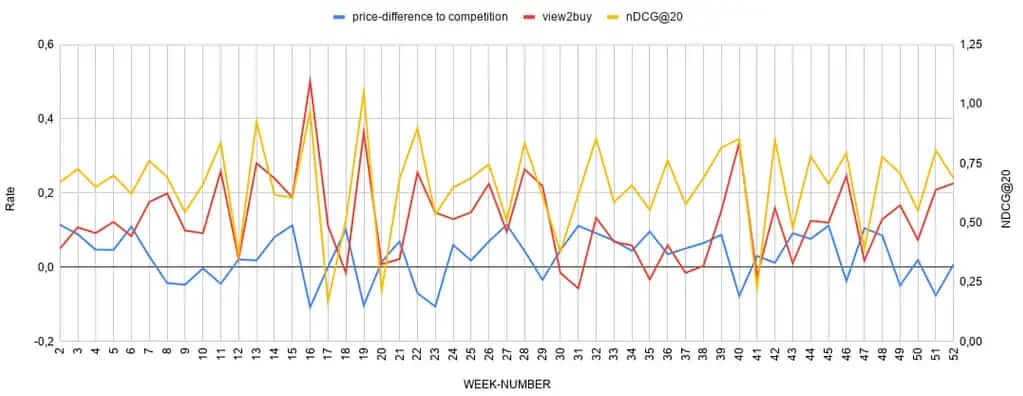
    With everything defined, I went on and calculated the different values for which I was looking. I did this for all three shop-competitor combinations and averaged the results, printing them in the following chart.

    View2Buy ratio vs. price difference to competition for products in the price range under €10

    The above chart illustrates the significant impact of price and availability on the number of clicks and carts for your search results. This results in quite a lot of bias in your search-quality measurement (or Learning-to-Rank) pipeline.

    The issue here is that changes in price or availability can significantly influence the user’s contextual relevance. This is true even if the textual and or semantic relevance between query and product hasn’t changed at all. This directly affects the click and cart probabilities.

    You may have spotted that I only include the data for the first price bucket. If you are interested in how the charts look like for the other buckets, PM me 🙂

    Conclusion

    This is the final entry for the Three Pillars of Search Quality in eCommerce Search series. I hope that the content I created helps you during your journey. To discover the perfect balance between what the seller wants to sell and what the users want to buy.

    Furthermore, if you’ve made it this far, you’re without excuse if you’re ever found stuck in strategies that never venture beyond findability improvements. You’re now equipped with the knowledge necessary to begin balancing the optimization of your discovery and inspiration journeys, against the underlying dimension of sellability.

    Final words: It’s no trivial task to fix these types of bias. I understand that. However, over-simplifying the problem and ignoring the facts won’t help you differentiate from the competition. There is no way around it. Offering an outstanding shopping discovery experience means taking external factors (like market trends, or competitor pricing) into account.

    Good Luck!

  • E-Commerce Site Search Overhaul – Super “selection” year 2021?

    E-Commerce Site Search Overhaul – Super “selection” year 2021?

    It’s not just politics that will be exciting this year. Changes are also on the horizon for e-commerce. The evaluation of an optimal e-commerce site search overhaul – make or buy a solution is quickly becoming a TOP trend in 2021.

    But how thorough to prepare an e-commerce search solution overhaul?
    Increasing the economic performance (e.g., CTR, CR) and improving the user experience (e.g., faster loading times, discovery features, and content integration.) Both are issues that undoubtedly concern all e-commerce retailers and will need to be dealt with to prevail against the competition.
    Reducing the manual effort required to maintain and control on-site search is an essential task in this regard.
    Beyond that, however, some other important questions need to be answered in advance within the organization.
    The following is a summary of the most critical points.

    E-Commerce Search Overhaul — Make or Buy?

    Algorithmic:

    How good is the search relevance model in full-text search, semantic correlations, long-tail keywords, languages?

    Discovery Features:

    How well are topics like complex price & availability dependencies, as well as guided selling and recommendations covered?

    Content Integration:

    What opportunities exist in terms of the controllable blending of products and promotional content?

    Merchandising Features & Analytics:

    How well can different sales-promoting strategies (including ranking) be combined with business KPIs and evaluated?

    Customization:

    How easily are individual requirements implemented?

    Intellectual Property:

    How can it be ensured that contributed domain knowledge and other forms of intellectual property remain in house?

    Deployment Model & Architecture:

    How flexible are the deployment model and system architecture?

    Integration & Ease of Use:

    How apt is the system integration, use, and operation?

    Which solution is the right one? Whether a commercial solution (such as Algolia, Attraqt, FACT-Finder, Findologic) or an open-source framework (such as OCSS https://blog.searchhub.io/introducing-open-commerce-search-stack-ocss) — the decision must be well-prepared.

    Conditions for the selection of an E-Com on-site search

    Before making an informed decision about selecting a new on-site solution/technology, it is vital to understand the implications, dependencies, and scope of such a decision.

    The deployment of such a solution quite often influences future business functions and strategic decisions without this being directly apparent in advance. Therefore, I examine the three most important influencing factors in more detail below.

    The Influence on corporate strategy:

    The core functions responsible for the broader business strategy’s economic success are a natural product of the medium- to long-term corporate strategy.

    The answers to the following questions about corporate strategy are particularly relevant when preparing for a vendor selection:

    1. Is a marketplace game plan a part of the corporate strategy in the next 2-5 years?
    2. To what extent do diversified local prices and corresponding availability need to be mapped via the on-site search solution?
    3. How will you divide your focus across customer channels in the mid-term? How will the ratios look?
    4. Which unique selling points/functionalities provide an anchor for your corporate strategy? Content leadership, expansion of digital advisor functionalities.
    5. What are midterm geographic growth markets already known?
    6. Is strategic ownership of core technological competencies and technologies part of the corporate strategy?
    7. Are there strategic requirements in terms of technological infrastructure (on-premise, private cloud, open cloud)?
    8. How large is the internal team (professional and technical) available to operate the on-site search?

    Influence of the IT architecture

    On-site search has to support many core functionalities of a digital enterprise. E-Commerce Search consumes, processes, or makes available for further processing, various data streams. As a result, an agile integration into existing IT-enterprise architecture is elementary for success.

    Suppose there is no acknowledgment of these foundational provisions. In that case, marred by lengthy, risky, and costly follow-up projects, subsequent adjustments, or even fundamental changes to the system landscape are often DOA (Dead on Arrival).

    In terms of the IT-organization, the answers to the following questions are particularly relevant when preparing a vendor selection:

    1. Which source and target systems integrations with on-site search currently exist, and which will be considered within the midterm?
    2. What are the data-security requirements? How often does this data need to be updated?
    3. Are there defined requirements concerning service-level agreements?
    4. Are there defined requirements in terms of deployment and infrastructure?
    5. Should the on-site search system-integration reside exclusively at the data level (headless architecture), or are rendering functionalities must-have requirements?
    6. From a technical perspective, should the on-site search system also be used as a product API?
    7. Are there complementary functionalities? For example, recommendation engines, personalization, or guided selling systems that need to be functionally linked or even combined with on-site search?

    Influence of operational resources and organization

    On-Site Search requires constant maintenance and must react to internal and external factors agily. For this reason, the selection, implementation, and operation of an on-site search is always only part of the solution. On the one hand, the system must be continuously managed and maintained by data-driven external systems (e.g., SearchHub.io) and operational staff with the appropriate domain knowledge.

    For the planning of operational resources and team organization, the following questions are essential for the professional selection of an on-site search solution:

    1. Does a dedicated team of employees already exist to maintain the on-site search manually? If so, how many?
    2. Does the team have developers, testers, and analysts? If not, is there a plan to expand the team’s skill set in these areas?
    3. Is the On-Site Search Team organized as a vertical business function in itself? I.e., does the team have all the necessary resources and skills to develop the On-Site Search business function on its own?

    Conclusion – E-Commerce Site Search Overhaul:

    Strategic internal deliberations significantly influence the evaluation of a new on-site search solution (make or buy). Answering these questions reveals their far-reaching and strategic nature. Naturally, thorough preparation will take time, and all necessary stakeholders will need to arrive at a consensus about the objective. This process leads to greater clarity regarding the next steps. Even if that means the best approach may be to keep the current, well-integrated platform and instead work on mitigating its weaknesses.

    There’s More than One Way to Skin a Cat

    There are often several ways to fix an on-site search-related deficiency. Resorting to blind action for the hell of it should never be one of them. Regardless of the euphoric high associated with onboarding a new complex piece of kit, if you haven’t done your homework, you’ll inevitably be trading fruit-flies for maggots. Like hoping to exchange your partner for a younger, less judgmental model, if you haven’t come to grips with your own shortcomings, you’re damned to take them with you to the next relationship.

    Know When to Hold ‘em, Know When to Fold ‘em

    I get it. Every so often, there’s nothing left to salvage. It’s best to cut ties and move on. However, between you and me, there are massive benefits in using software like searchHub to boost an existing system quickly. Furthermore, setting up searchHub affords more forward flexibility. This kind of software runs independently of any search solution. Meaning, you can use the logic you built with us and take it to any other search provider you migrate to in the future.

    • Best-case scenario: you turn your current solution into a searchandizing powerhouse.
    • Worst-case scenario: you now clearly understand what type of e-commerce search solution your business requires. And because your search-engine logic is not married to your on-site search, you’re able to migrate to a new solution with next to zero downtime.


    searchHub.io offers data-driven support and helps optimize existing search applications without making a corresponding system change.

  • Sustainable Development for ecommerce site search

    Sustainable Development for ecommerce site search

    What’s your first association when you read “sustainable development”? Perhaps it conjures up some dry country in the Southern Hemisphere with lots of potential for present and future development? Maybe IT startups developing solutions that help reduce CO2 emissions are your thing? Or perhaps a Tesla Model S Plaid+ that “develops” you from 0-100 km/h in a sustainable 2.1 seconds?


    © Photo: Johan Eriksson for Dollar Street 2015

    My Association with Sustainable Development? Cache!

    My Association is Cache. Not Cash. Cache.

    These days, everyone’s talking about website performance. The rapid increase in online traffic during the pandemic has contributed to an even greater focus on the topic. And what better way to increase website performance in volatile times than an intelligent caching strategy? The knowledge is not new but bears frequent discussion.

    A clever caching design not only increases the performance of your website, but it’s also a smart way to build environmentally friendly and develop sustainable scaling applications.

    Siegfried Schüle

    Before continuing with this post, it will serve you well to familiarize yourself with the following: Latency numbers every programmer should know.

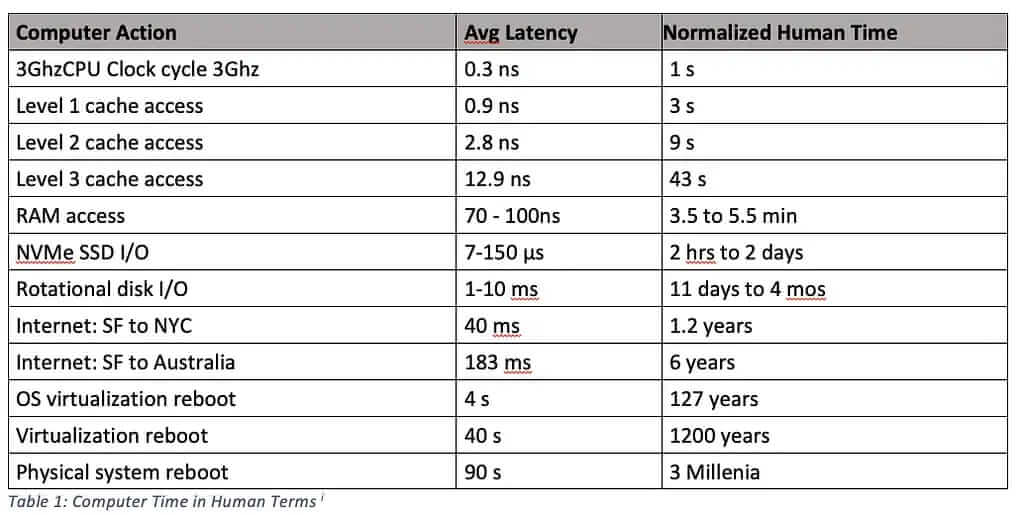
    Wow, — that’s impressive. One quick check in the server’s local memory is 1,500,000 times faster than requesting the same information with an HTTP-request over the internet. Not only is it faster, but it’s more efficient and climate-friendly as well.

    Tiny little numbers aren’t your thing? The following compares all the stuff with numbers more humanly compatible:

    Compute Performance – Distance of Data as a Measure of Latency

    How to Sustainably Develop Ecommerce Infrastructure?

    I have often stumbled over the same problem while building e-commerce applications over the last 20 years: website users want to see stuff other users have already seen. This behavior has not changed a tiny bit. Things like a product image, the detailed description of the newest Xphone, a search result page, or in most cases, even the “in stock” status. Now, what’s a developer to do, tasked with delivering this information correctly to the customer?

    List of Developer Tasks to Right the World

    • Images: Loading the image from the media database (usually stored in high resolution), scale it to the correct resolution for the customer’s device, and send it over the net.
    • Article texts: Load the texts from the PIM (product information management), where all the marketing people could edit the texts at any time and want to see the latest update online as soon as they hit the save button.
    • In Stock status: Send a request to the ERP system asking for the number of articles still available and determine the “in stock” status based on various information like “already put in some other customers’ baskets,” “already ordered, but the customer has still not finished payment process, and so I do not know exactly whether this one-piece has finally been sold or not” and maybe other fancy stuff.
    • Search Results: Sending the user query for “ihpone” to the search index, which will try to find products that are more or less similar to the user query and — if lucky — return some iPhones or matching accessories


    Congratulations to the development team. If they followed all the guidelines above, they would have built a rock-solid system that will always show real-time data to the customers. But it will not be sustainable.

    Why Your e-commerce Infrastructure Development isn’t Sustainable?

    The type of development described above requires servers all over the planet to repeatedly calculate or HTTP-request the same stuff, though not a single kilobyte has changed since the last time they (or some other server) calculated it.

    You Need A Strategic Caching Approach

    It’s all about the Cache

    Let’s look at this practically.

    • If your product images’ source has not changed, there is no need to ask your SaaS image-scaling-service to scale the image to some smaller resolution more than once. It will produce the same output for the first time, the 10th time, or the 1000th time.
    • Suppose your article texts have not been SEO-optimized within the last few minutes, and there has been no other activity connected with this specific product either. Why then should you bother the (maybe distant) database?
    • Or suppose no system has yet registered the status change of a particular article from “in stock” to “unavailable.” As a result, interested parties have yet to receive a notification. Why continue asking the ERP like a three-year-old kid bugging his parents, then?
    • If your domain-specific language hasn’t changed, and as long as customers typing “ihpone” still mean “iPhone,” why should your search engine try finding fuzzy matches all day long? 🤦‍♂️


    While the first three aspects are quite obvious and implemented widely throughout the eCommerce landscape, the latter is not. But its impact is enormous!

    What is the Impact of Poorly Cached Site Search?

    Imagine a search index of product texts which can easily contain 1,000,000 different words. If a user searches for any given phrase, the index must, to some extent, compare each input word with each indexed word. As long as we are talking about exact matches (“iPhone” → “iPhone”) or matches explicitly made by some analyzers such as stemmers (“iPhones” → “iPhone”), this should be no concern. But as soon as we are using more sophisticated fuzzy matches, the impact can be huge. Some algorithms are much less efficient in FACT than the ones used by Elastic — some say this is necessary to achieve higher precision.

    I, however, adhere to a massively different approach. Imagine you are sure regarding how relevant a specific user input for a particular product text is. In that case, it would be wise to remember this decision (or load all appropriate decisions into memory). This way, you don’t have to calculate it again next time. Let me show you a rough calculation of the effect this has on your server load. To simplify the calculation, I’ll measure all server costs in milliseconds necessary to perform the operation and the resulting CO2 emissions:

    Server Load Relative to CO2 Output

    User input Matching Algorithm Costs (ms) Result Costs per Search CO2 Emissions per search CO2 Emissions per 1M Searches

    ihpone

    exact

    0.1

    unsuccessful

    0.1

    0.001 mg

    1g

    ihpone

    Levenshtein Distance 1

    1

    unsuccessful

    1

    0..1 mg

    10g

    ihpone

    Levenshtein Distance 2

    5

    iPhone

    5

    0.05 mg

    50 g

    ihpone

    Sophisticated algorithm

    100

    iPhone

    100

    1 mg

    1kg

    ihpone

    Sophisticated algorithm with cached result + exact match

    100.1

    iPhone

    100 + 0.1 x search

    decreasing

    1.001g

    Calculations based on information found here.

    How Site Search Server Load Increases Your Shop’s CO2 Footprint

    The first time the term “ihpone” is entered into your shop, it’s necessary for your eCommerce application to use a sophisticated algorithm to determine that the user intended to find an “iPhone.” Some search engines use sophisticated (i.e., load-intensive) algorithms by default. Admittedly, they are easy to use. Simply provide enough server power to scale them horizontally, and they will return surprisingly good results.

    Mind your ecological footprint

    On the other hand, if we take an ecologically strategic approach to server load compared to its strain on the environment, the story looks dramatically different.

    For example: How often do you think users’ search intent changes, for an identically misspelled phrase, over, say hours, days, or even years? Although the product changed since its 2007 debut, the “ihpone” typo and its intent have remained stable throughout the last 14 years. How many billions of search requests have been executed within that period requiring search engines to apply more or less sophisticated algorithms forcing server CPUs to produce heat and resulting CO2?

    Only the typo’s first appearance needs expensive algorithms to calculate a proper response in an ideal world. After that, every request uses exact (and cheap) matching technologies.

    With searchHub, we do our best not only to optimize the search result quality. By making exact search easy and using it frequently, we also reduce eCommerce search’s climate footprint by utilizing sophisticated calculating knowledge only once and reusing it wherever possible.

    American Carbon Footprint is relatively high – Townsquare Media

    With 56 billion optimized search requests, we project to have saved roughly 30 tons of CO2 emissions within the last 12 months. That’s equivalent to approximately the yearly CO2 amount of four Belgians, or just over one American! True, this is a tiny drop upon the hot rock we all call home, but maybe it inspires you to rethink caching strategies for your product or within your eCommerce shop.

    Siegfried Schüle

    CEO