Blog

  • Why the smartSuggest Module Might Matter to You

    Why the smartSuggest Module Might Matter to You

    We at searchHub live to make existing search engines better understand humans and deliver exceptional search experiences. So, why have we now created our own smartSuggest Module, and why does this matter to you? Until a couple of months ago we were mainly focusing on rewriting the user queries into the best possible search engine queries helping our customers to deliver better results for a given user query and gain fantastic uplifts in their key business metrics.

    Why Site-Search Should be Considered Part of the User Experience

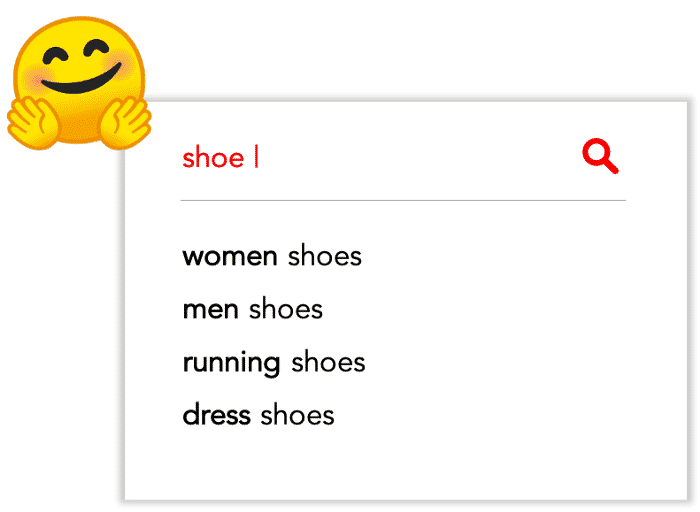
    But soon we realized that we still left much of its potential unused. Why? — because search is a process and not a single feature. Until now, we have thoroughly ignored the part of the whole search process where the user formulates his query. — and guess what — there is already a nice feature for that called “auto-suggest” or “query suggestions” or “auto-complete” in the search universe.
    1. The Goal of Serving Query Suggestions – smartSuggest

    Disclaimer — in this article we’ll not talk about UI and frontend implementations at all — instead we are going to focus on information-need and information delivery.

    We’re already a highly data-driven company. So, we went out and started to analyze our tracking data to find strong evidence that it is worth it to spend a significant amount of development time on either improving an existing or building our own query suggestions-system and to identify the areas we should focus on.

    But before we take a closer look at what the data revealed, let’s check if we can find some best-practice articles on the internet and see what they recommend:

    The Nielsen Norman Group recommends using query-suggestions to:

    • Facilitate accurate and efficient data entry
    • Select from a finite list of names or symbols, especially if the item can be selected reliably after typing the first 1–3 characters
    • Facilitate novel query reformulations
    • Encourage exploratory search (with a degree of complexity and mental effort that is appropriate to the task). Where appropriate, complement search suggestions with recent searches.

     In our summary, this boils down to — guide the user during the search formulation process to facilitate accurate data entry and encourage exploratory search. However, this is very much biased towards the user of a webshop— but what about the goals and needs of a webshop owner? Again, we can find some inspiration on the internet. Lucidworks, for example, points out some opportunities in terms of merchandising when it comes to query suggestions. 

    • Customize autocomplete suggestions according to where a visitor is on the site.
    • Retailers can use autocomplete search suggestions to draw customers’ attention to certain merchandise. Products that are on sale, that are from certain brands or have a higher margin.
    • Use past online behavior to shape search recommendations.
    • Tie autocomplete results to customer trends.
    • Factor geography into autocomplete recommendations.

     Time for another summary — while guiding the user during the search formulation process, encourage exploratory search, and boost product discovery for users. If we combine the essence of both summaries, we end up with something like:

    Guide the user during the search formulation process to facilitate accurate data entry, encourage exploratory search and boost product discovery.
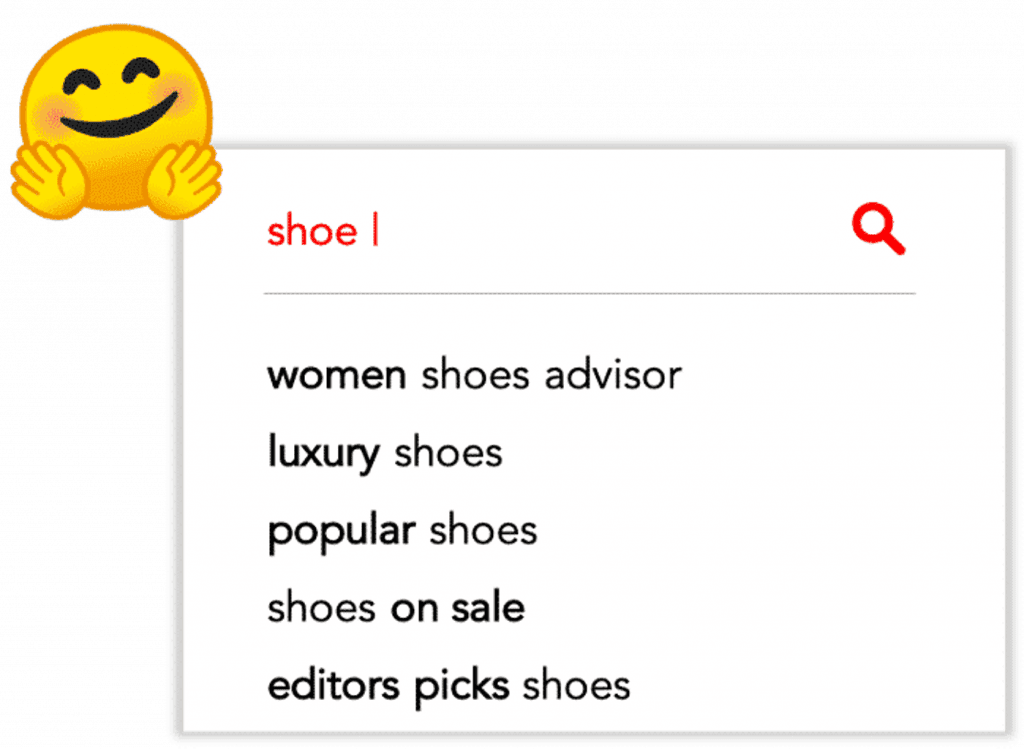
    Now that we have a goal, query suggestions work well, if we observe that they help the user articulate better search queries and help to better discover the product offering. It’s rather about accelerating the search process than about guiding the user and lending them a helping hand in constructing their search query and guiding them through the available options.

    2. Validating the goal and identifying the most valuable use cases

    Now that we know which query suggestions should enable us to offer the user, let’s slice and dice some logs and tracking data to come up with the most valuable use cases we need to enable.

    To validate our goals or assumptions, we’ve sampled around 120,000 search sessions across several customers. We further filtered them down to roughly 57,000 search sessions by only looking at sessions that consist of two or more different searches, where at least one of these search types was either a “typed search” or a “suggested search”.

    • In this context, a “typed search” is defined as a query formulation process where the user typed each letter, digit, or punctuation that resulted in a search.
    • A “suggested search” is defined as a query formulation process where the user typed something and selected a query suggestion that resulted in a search.

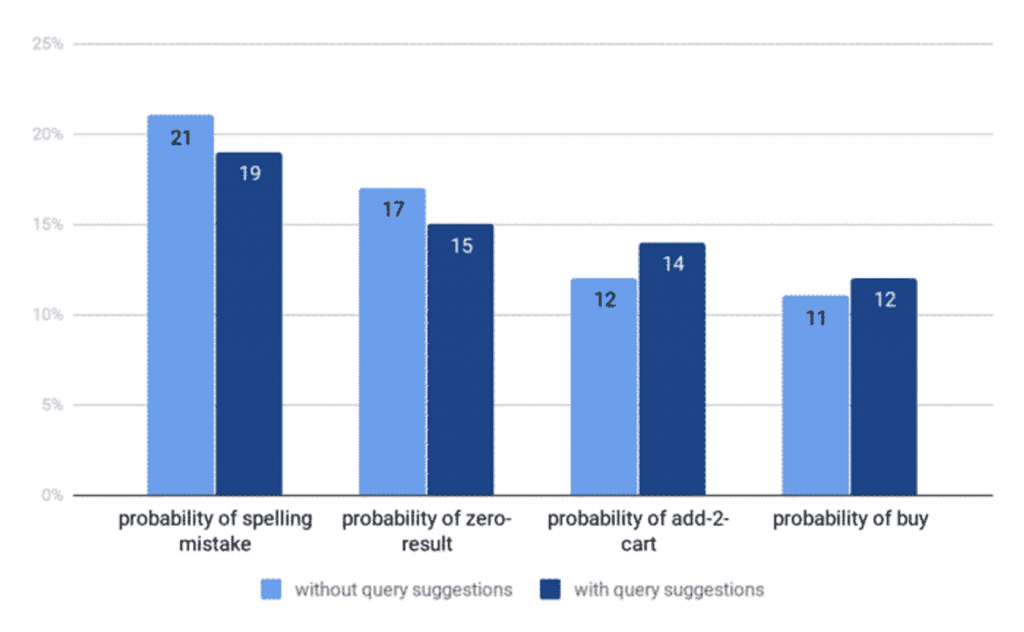
    From here on, we compared the different search types in terms of their KPIs. The query suggestions have a large positive impact on, probability of add-2-cart and probability of buy and a large negative impact on the probability of spelling mistake and probability of zero-result. Therefore, serving query suggestions shows an improvement in all metrics.
    Results:

    • Query suggestions are used only if they are relevant and good enough to provide genuine guidance during the query formulation process. This is what we call the intent matching or retrieval process.
    • The likelihood of influencing the user’s query formulation process with query suggestions is highly dependent on the session context, resulting in a need for query and ranking flexibility. This is the so-called scoping, filtering, and ranking process.

    3. The Task of matching user intent and serving query suggestions

    How often have you already cursed your smartphone’s autocorrect?

    Any query recommendation should be relevant to the user. If irrelevant information (false promises or unintended suggestions) appears too often, the user’s confidence in the results will diminish, as will engagement. During the intent matching or retrieval process mainly two parts decide if you are able to provide relevant and inspiring query suggestions that can guide users. The first one is the suggestion corpus. And the second one is the matching strategy.

    Building the suggestion corpus.

    Let us first focus on the suggestion corpus. As with any data-driven application, the fundamental rule (bullshit in — bullshit out) still stands. The quality of the displayed query suggestions will mainly be dependent on building a quality corpus. A smart query suggestion solution needs to provide a robust process of building and updating the suggestion corpus(es).

    This corpus may rely on different sources like customer query data logs, product data, or even other data-pools like a knowledge-graph for example. Only by combining these data sources, you can provide the diversity in the suggestions you need. But this combination comes at a cost — redundancy.

    • Query suggestions that are semantically similar but contain different spellings should only be displayed once. As there is no value in showing semantically identical phrases with close spellings, for example:
    • Singular vs. plural forms of nouns (“women dress” vs. “women dresses”)
    • Order of words (“long blue dress” vs. “blue long dress”)
    • Compound words (“dishwasher” vs. “dish washer”)
    • With and without stop-words (“women dress” vs. “dress for women”)
    • Special characters (“swell bottle” vs. “s’well bottle”)
    • Alternative spellings (“barbecue” vs. “barbeque”)
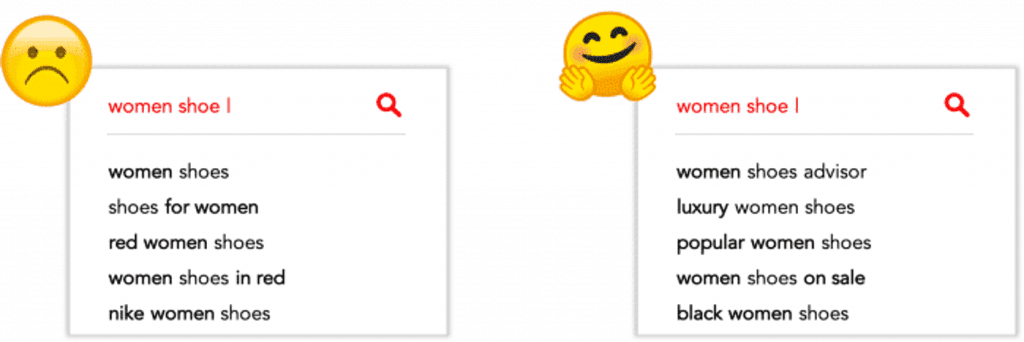
    To be able to ingest, combine, clean, and update this suggestion corpus in almost real-time is the key challenge for every query suggestion system and by the way, a very challenging engineering task.

    The query or user intent matching strategy

    The second part is how to match the given user query or user intent against the corpus and respond with a relevant and helpful list of query suggestions. To do so, you need a system that can handle the following cases in an intelligent and graceful way.

    • query normalization and spell correction. Since user input tends to be messy, your system needs to provide normalization & spelling correction functionality. When a customer misspells a word or a phrase in the search box, autocomplete identifies the misspelling, fixes it on the fly, and displays the correctly spelled suggestions instead.
    • partial and multi-matching. Multi-match is used in product searches to allow matching of different tokens of a phrase on the same product attribute or value.

    To handle all these cases, your query suggestion system must provide different types of suggesters. For example, with built-in suggesters you can choose an implementation that allows for fuzzy matches (celvin can return calvin) or another one matching infixes (calvin can return calvinklein for men), but you can’t have both. A nice query suggestion system can do both (celvin can return calvinklein for men)

    4. The art of Scoping, filtering and Ranking query Suggestions

    Once we have managed to get the matching or retrieval right, and we can receive meaningful and helpful query suggestions, we still have to work on the scoping, ranking, and filtering process to make the query suggestions even more relevant, more diverse, and more inspiring.

    1. query suggestion scoping. If we already know that we might be able to help the user to articulate his intent by scoping a broad query (“TV”) with relevant categories or important features, the chances he might find what he is looking for will be increased.
    2. query suggestion filtering. There will always be a situation where you might need to exclude or filter specific suggestions based on different data points. Some common examples are.
    • false promises — query suggestions, which yield a false promise or zero results, should be excluded from the autocomplete display.
    • blacklisted queries — Some phrases may be suppressed via a blacklist.
    1. query suggestion ranking. Since we are going to present the user a list of possible choices, ranking becomes a powerful tool to guide and inspire. Again, some common examples.
    • ranking query suggestions by business metrics — the most obvious approach is to rank suggested phrases by the number of search events, which works fairly well. But a higher number of search events does not necessarily mean a higher business value. Other relevant metrics could be considered in the ranking, such as the number of sales, margin, etc., which affect its business value. If business metrics are collected over a long period, it can be useful to boost the value of more recent events.
    • promote brands or important features — If a user types in a generic subject, say “TV”, a smart query suggestion system will use this opportunity to suggest tv brands, like “Samsung TVs” or tv types, like “curved TVs”, or “4K TVs”, which give users a helpful suggestion, and also applies a merchandiser’s business logic of promoting a brand or specific type of tv.
    • promote query suggestions by geographic segmentation — considering the user’s geographic location might improve ranking results. Users coming from different countries might have different interests.
    • promote query suggestions based on taxonomy location — taking into account the user’s location in the product taxonomy might help to add additional context to the user query. For example, a user typing in “t-shirt” while in the menswear section. Then the user might be more likely to be interested in shirts for men, rather than shirts for all genders.

    Again, a system with maximum flexibility helps to improve the system over time and adapt it to upcoming trends or new ideas and business opportunities. Being able to influence and optimize the ranking of your query suggestions based on behavioral and conditional signals is crucial for your business when it comes to anticipating a customer’s search intent, and provide useful suggestions. These suggestions will help guide the customer through the product discovery experience and remove barriers to finding new products online.

    The smartSuggest lib

    Since we at searchHub already solve the task of matching user intent, apply semantic deduplication, and provide query sharpening or query relaxation, we tried to find an existing system for serving query suggestions that on top provides the three above-identified use-cases of scoping, filtering and ranking Query Suggestions. Unfortunately, we could not find such a system and went down the path of building it on our own based on Lucene.

    With the data provider SPI, any kind of data source can be used to build up the suggestion corpus. The built data is then already tagged for boosting and filtering. It will then be indexed with different indexers, each one optimized for the particular search approach.

    For a search request, we search these indexes one after the other, until enough suggestions could be retrieved. This means if there are enough prefix matches, no unnecessary fuzzy matching is done. In a final step, the results are ranked and optionally grouped and truncated. This way the maximum performance with the necessary feature set can be achieved. Everything that’s not necessary will be skipped and won’t affect response time.

    The plugin is built as a production-grade workhorse, handling a load of up to 1500 QPS. And for customers using our smart query suggestion, more than 40% of all user sessions already start with a clicked query suggestion, which proves the quality of the suggestions served.

    smartSuggest can be a powerful discovery tool when implemented correctly since it offers you a simple, clean API to influence the query suggestions the way you want them by using contextual boosting tags, contextual filters & scopes, blacklists, and business ranking. smartSuggest is simple to integrate, too. You are only two steps away from testing it.

    1. Provide your search analytics data API (e.g., GA) or use our Search Collector SDK
    2. Start the smartSuggest service in your environment or request a SaaS instance
    3. Integrate the smartSuggest API in your Frontend…

    The value smarter query suggestions bring

    Especially in mobile-first scenarios, where the smaller screen and keyboard limit the use of more traditional faceted search selectors, smart query suggestions do more than merely forecasting words or phrases the user is typing. smartSuggest goes a huge step further, and anticipates the user’s intentions to make helpful suggestions.

    These suggestions improve the user’s search experience, increasing both online conversion rates and average online cart value. Overall, smart query suggestions improve both the customer’s experience, as well as helping the retailers merchandisers and the business bottom line. Investing in such features will consistently improve online conversion rates and the size of online shopping carts, especially on mobile devices. Given the high impact from this feature, retailers with a large online catalog are essentially leaving money on the table without such a powerful smart query suggestion solution.

    The technology behind searchHub is specifically designed to enhance our customer’s existing search, not replace it. With just two API calls, search|hub integrates as a proxy between your frontend application and your existing search engine(s) injecting its deep knowledge.

    If you’re excited about advancing searchHub technology and enabling companies to create meaningful search experiences for the people around us, join us! We are actively hiring for senior Java DEVs and Data Scientists to work on next-generation API technology.

    www.searchhub.io proudly built by www.commerce-experts.com
  • Humans — Search for Things Not for Strings

    Humans — Search for Things Not for Strings

    Information Retrieval (IR) systems are a vital component in the core of successful modern web platforms. The main goal of IR systems is to provide a communication layer that enables customers to establish a retrieval dialogue with underlying data. However, the immense explosion of unstructured data and new ways to interact with IR systems (voice, image…) drives modern search applications to go beyond just fuzzy string matching, to invest in a deep understanding of user queries through the interpretation of user intention (we like the term Query-Understanding) in order to respond with a relevant result set. In short: humans search for things, not for strings.

    How to Master the Challenge of locating Things not Strings

    Since the problem is not always obvious, I spent some time to find relevant real-life examples that do not require a lot of domain knowledge to judge the result quality.

    The good thing, here at searchHub, is that we currently have access to more than 15,000,000 unique search queries from the e-commerce domain. Why is it good? — well, by having access to this kind of information I was able to pick a very representative query — “women red dress size s” — which made it into our top-1000 fashion queries in terms of frequency and into the top-100 queries in terms of value per search. In essence, this query (and it’s variants) drives almost 1 Million USD in revenue per day for our customers!

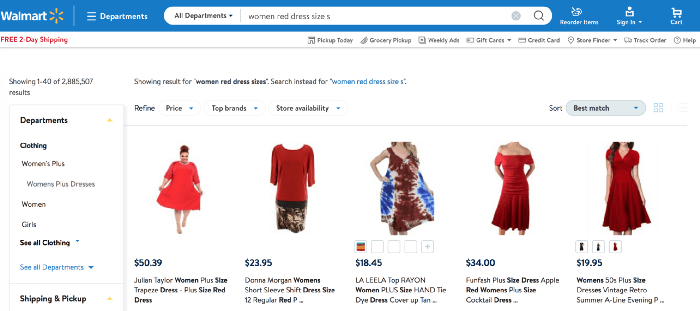
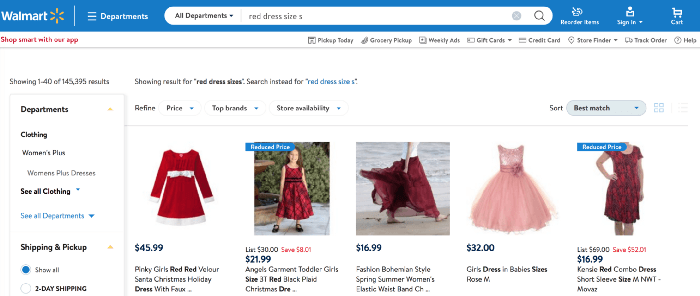
    Having found an economically relevant query example I went on to check the results for this query, and it’s top-variant on one of the biggest retail-sites on the planet walmart.com and this is what I received as feedback:

    search result for “women red dress size s” on walmartcom

    search result for “red dress size s” on walmart.com

    I’m not going to criticize these results in detail, but I’m pretty confident that these results do not represent the best possible feedback the system could come up with in terms of economic performance. Why am I saying that? — Well, firstly, there is and will always be a strong correlation between result-size and search conversion rate— the reason for this lies in the “paradox of choice” with search-effort. The impact of result-size vs. search conversion rate increases even more the more specific a query gets.

    Unfortunately, still most of the domain owners in search think that this challenge can be solved by a learning-to-rank approach. But you can’t — learning-to-rank will not solve the underlying precision problem. I agree that you might be able to reduce the negative impact by learning to push more relevant products to the top or to the first page, but you’ll still miss 70–80% of the underlying potential!

    Let’s be honest: when somebody is willing to spend the effort to articulate a quite specific query like — “women red dress size s” — he has a specific intent and wants to be understood. — Essentially, the visitor is looking for a “red colored dress in size s.

    Time for an experiment 🙂

    Since Walmart.com is unfortunately not one of our customers yet 🙂 we don’t have access to qualitative query performance data. But to test our hypothesis, we did a simple experiment with real-life users.

    We used the faceted navigation result representing the intent of the given query “red dress size s” on walmart.com. We think that from a precision perspective, this would be the most relevant set of products Walmart could reply to the given query. Then we rebuild the page so that it matches perfectly a search results page in terms of look and feel.

    original faceted navigation result representing the intent for the given query “red dress size s” on walmart.com

     fake search result for the given query “red dress size s” on walmart.com based on the faceted navigation result

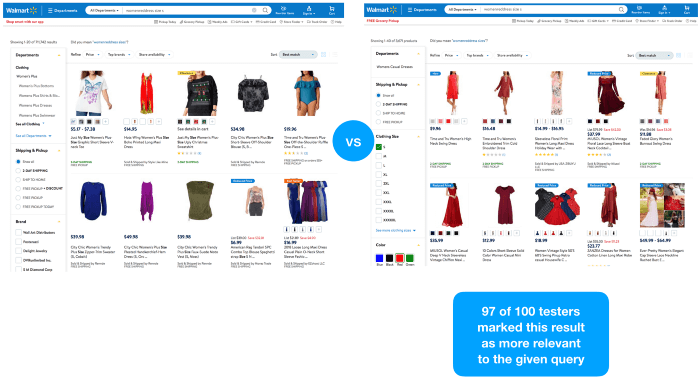
    We did the same for our top-3 variant queries, whilst again maintaining the same look and feel. Afterwards, we established a crowdFlower Human-In-The-Loop Search Relevance experiment with 100 users to receive some relevancy judgments for the different variations.

    Test results for variation 1 compared to test results for variation 2

    Test results for variation 3

    Results

    The results speak for themselves. Understanding the intent behind a search query is superior to string matching in isolation. And the reason for this is quite obvious — “people search for things rather than strings” —

    The Solution — Query Understanding (We Know “Things”)

    Search can and should be a gateway to open-ended exploration and discovery. Sometimes searchers want to be inspired, but most likely come to search with a specific need in mind. Here at searchHub, we work towards understanding user intent with the aim of bridging the gap between user intent and relevant results. We think a search engine should encourage searchers to express their specific needs by driving searchers to create search queries that are more specific. Our goal is to make the leap from query-to-intent less tedious to a more seamless search approach.

    Our Approach to Help Humans find Things

    Deciphering users’ ‘intent’ is the mind-reading game we have to continuously play with our customers. But how do we do that?

    searchHub’s stages of Query Understanding

    1. In the first stage, we start by improving the user queries themselves.

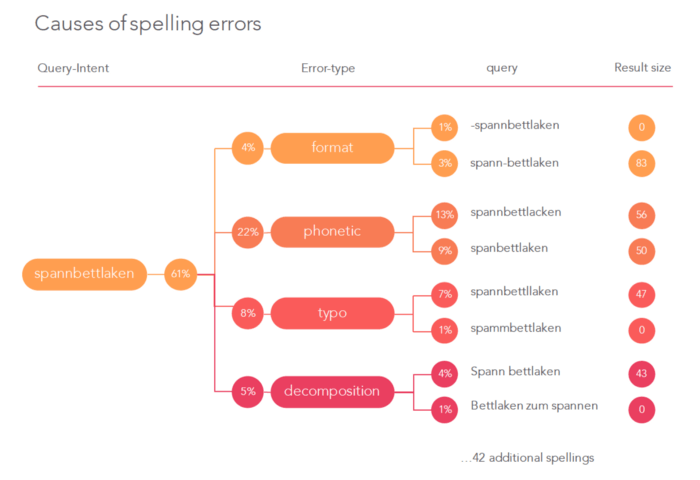
    Here we take advantage of our superior contextual query correction service which uses our concept of controlled precision reduction control. It automatically handles typos, misspellings, term decomposition, stemming and lemmatization at a yet unmatched level of accuracy and speed.

    2. In the second stage, we try to understand the intent/meaning of the query

    at this stage, the system tries to extract the entities and concepts mentioned in a query. As a result, search|hub predicts one or more possible intentions with a certain probability, which is particularly important for ambiguous queries.

    Most other solutions that attempt to tackle the same problem are using predefined knowledge bases / ontologies to represent dependencies and invoking meaning into the system. We spend a lot of time evaluating existing models and decided to do it differently because we wanted to build a system that learns at scale (different domains), can solve the language gap between visitors and catalog domain experts (wording and language) and even more essential automatically reshapes / optimizes and adapts itself based on explicit and implicit feedback. Therefore, we have developed an automated entity relationship extraction and management solution based on reinforced learning. Another benefit of this solution is that it does not waste computation time and money on building knowledge we don’t need to have 🙂

    3. Continuously test and learn which query/queries perform best for a given intent/meaning

    Another big differentiator of search|hub is that it is entirely data-driven. For quite several queries, there is no single best intent / meaning. In these cases, the right intent / meaning might be dependent on context (time, region, etc.) Therefore, we automatically multivariate test ambiguous queries and query intentions.

    The technology behind searchHub is specifically designed to enhance our customer’s existing search, not replace it. With just two API calls, searchHub integrates as a proxy between your frontend application and your existing search engine(s) injecting its deep knowledge.

    If you’re excited about advancing searchHub technology and enabling companies to create meaningful search experiences for the people around us, join us! We are actively hiring for senior Java DEVs and Data Scientists to work on next-generation API technology.

    www.searchhub.io proudly built by www.commerce-experts.com
  • searchHub Dramatically Improves Revenue for E-commerce by up to 39.6%

    searchHub Dramatically Improves Revenue for E-commerce by up to 39.6%

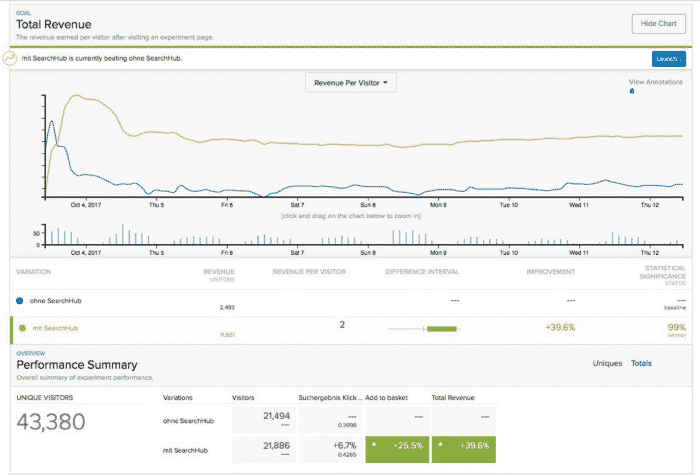
    We decided to put search|hub to the test, and the staggering results are in. By using searchHub with one of our customers current search solution, our customer made the following gains:

    • 39.6% improvement on total revenue
    • 39% improvement on revenue per User
    • 25.5% improvement on purchases
    • 6.7% improvement on total clicks on search results

    Over a period of 14 days, with almost 45,000 unique visitors, search|hubs self-learning query intelligence API helped to increase total revenue by 39.6% and purchases by 25.5% with a 99% confidence score. This impressive achievement is solid evidence that search|hub improves revenue and user engagement for online retailers.

    How We Determined searchHub’s superior performance – the Experiment

    For our comparison, we performed an A/B test using Optimizely to ensure unbiased results. The traffic allocation was set to 50% for their current onsite search solution and 50% for searchHub with their current search solution.

    We instituted a test period of two weeks. During the test period, we were tracking the following goals, with total revenue set to be the primary goal of the test:

    1. Total revenue (Primary goal)
    2. Revenue per Visitor

    Before starting the A/B test, search|hub was trained based on almost half a million searches with clicks and add-to-basket actions, extracted from existing search engine query logs. During the A/B test, search|hub used clicks and add-to-basket actions to continuously learn from user behavior.

    Results

    The results of the A/B test are staggering:

    1. 39.6% improvement on total revenue
    2. 39% improvement on revenue per User
    3. 25.5% improvement on add to basket
    4. 6.7% improvement on total clicks on search results

    (searchHub-A/B-Test — customer site search with and without searchHub)

    The results clearly show that while having a manually optimized state-of-the-art search engine can be of benefit, having searchHub’s self-learning query intelligence API as a layer on top of it helps to boost user engagement and revenue even more.

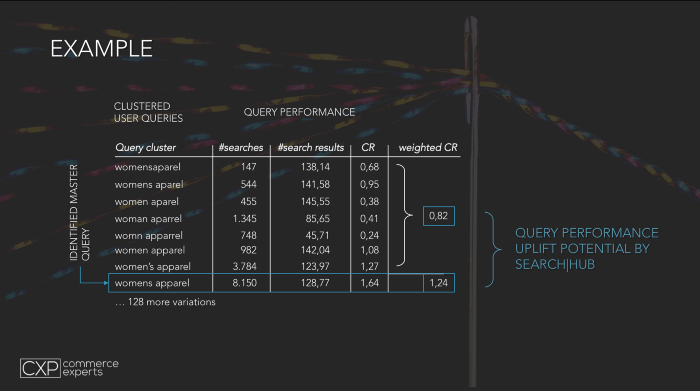
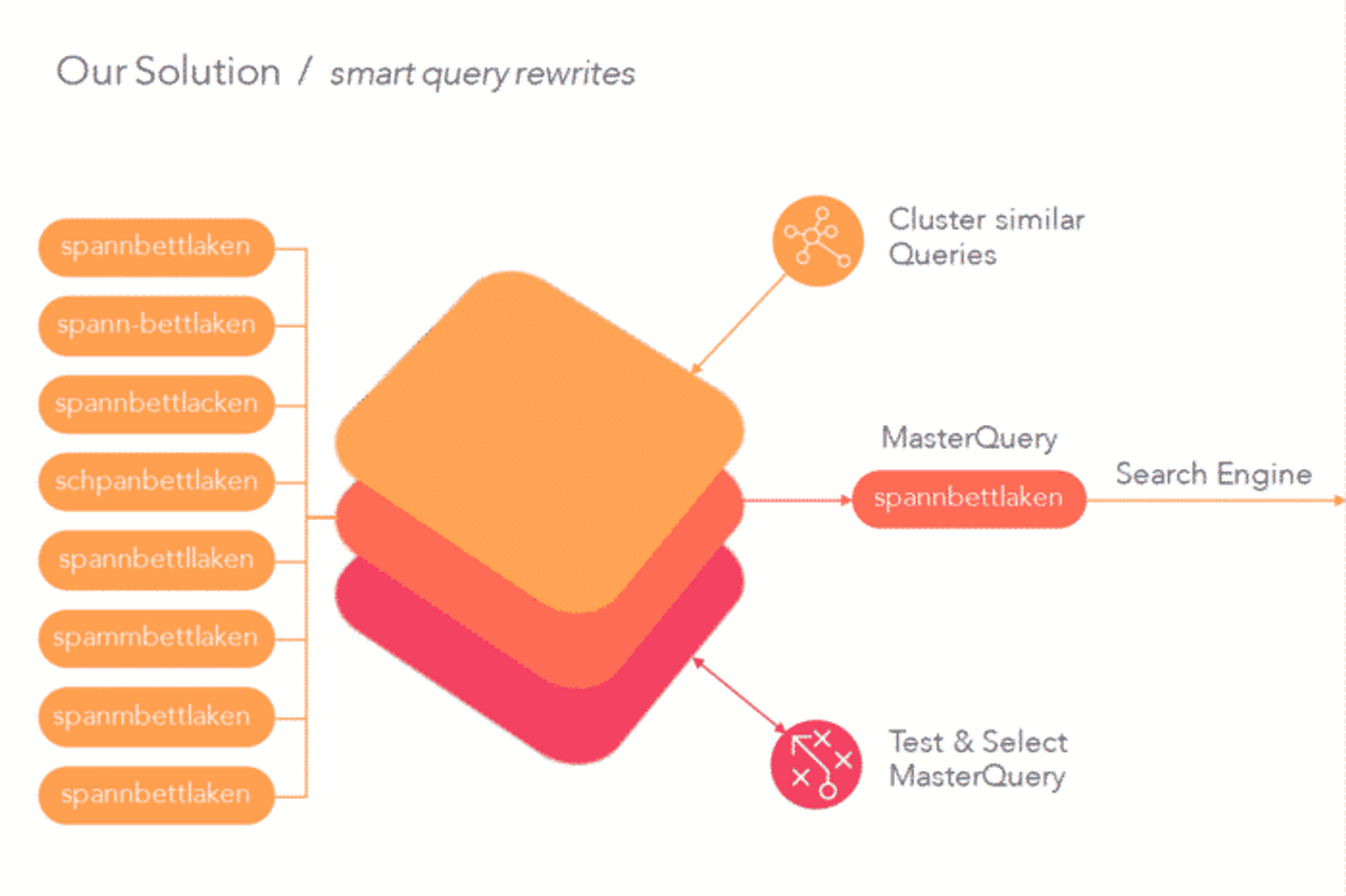
    What we see here is a great collaboration of humans and machines. People have used their onsite search tools to optimize queries, add synonyms & pre-processors and search-campaigns to the system, which were also optimized by searchHub. Moreover, searchHub automatically cleans, clusters search queries, and optimizes the search results for all queries by applying automatic query rewrites.

    IMPROVE YOUR SEARCH TODAY — Try searchHub now

    searchHub dramatically improves user engagement and revenue for e-commerce sites. It adds an intelligent layer to your search infrastructure and accounts for business rules, synonyms and extends them to optimize search results across all queries. The results of A/B testing shows good search is important and increases user engagement and revenue for online retailers.

    Get in touch to learn how we can help your online business with better search.

    www.searchhub.io proudly built by www.commerce-experts.com
  • searchHub.io Wins Award for Most Promising Start-Up 2017

    searchHub.io Wins Award for Most Promising Start-Up 2017

    searchHub is the Most promising start-up of 2017

    searchHub by CXP Commerce Experts GmbH for their work on developing and commercializing a system that infuses human understanding into existing search applications by automatically correcting human input and building context around each query.

    On November 29th 2017 — London — we have been awarded for our work on making search smarter. We are thrilled — that’s definitely a really cool prize and even more special — from people who clearly understand the challenges in this field.

    Thanks to the Information Retrieval Specialist Group of the BCS and the judges Charlie Hull, Rene Kriegler and Ilona Roth.

    we had a number of very strong submissions for this category, so I hope you share my view that this makes your award all the more special

    Tony Russell-Rose on behalf of the BCS IRSG committee

    About the IRSG

    Information Retrieval (IR) is concerned with enabling people to locate useful information in large, relatively unstructured, computer-accessible archives. In this respect, anyone who has ever used a web search engine will have had some practical experience of IR, as the web represents perhaps the largest and most diverse of all computer-accessible archives.

    Much of the technical challenge in IR is in finding ways to represent the information needs of users and to match these with the contents of an archive. In many cases, those information needs will be best met by locating suitable text documents, but in other cases it may require retrieval of other media, such as video, audio, and images.

    In addition, IR is also concerned with many of the wider goals of information/ knowledge management, in the sense that finding suitable content may only be part of the solution — we may also need to consider issues associated with visualization of the contents of an archive, navigation to related content, summarization of content, extraction of tacit knowledge from the archive, etc.

    The IRSG is a Specialist Group of the BCS. Its aims include supporting communication between researchers and practitioners, promoting the use of IR methods in industry and raising public awareness. There is a newsletter called, The Informer, an annual European Conference, ECIR, and continual organization and sponsorship of conferences, workshops and seminars.

  • Why AI Driven Site-Search is the Key to Success for Ecommerce Marketplaces

    Why AI Driven Site-Search is the Key to Success for Ecommerce Marketplaces

    We all know about artificial intelligence (AI). But what many of us don’t know is that AI is now an essential component of e-Commerce, and specifically, site-search. AI impacts the site search performance of your marketplace, and is a key success factor in holding a conversation with your customer — and in converting that conversation to revenue.

    How to Tune Your Ecommerce Site-Search – Not Replace it

    searchHub.io uses AI to integrate customers into your site’s search, with their unique ways of searching, their needs, and their preferences. Our AI technology predicts and understands what customers want, seamlessly and fast. We do this through intelligent query clustering, and through understanding the complex and unique characteristics of your customers queries to make search more intelligent, and tailored to each individual who visits your marketplace.

    Most standard site-search solutions are not optimized for the critical requirements marketplaces must deal with, such as large product catalogs, high site performance and scalability, and fast-changing product availability.

    Managing your audiences’ broad search choices

    A broader range of products means that visitors have more choice, which attracts more customers, and leads to increased revenue and profitability. This rule applies both to horizontal marketplaces where customers can find a wide range of products (e.g., otto.de), and vertical marketplaces where customers can find more specialized products (e.g., zalando.de).

    That’s why many marketplaces develop their own site-search solution based on Solr or Elastic, the most common open-source technologies. But these technologies don’t provide search results that are relevant to all users out-of-the-box. With a wider range of products, your long tail in search increases, and your site-search has to manage a much wider range of problems (long tail is the broad variety of search and keywords customers use when searching for the same thing). This can dramatically affect your search result quality.

    Your site search is your business card

    Your catalog is the way you introduce your marketplace to your visitors. Search is a key touchpoint in the buying process. It’s the place where the users are telling you what they want. If your search engine speaks the same language as your users, search becomes a conversation, and a conversation is the first step to a relationship.

    Therefore, search is the most vital function on your marketplace. Many businesses make high investments in product descriptions and other site content, but then lose their customers due to a poor search experience.

    Like any other e-Commerce site, marketplaces need to make sure that the process of product discovery is frictionless: visitors need to find and compare products easily, without wasting their time browsing an infinite catalog.

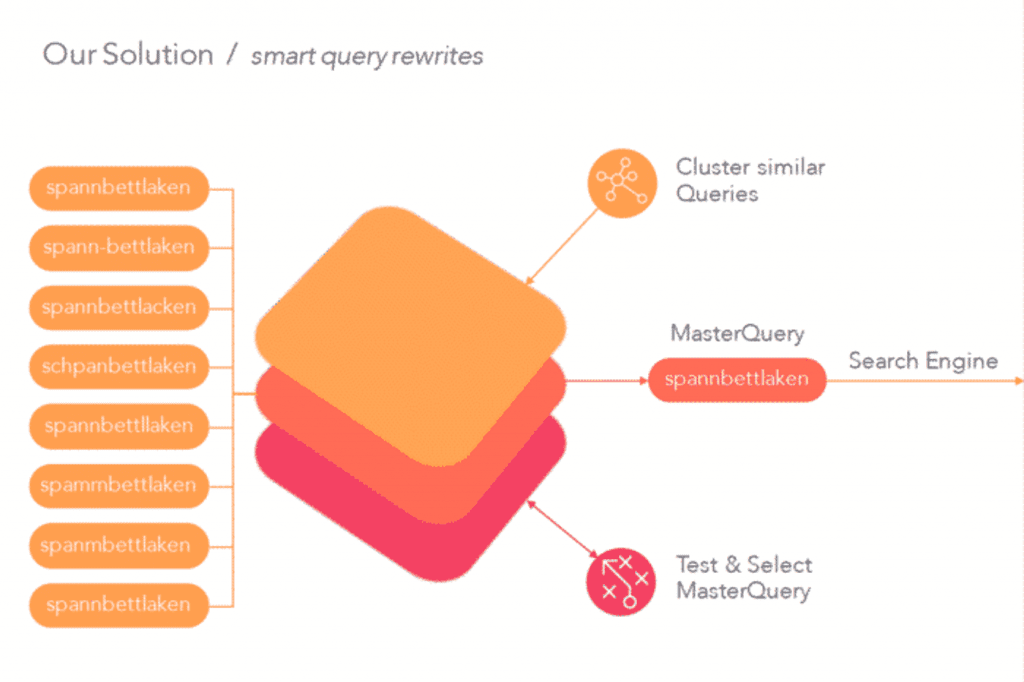
    Most marketplaces offer only limited capabilities of clustering search behavior. This means if a customer types in a more complex search term, there is a good chance of zero results and your customer will leave your marketplace. With searchHub’s AI technology, we automatically cluster millions of user and search queries by meaning and proximity. Deep learning testing and optimization continuously tests search queries for their economic outcome and optimizes the query rewrites accordingly in near-time.

    We are hiring

    If you’re excited about advancing our search|hub API and strive to enable companies to create meaningful search experiences, join us! We are actively hiring for Data Scientists to work on next-generation API & SEARCH technology.

    www.searchhub.io proudly built by www.commerce-experts.com

  • The Future of Ecommerce Site Search

    The Future of Ecommerce Site Search

    Which On-Site Search Changes to Watch Most Closely

    E-commerce site search has been evolving dramatically recently, moving away from a legacy keyword-driven approach, that often yielded inaccurate and confusing results, towards a leaner, more intuitive approach that puts user experience at its heart.

    The adoption of several worthy to mention technologies played a fundamental role in this evolution.

    NLP and Self-Learning Technologies

    Natural language processing (NLP) has already started to make a big impact in search, and its take-up is likely to accelerate in the coming years. NLP takes search away from the simplistic “is this keyword present in the title or description” approach, and starts asking “what is the customer really asking for?”. By taking a semantic angle to evaluating search results, the results produced are far more accurate and relevant to the customer’s actual search intent. Factor in the self-learning capabilities of many NLP-based engines, and suddenly site search starts to look very different.

    In the past, keyword-based search algorithms have often led to something of a ‘chicken and egg’ situation, with website visitors trying to ‘guess’ what terms they need to enter in the search box, in order to get the results they want from their search.

    Clearly, this is not an ideal approach, and, historically, it has led to high levels of frustration for information seekers.

    Natural language processing (NLP) is a component of artificial intelligence (AI) that enables computer programs and functions to understand human speech as it is spoken. In commerce-oriented websites and apps, NLP supports meaning-based search, allowing shoppers to search for items in their own language while still producing relevant results, even if the search terms do not directly match keywords in product records.

    All of this is possible because of NLP-based search, switches the focus from keywords to the actual meaning. Taking a semantic approach means that search results have a ‘connection’ to the search terms, rather than having to actually contain those search terms.

    Therefore NLP search can deliver accurate results and a successful user experience, where traditional text-based searches would typically fail.

    NLP and Linguistic Nuances, Synonyms, Misspellings

    NLP in site search must be able to recognize similar (though not identical) search terms, based on individual searchers unique lexicon preferences and context. NLP must be able to identify these items as being one and the same thing, producing the same relevant results regardless of the exact terminology being used.

    Most sites can’t afford to lose conversions to human errors. NLP can help ensure that a misspelled search for “red jacket” will deliver the same relevant results as a correctly typed search.

    NLP search can also outperform traditional search by learning about common miss-spellings, mixed-up brand names and other potential issues that could be entered into the search box. With self-learning abilities, NLP search never stands still, and continually becomes more accurate and better able to ‘understand’ customer intent.

    Conclusion

    Applying NLP to search can be incredibly powerful because it switches the focus from keywords to actual meaning, allowing humans to be humans while a machine does the work of accurate, intent-based interpretation. When applied to text-based site search, the NLP capabilities described above can play a key role in creating the kind of frictionless, seamless interactions that drive conversions, in a way that antiquated text-based searches simply can’t hope to.

    We are hiring

    If you’re excited about advancing our search|hub API and strive to enable companies to create meaningful search experiences, join us! We are actively hiring for Data Scientists to work on next-generation API & SEARCH technology.

    www.searchhub.io proudly built by www.commerce-experts.com

  • How searchHub.io Changed the Way of Working for Site Search Consultants

    How searchHub.io Changed the Way of Working for Site Search Consultants

    I spent a large portion of my e-commerce search life explaining why searching for “t-shirt” and “tschirts” sometimes yields totally different results in terms of result size, product selection, sorting and visual display. The major part of my job (as may apply for other “Customer Excellence” or “Site Search” consultants out there) was to teach e-commerce professionals how to tweak their search engine to produce exactly the results they wanted.
    Things like adding synonyms, defining manual search rewrite rules or even more advanced curated search results. Or (for the real, real professionals) configuring the internal settings of the search engine (fuzziness, field weight, product ranking rules).

    How to approach On-Site Search honestly

    Usually, all of these efforts resulted in numerous quite well-optimized search result pages that converted nicely. But they entirely ignored Long Tail! Even worse: Only in very rare cases, optimized or curated search results were tested properly to make sure to have the best possible result set. Even if they were tested — things changed within a matter of weeks or days and test results turned old.

    The enemy of a good search result may be a new marketing campaign, new viral hype or (in most cases) a simple index update with new products.

    I’ve seen many customers who have tried to solve these issues by adding almost endless lists of “synonyms” to outsmart the search engine whilst thoroughly ignoring the definition of a synonym. Synonyms represent terms with the same meaning but different spelling. A good example for a pair of synonyms is notebook and laptop. In this case, you might need to add a synonym because the word similarity is extremely low while the semantic similarity is quite high.

    However, introducing synonyms for handling spelling errors, over-/understemming, decomposition problems is something different and represent nothing more than a non-scalable short-term solution to a much bigger problem. As it produces other problems like unmanageable lists of thousands of synonyms, very complex queries with sometimes transitive matches, especially when you have to deal with multi-term synonyms.

    Finding a Totally New Approach to Site Search

    When we at CXP decided to create a new kind of search appliance, we wanted to avoid inventing yet another search engine. Nor did we want to create even better tweaks for existing search engines.

    Instead, we wanted to create something that really helps search engines to finally deliver the best result available for every search request.

    The best result is a result that really fits the customer’s need.

    But how could a search engine know what a customer wants? Very easy: They are telling us what they want by typing letters in a search box (or by commanding Siri, Cortana, Alexa, … to do so).

    Once we know what our customer want, we can automatically deliver the result that performed best for others who wanted the same by infusing the unbeatable combination of data and AI. It is as simple as that.

    Now this is Exactly what CXP searchHub does:

    • Understanding customer intent.
    • Find the search request that best served other customers with the same intent
    • Ask the internal search engine to deliver a matching result set
    • Observe the customers’ behavior and feed it back into the searchHub Analytics

    Facing the same challenges as Site Search Consultant. Give www.searchub.io a try and make your search fly.

    www.searchhub.io proudly built by www.commerce-experts.com